




Royal Worcester Statues
Royal Worcester statues bring character to a room through finely modelled porcelain figures shaped by Victorian and Edwardian hands.
Royal Worcester Statues
Royal Worcester statues encompass porcelain figures, figurines and decorative sculptures created across the nineteenth and twentieth centuries. When searching for royal worcester statues, buyers encounter pieces ranging from Victorian classical revivals to Edwardian studies and Art Deco figures.
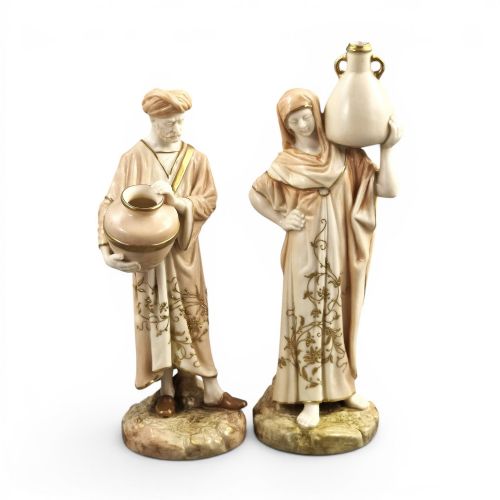
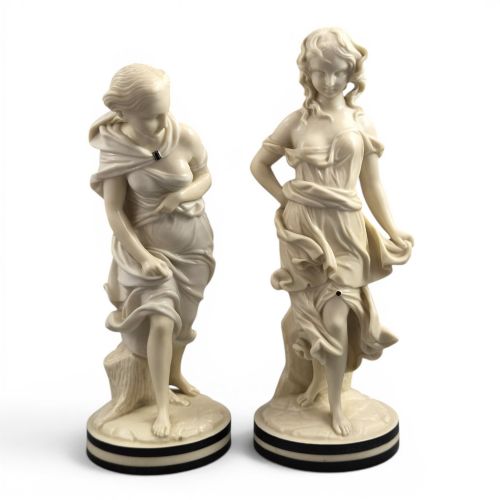
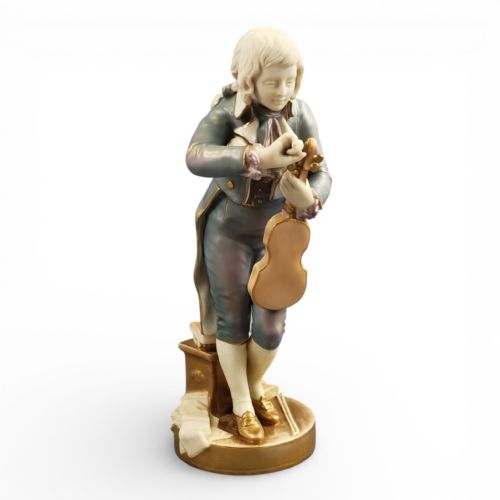
The selection here includes works modelled by James Hadley alongside factory pieces spanning the Victorian, Edwardian and later periods. Figures depict classical maidens, water carriers, musicians and historical subjects rendered in glazed porcelain or parian ware.
Victorian Orientalism and neoclassical revival styles dominate the earlier output, while later decades introduce simpler figures and character studies. Pieces appear both as individual models and in matched pairs mounted on circular bases.
Materials and technique
Makers utilised porcelain, parian ware and biscuit porcelain as the foundational bodies for these sculptures. Parian ware provided a dense, unglazed finish mimicking white marble, whilst standard porcelain bodies allowed for detailed enamel painting and surface gilding.
Specialised techniques such as blush ivory grounds, shot enamel and patent metallic finishes gave surfaces their characteristic sheen and colour depth. Modelled details were shaped by hand or cast in moulds before being hand-finished and fired in kilns.
Monks, musicians and water carriers populate these shelves, proving that nineteenth-century shelf pottery loved a good character as much as we do.
Assessing the work
Quality rests upon the crispness of the modelling and the sensitivity of the hand-painting applied to the porcelain body. Stronger examples retain sharp facial expressions, delicate hand placement and clear relief in drapery or costume details.
The sophistication of the surface finish dictates distinction, whether through subtle blush ivory shading, precise gilding or the matte purity of parian ware. Model complexity and the presence of named designers elevate certain figures above standard factory output.
James Hadley·Kerr and Binns
The Royal Worcester Statues Glossary
- Parian Ware
- A fine-grained, unglazed porcelain developed to imitate marble, often utilised for nineteenth-century classical figures. It achieves its smooth texture through a lower firing temperature and high feldspar content.
- Blush Ivory
- A tinted, cream-coloured porcelain ground developed by the factory, frequently accented with gilt and polychrome enamel. This finish defines many decorative wares and figures from the late nineteenth century.
- Biscuit Porcelain
- Unglazed ceramic fired once before decoration, yielding a matte surface texture similar to marble. It allows sculptural details to remain crisp and unhindered by glossy glazes.
- Shot Enamel
- A specialised glaze technique that produces a shimmering, iridescent colour shift across the surface of the piece. It appears on select decorative figures from the Edwardian era.
Royal Worcester Statues: Frequently Asked Questions
What periods do royal worcester statues cover?
The pieces span from the mid-nineteenth century through the Edwardian era and into the twentieth century. Production encompasses Victorian classical revivals, Hadley designs, and later twentieth-century models.
Dates range from the Kerr and Binns period of the 1850s through Victorian Orientalism up to pieces dated around the middle of the twentieth century.
How do I identify parian ware figures?
Parian ware appears as a dense, unglazed white porcelain designed to resemble carved marble. These pieces lack glossy glazes and rely on the purity of the ceramic body to show sculptural relief.
They emerged during the nineteenth century as popular mediums for classical figures and portrait busts.
Who was James Hadley?
James Hadley was a principal modeller and designer working for the factory during the late nineteenth century. His creations include orientalist figures, water carriers and expressive character studies.
Pieces bearing his name often reflect distinctive modelling and proprietary glaze effects like patent metallic.
How should I display these porcelain figures?
Place figures away from direct sunlight and high traffic areas to protect delicate enamel painted surfaces and gilding. Stable shelving ensures that figures mounted on circular bases remain secure.
Dust them gently with a soft brush rather than liquid cleaners to preserve the original finish.