
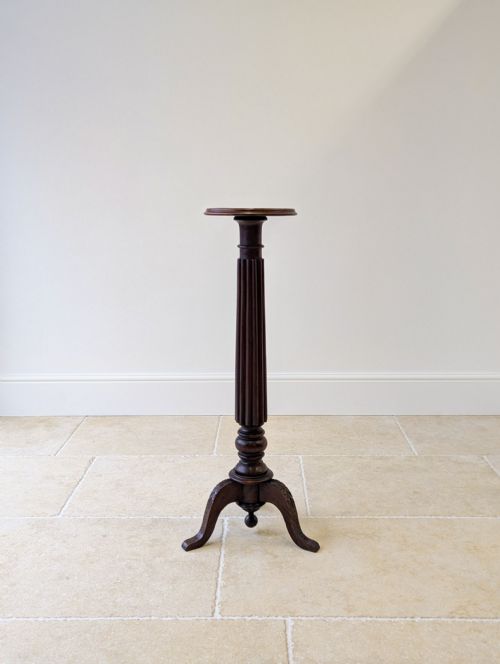
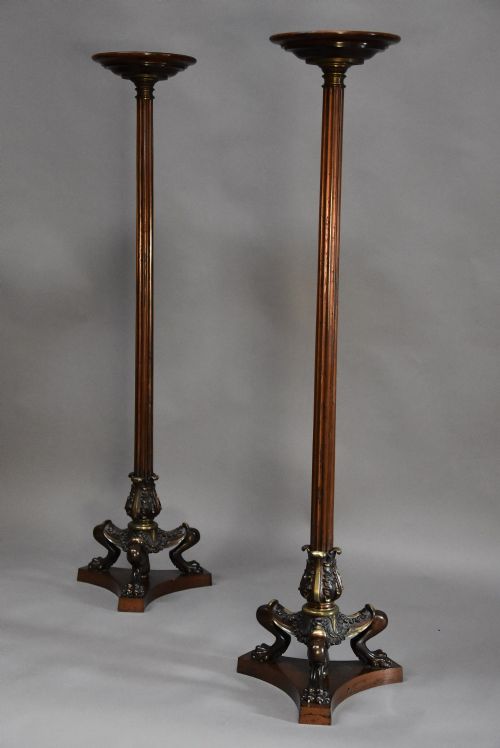


Regency Torchere Stand
A regency torchere stand brings elevated classical proportion to a room, holding a light or a plant upon a slender column.
Regency Torchere Stand
A regency torchere stand serves as a tall pedestal designed to elevate a lamp, candle, or plant above the floor level. These pieces draw from neoclassical tastes, presenting upright columns, tripod supports, and occasionally jardiniere tops.
The selections span the Georgian and Regency periods alongside later revivals, displaying forms ranging from simple mahogany shafts to elaborate giltwood and simulated marble creations. Most examples function as plant stands, occasional tables, or display pedestals.
Makers fashioned these stands primarily in mahogany, walnut, rosewood, and yew wood, often incorporating brass mounts or marble inserts. The proportions remain narrow and vertical, designed to occupy corners or spaces between windows.
Materials and construction
Cabinetmakers constructed the main shafts and columns from dense hardwoods such as mahogany, walnut, and rosewood, frequently turning timber on a lathe to achieve smooth tapering profiles. Tripod bases were joined with sturdy tenons to support the elevated weight above.
Surface treatments included ebonising, lacquer work, and painted simulations of marble upon pine, adding colour and pattern to the timber core. Gilt wood details and cast brass mounts provided reflective highlights typical of the neoclassical vocabulary.
Object forms span dedicated torcheres, plant stands, jardiniere tables, and occasional pedestals sharing a common tall vertical column.
Distinctions in quality
Superior examples distinguish themselves through the choice of figured timber, such as well-matched rosewood veneers or finely grained yew and mahogany. The crispness of carved details on tripod legs and capitals separates standard production from workshop pieces of higher ambition.
Construction integrity dictates longevity, visible in the stability of the central column and the precision of the joints connecting the base. Original surfaces and retained gilding or lacquer preserve the intended visual weight of the design.
George Smith·Thomas Hope·Gillows·Humphrey Hopper
The Regency Torchere Stand Glossary
- Torchere
- A tall stand designed to hold a light or a candle. The form evolved from lighting supports into general display pedestals.
- Jardiniere
- An ornamental pot or stand for holding plants and flowers. These often feature inset marble tops or lead-lined wells.
- Neoclassical
- A style drawing inspiration from classical antiquity. It manifests in clean architectural lines, columns, and symmetrical ornamentation.
- Tripod base
- A three-legged support structure commonly found on these stands. This configuration ensures stability on uneven floors.
- Ebonised wood
- Timber treated to resemble ebony through staining or painting. This dark finish creates high contrast against gilt mounts.
Regency Torchere Stand: Frequently Asked Questions
What is a regency torchere stand used for today?
These stands serve primarily as display pedestals for house plants, decorative bowls, or table lamps. Their narrow footprint allows them to occupy awkward corners without crowding a room.
Historically designed to hold candles or torches, modern interiors utilise their height to introduce vertical interest and break up flat expanses of wall.
How do I tell an original period stand from a later revival?
Examining the timber shrinkage, construction joints, and underside fixings provides clues regarding age. Period pieces from the early nineteenth century show hand-tool marks and traditional joinery methods distinct from twentieth-century machinery.
Furthermore, the patina on mahogany and rosewood develops a soft lustre over decades of handling that chemical finishes struggle to replicate.
Can these stands support heavy plants or lamps?
Solid mahogany and rosewood versions with sturdy tripod bases offer substantial stability for standard household items. The weight distribution depends heavily on the spread of the feet at the base.
Care should be taken with unusually top-heavy arrangements, particularly on carpeted surfaces where the feet might not sit flat.
Where should I place a torchere stand in a room?
They find a natural home in empty corners, beside armchairs, or flanking doorways where vertical accents balance horizontal furniture like sofas. Placing them away from direct heat sources protects the timber and veneer from drying out.
Because the surfaces sit above eye level, positioning them where the top can be appreciated from a seated position works best.