
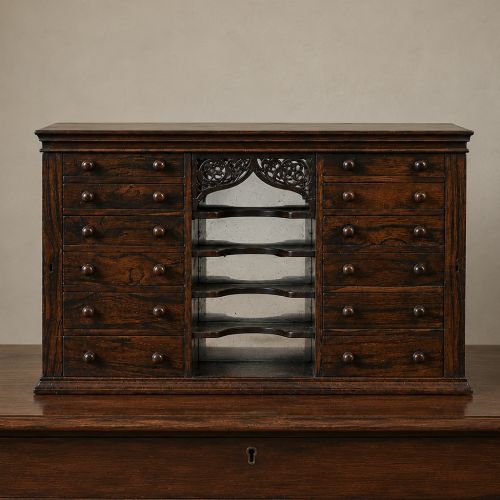


Regency Miniature Chest
A regency miniature chest is a small-scale drawer unit crafted with fine cabinet-making skills that appeals to collectors of period furniture.
Understanding the regency miniature chest
A regency miniature chest represents a scaled-down version of full-sized domestic storage furniture from the Georgian and nineteenth-century periods. These compact pieces typically take the form of miniature chests of drawers or bowfront chests.
Most examples found on this page date from the nineteenth century and the late George III period. They reflect the domestic furniture designs of their era in a reduced format.
Materials and construction
Cabinet-makers built these miniature items using solid timbers and veneers such as mahogany, oak, and burr oak. They frequently incorporated inlay wood and brass details to decorate the surfaces.
The construction follows traditional cabinet-making techniques used for full-sized furniture, adapted carefully for small dimensions.
Retail Price Guide 2026
Typical UK retail prices for regency miniature chest, calculated from the Sellingantiques database of over a million retail prices indexed since 2003. This retail price guide relies exclusively on Sellingantiques data; no external sources or auction records are used, so the figures do not describe the wider market.
Judging quality and craftsmanship
The distinction between standard items and superior pieces lies in the choice of timber figure, such as burr oak or figured mahogany, and the precision of the woodwork. Refined handling of inlay work and brass fittings elevates certain chests above simpler examples.
Proportion and the fidelity of the miniature scale relative to full-sized furniture indicate the skill of the maker. Pieces that maintain crisp detailing and careful drawer construction stand apart in any collection.
The Regency Miniature Chest Glossary
- Bowfront
- A convex curved front profile typical of many miniature chests from the Regency period. This shape softens the corners of the furniture.
- Burr oak
- A timber harvested from tree growths that produces intricate, swirling grain patterns. It is prized for decorative veneering.
- Inlay
- A technique where contrasting strips of wood or other materials are inserted into the surface to form decorative patterns. It adds visual complexity to the piece.
- Miniature furniture
- Small-scale domestic items produced either as master pieces by cabinet-makers or as specialised furnishings. They replicate full-sized domestic forms accurately.
Frequently Asked Questions
What is a regency miniature chest?
A regency miniature chest is a small-scale drawer unit produced during the nineteenth century or the late Georgian period.
These pieces replicate the design and construction of full-sized chests in a compact format.
How were miniature chests used?
These small chests served as decorative items or specialised containers within larger rooms.
Cabinet-makers also created some as demonstration pieces to display their skills to prospective clients.
What woods are common?
Makers relied heavily on mahogany, oak, and burr oak for the primary carcases and drawer fronts.
They often added decorative inlay wood and brass elements to enhance the appearance.
How do I identify the period?
Dating relies on timber selection, construction methods, and stylistic details associated with George III and Regency periods.
Comparing the hardware and overall proportions helps confirm the nineteenth-century origins.