


Pierced Silver Salt Cellar
These pierced silver salt cellars are table salts and condiment pots designed to hold salt at the dining table.

Pierced Silver Salt Cellar
A pierced silver salt cellar sits on the dining table as part of a cruet set or tableware collection, serving salt to guests. When you search for a pierced silver salt cellar, you encounter salt cellars, table salts, condiment pots, and cruet stands originating from the Georgian, Victorian, and Edwardian periods.
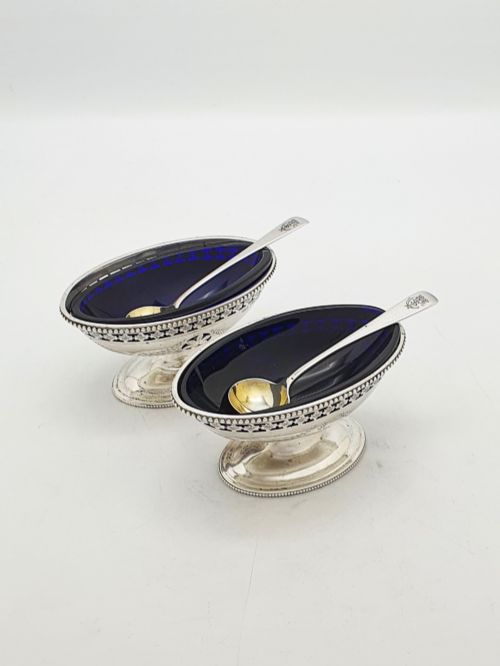
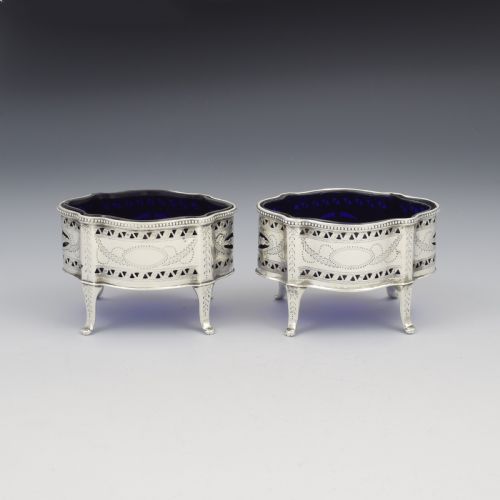
The pieces on this page appear as single items, matched pairs, or cased sets. Many of these table salts take boat shapes or serpentine forms, often accompanied by glass liners in cobalt or green.
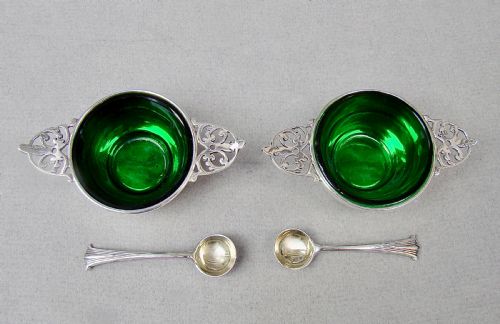
Makers from London and provincial workshops produced these condiment pots in sterling silver and solid silver. Alongside standard salt cellars, novelty forms such as quaich salts also emerge in the evidence.
How they were made
Silversmiths shaped sterling silver and solid silver into boat shapes, serpentine profiles, and quaich forms using traditional metalworking techniques. Piercing work created openwork patterns in the silver bodies of the salt cellars.
Makers fitted these pierced silver frames with removable glass liners, typically blown in cobalt glass or green glass to protect the silver from corrosion by the salt. Satin and velvet linings frequently appear inside fitted boxes for cased sets.
The objects range from single mustard pots and cruet stands to pairs of boat-shaped table salts with original blue glass liners.
What varies in quality
The crispness and depth of the pierced openwork ornamentation dictate the visual distinction between individual salt cellars. Finer examples display meticulous piercing that maintains structural integrity while creating intricate patterns across the silver.
The presence and originality of coloured glass liners influence the completeness of a table salt. Sets retaining their original cobalt glass or green glass liners hold greater historical integrity than those paired with replacements.
Josiah Williams & Co·William Hutton & Sons
The Pierced Silver Salt Cellar Glossary
- Salt Cellar
- A small vessel used to hold salt on the dining table before the invention of free-flowing table salt. These pieces often feature glass liners to protect the metal.
- Cruet Stand
- A metal frame designed to hold multiple condiment pots, such as salt cellars, mustard pots, and pepper shakers, together on the table. Cruet sets organise table service.
- Cobalt Glass
- A deep blue glass used for the removable liners inside silver salt cellars. The dark colour contrasts sharply with the pierced silver exterior.
- Quaich
- A traditional Scottish two-handled drinking vessel adapted in some instances as a novelty salt cellar. These pieces translate a large form into a miniature condiment pot.
- Serpentine
- A curved outline featuring alternating convex and concave sweeps. This form appears on the bodies of Victorian table salts.
Pierced Silver Salt Cellar: Frequently Asked Questions
What is a pierced silver salt cellar?
A pierced silver salt cellar is an openwork silver vessel used to hold salt on the dining table. These condiment pots protect and display salt during meals.
Most examples date from the Georgian, Victorian, and Edwardian eras. They frequently incorporate coloured glass liners inside the pierced silver framework.
Why do salt cellars have glass liners?
Glass liners protect the sterling silver or solid silver body from corrosion caused by direct contact with salt. Cobalt glass and green glass liners are typical.
These removable inserts allow the silver to remain clean and undamaged over decades of use.
What periods do these pieces date from?
The available salt cellars span the eighteenth century, the Victorian period, and the Edwardian era. Stylistic markers correspond to these specific eras.
Georgian, Victorian, and Edwardian designs reflect the changing tastes of silversmiths and dining fashions across different centuries.
How were salt cellars used on the table?
Table salts sat upon the dining table either individually or as part of a cruet set alongside mustard pots and cruet stands. Guests used small spoons to transfer salt to their plates.
Cased sets kept matched pairs of salt cellars protected when not in active use on the dining table.