


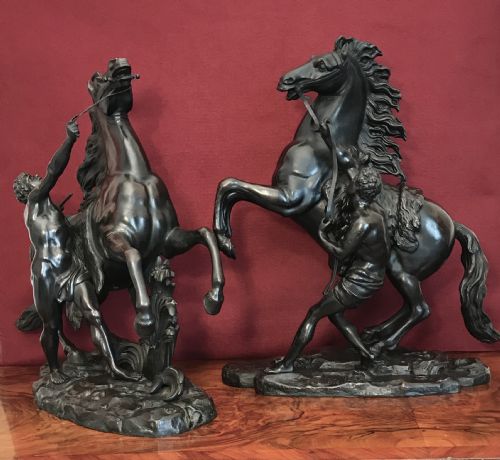


Pair of Bronze Horses
These heavy metal sculptures bring classical symmetry and equestrian movement directly to the mantel or desk.

Pair of Bronze Horses
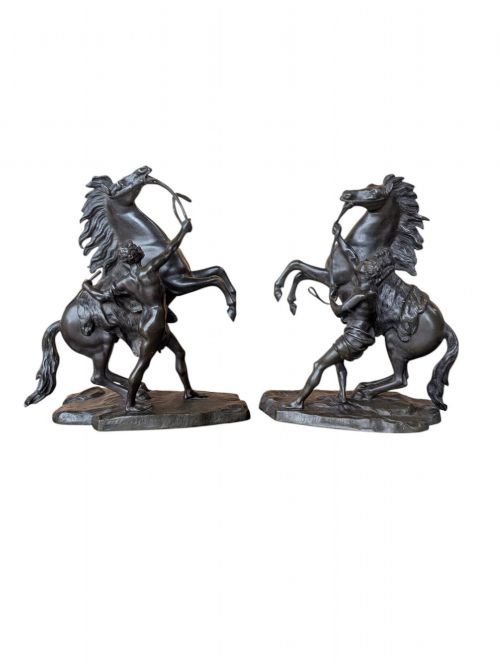
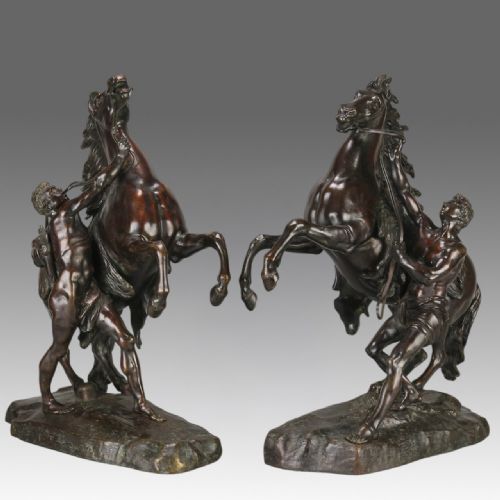
A pair of bronze horses typically takes the form of the famous Marly horses, modelled after the monumental sculptures created by Guillaume Coustou for the French royal residence. These pieces appear frequently alongside animalier subjects, bookends, doorstops, and mounted figures from the nineteenth century.
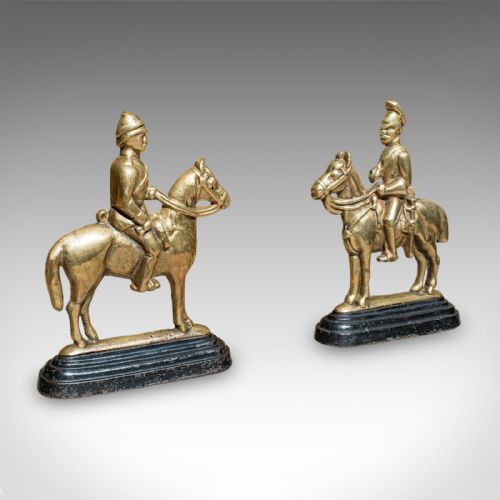
Buyers encounter French Neoclassical interpretations alongside Victorian English castings and Chinese examples. The subjects range from rearing steeds restrained by handlers to racing thoroughbreds with jockeys.
The format is almost exclusively sculptural, designed symmetrically to face one another or pull in tandem. Dating stretches primarily across the nineteenth century, encompassing Victorian and Grand Tour productions.
Materials and casting methods
Foundries utilised traditional metalcasting techniques, primarily producing solid or hollow casts in bronze, gilt bronze, and patinated bronze. Alternative versions appear in brass, cast metal, cast iron, and bronzed metal.
Many nineteenth-century castings rest on secondary materials, including carved olive wood bases or fitted bookend structures. Surface finishes vary from dark patination to gilded highlights applied over the metal.
Listings feature items dated across the nineteenth century, including specific production years from 1875 to 1900.
Factors separating standard castings from exceptional ones
Quality rests significantly in the crispness of the chase work, where artisans hand-tooled the cooled metal to define muscle sinews, manes, and harness details. Finer pairs retain subtle facial expressions and deep relief on the accompanying handlers.
The weight and stability of the casting indicate the amount of metal used in the production. Superior examples also demonstrate balanced proportions between the paired animals and their respective bases.
Guillaume Coustou·P. J. Mene·Jules Moigniez·A. Tchernochtchekov
The Pair of Bronze Horses Glossary
- Animalier
- A nineteenth-century art movement dedicated to the realistic portrayal of animals. Sculptors in this genre focused heavily on anatomical precision and dynamic movement.
- Marly Horses
- A pair of monumental marble sculptures depicting restrained horses and their grooms. The original works were commissioned for Louis XV and inspired numerous nineteenth-century bronze reductions.
- Patination
- The chemical or natural coloration applied to the surface of bronze. This treatment produces tones ranging from deep chocolate brown to green and black.
- Grand Tour
- A cultural journey undertaken by nineteenth-century Europeans acquiring souvenirs. Small bronze sculptures served as popular portable mementos of these travels.
- Chasing
- The manual finishing process applied to a raw metal casting. Artisans use small chisels and hammers to refine surface textures and remove casting flaws.
Pair of Bronze Horses: Frequently Asked Questions
What are Marly horses?
These are representations of rearing horses being restrained by attendants, originally sculpted in stone by Guillaume Coustou for a royal watering place in France. Nineteenth-century foundries scaled down these iconic monuments into popular bronze ornaments.
Such pairs were cast to stand symmetrically, mirroring each other's posture and tension on opposite ends of a mantelpiece or desk.
How were these sculptures used?
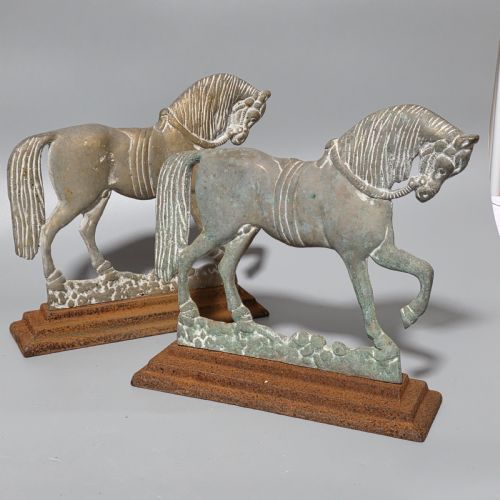
Nineteenth-century households utilised these metal figures primarily as decorative mantel ornaments or paired heavy bookends. Certain utilitarian variations incorporated horse figures into functional doorstops.
Larger pairs served as standalone sculptural statements on tables, pedestals, or architectural brackets within libraries and studies.
How do I date a bronze horse?
Dating relies heavily on the style of the casting, the quality of the patination, and any foundry marks or signatures stamped into the metal. Nineteenth-century pieces often display specific patinas and mounting styles associated with French or Victorian production.
Base materials also provide clues, as older iterations frequently utilise fitted wooden platforms like olive wood or integrated brass framing.
Are bronze horses always French?
While the famous Marly designs originated in France, nineteenth-century British, Italian, and Chinese foundries also produced equestrian sculptures. English makers frequently adapted the horse motif into utilitarian items like doorstops and book rests.
Italian workshops contributed Grand Tour souvenirs, and Chinese artisans created distinct interpretations of the equine form in bronze.