
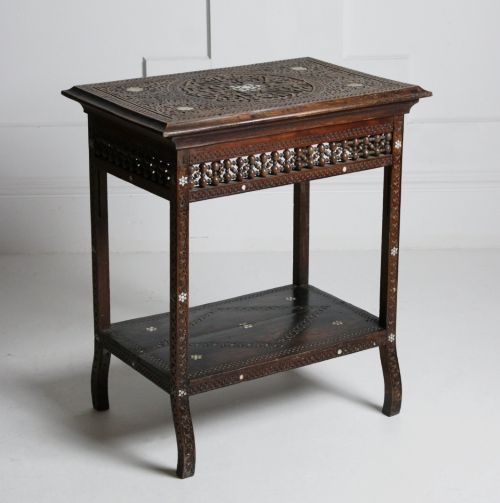

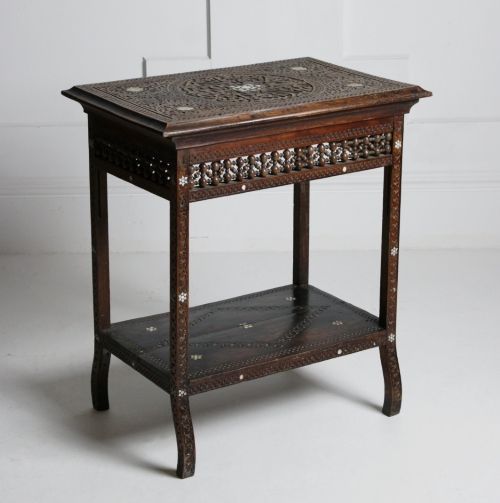
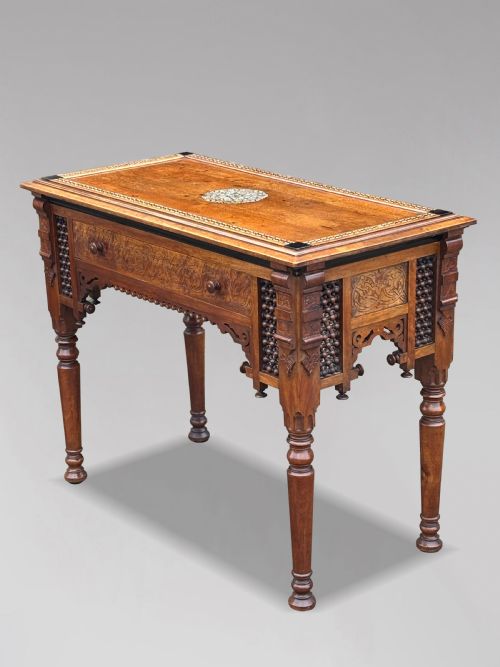
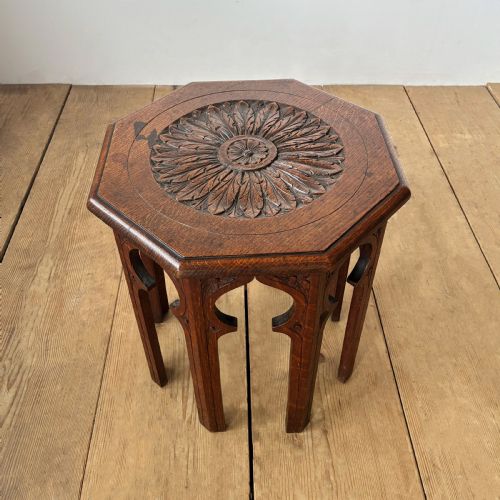


Orientalist Carved Side Table
An orientalist carved side table brings intricate geometric inlay and dense fretwork from distant workshops into British drawing rooms.
Orientalist Carved Side Table
An orientalist carved side table merges nineteenth-century European enthusiasm for exotic furnishings with traditional Middle Eastern and Asian woodworking traditions. These pieces function primarily as occasional, coffee, centre, or games tables within domestic interiors.
You will most frequently encounter nineteenth-century Syrian and Moorish revival forms characterised by octagonal profiles, folding bases, and two-tier structures. Styles range from Anglo-Indian and Anglo-Japanese to Venetian Baroque Revival and Mamluk Revival.
Makers such as Liberty & Co and Carlo Bugatti contributed distinct interpretations to this genre, employing ebonised wood, mahogany, walnut, and black lacquer. These tables served both as functional furniture and as exotic display pieces for nineteenth-century collectors.
Materials and construction methods
Cabinetmakers utilised hardwoods such as walnut, oak, and mahogany as foundations for intricate surface decoration. Ebonised wood and black lacquer also appear, particularly in Aesthetic Movement and European revival interpretations.
Artisans applied elaborate surface enrichment through bone, brass, and mother-of-pearl inlay arranged in geometric and star patterns. Hand carving defined the structural elements, creating deep relief and pierced fretwork panels across octagonal and folding forms.
Current listings feature pieces spanning the nineteenth century, including specific dates from 1850 through the Edwardian period up to 1920.
Judging quality and execution
Quality rests in the precision of the joinery and the density of the inlay work. Finer examples display tightly fitted geometric tessellation using genuine mother-of-pearl and bone rather than painted substitutes.
The depth and crispness of the hand carving distinguish superior pieces from utilitarian production. Attribution to notable firms like Liberty & Co or Carlo Bugatti elevates the standing of a table through documented design provenance.
Liberty & Co·Carlo Bugatti
The Orientalist Carved Side Table Glossary
- Moorish Revival
- A nineteenth-century architectural and decorative style inspired by the Moorish architecture of North Africa and the Iberian Peninsula. It heavily influences the arches and geometric patterns found on these tables.
- Inlay
- The technique of embedding pieces of contrasting material, such as bone or mother-of-pearl, into a solid wood surface to form a flush decorative design. This creates the intricate surface patterns characteristic of Middle Eastern furniture.
- Mamluk Revival
- A design movement drawing upon the metalwork, glass, and woodwork of the Mamluk Sultanate. Pieces in this style often incorporate dense brass elements and complex geometric motifs.
- Anglo-Japanese
- An aesthetic movement style combining British furniture forms with Japanese artistic motifs and construction techniques. It appears in occasional tables featuring ebonised finishes and pagoda silhouettes.
- Occasional table
- A small, movable table designed for specific, intermittent uses such as holding books or tea. These form the majority of surviving examples in this category.
Orientalist Carved Side Table: Frequently Asked Questions
How do I clean an inlaid table?
Dust surfaces gently with a dry, soft cloth to prevent debris from lodging in the crevices of the inlay. Avoid liquid polishes and commercial cleaners, which can loosen bone, brass, or mother-of-pearl elements.
Maintain stable indoor humidity to prevent the timber from expanding and causing the delicate inlay tesserae to lift. Professional conservation is recommended if any individual pieces of inlay begin to loosen.
Where should I place this table?
Position these tables in low-traffic areas where their intricate surfaces can be appreciated without risk of accidental impact. They function well as bedside tables, lamp stands, or decorative accents in sitting rooms.
Keep them away from direct sunlight and heat sources to protect the polished wood finishes and prevent the natural adhesives used in the inlay from drying out.
Are folding tables structurally stable?
Many Moorish and Anglo-Indian tables utilise hinged, folding bases designed for portability. These require careful handling when moving to ensure the wooden hinges or interlocking joints align correctly.
Check that the tabletop rests securely on the collapsible base support to prevent wobbling during everyday use. When properly aligned, these folding constructions provide surprising rigidity.
What defines Moorish revival style?
Moorish revival furniture incorporates horseshoe arches, intricate pierced woodwork, and complex geometric tile-inspired patterns. Makers adapted these architectural motifs to domestic tables for nineteenth-century European homes.
This style emphasises surface texture and pattern over simple classical lines, creating visually dense pieces that served as conversation starters in Victorian drawing rooms.