


Neoclassical Painted Sideboard
A neoclassical painted sideboard brings classical restraint and layered colour to a room, offering both surface display and concealed storage.
Neoclassical Painted Sideboard
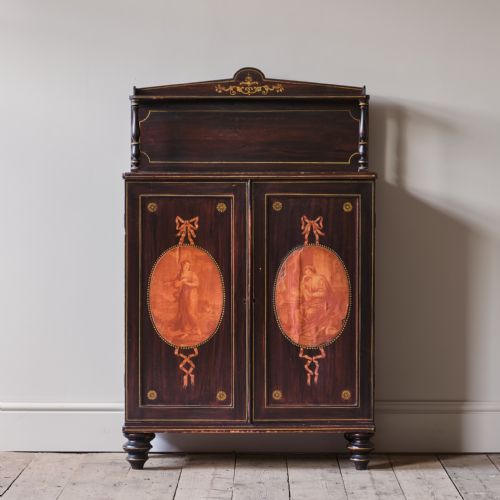
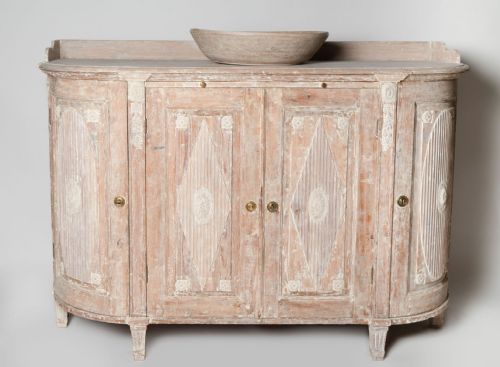
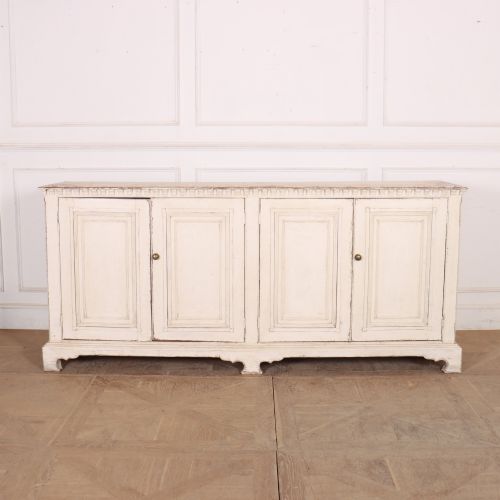
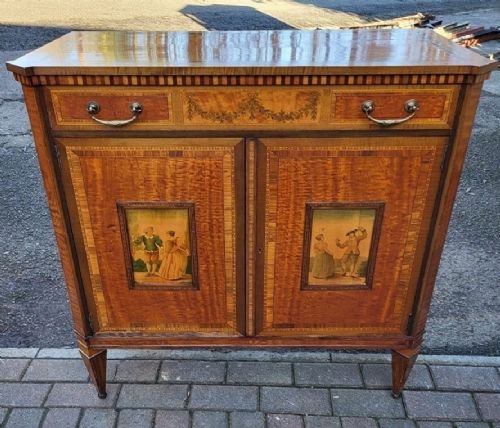
A neoclassical painted sideboard encompasses side cabinets, servers, enfilades, and commodes produced across the eighteenth, nineteenth, and early twentieth centuries. These forms reflect diverse regional interpretations, ranging from English satinwood and Sheraton revival pieces to Gustavian buffets, Dutch breakfronts, and Italian serpentine commodes.
Buyers encounter items finished in simulated rosewood paint, original polychrome schemes, and gilt decoration, often featuring marble tops. The selection spans formal Regency and Adam revival designs alongside provincial French and Swedish works.
How they were made
Construction relies on timber foundations such as pine, mahogany, and maple, frequently surfaced with satinwood veneers. These woods provide stable substrates for detailed painted ornamentation and inlay.
Surface decoration employs hand-applied paint, simulated wood graining, and gilt highlights. Structural hardware incorporates brass fittings, while heavier top surfaces integrate fitted marble slabs.
Materials recorded across the inventory include satinwood, pine, mahogany, maple, brass, marble, and paint.
What varies in quality
Quality rests in the precision of the underlying cabinet work, seen in the fluid sweep of serpentine fronts and breakfront proportions. Finer examples display harmonious timber selection, such as figured satinwood, matched with crisp joinery.
The integrity and sophistication of the painted surface dictate distinction. Original pigment application, balanced polychrome palettes, and restrained gilding elevate a piece above later or heavier decorative schemes.
Maple and Co.·Kaufman
The Neoclassical Painted Sideboard Glossary
- Commode
- A low cabinet or chest of drawers designed for domestic storage, frequently fitted with a marble top in European examples.
- Enfilade
- A long sideboard or serving table intended for formal dining rooms, often matching other case furniture in a suite.
- Demi-lune
- A half-moon shape used for the footprint and top of console tables and commodes, designed to sit flush against a wall.
- Gustavian
- The Swedish interpretation of French neoclassical design, characterised by pale painted finishes and simplified classical motifs.
Neoclassical Painted Sideboard: Frequently Asked Questions
What is a neoclassical painted sideboard?
A neoclassical painted sideboard is a decorative storage piece drawing on classical antiquity, finished with painted surfaces or veneers.
These items include side cabinets, servers, and commodes produced in various European styles during the eighteenth and nineteenth centuries.
Where were these sideboards used?
They typically served in dining rooms, halls, and drawing rooms for storing tableware, linens, and serving food.
Their decorative surfaces also provided a display space for lamps, urns, and porcelain collections.
How do I care for painted wood?
Protect the painted finish by keeping the piece away from direct sunlight and sudden changes in room temperature.
Dust gently with a soft dry cloth and avoid harsh chemical cleaners that can damage the historical pigment.
How do I tell periods apart?
Eighteenth-century examples often show deeper regional characteristics, such as Dutch breakfronts or Italian serpentine forms, with hand-mixed original pigments.
Later nineteenth-century revival pieces, including Sheraton and Adam styles, frequently utilise satinwood veneers and more standardised decorative hardware.