
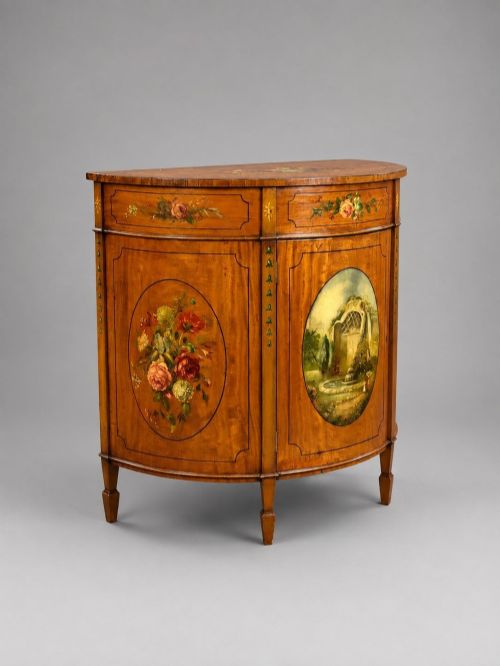

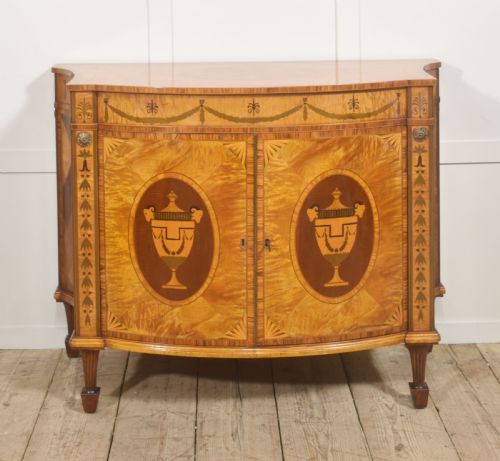


Satinwood Demi Lune Cabinet
These satinwood demi lune cabinet pieces bring curved elegance and painted neoclassical detail to a room, offering both surface display and concealed storage.
Satinwood Demi Lune Cabinet
A satinwood demi lune cabinet presents a distinctive half-moon shape designed to sit flush against a wall while drawing the eye with its curved silhouette. You will most frequently encounter Edwardian and Sheraton Revival examples on this page, alongside earlier Georgian and 19th Century forms.
The evidence shows these pieces functioning as side cabinets, commodes, and display cabinets. They bridge the gap between architectural furniture and decorative art, often featuring flat tops above semi-circular cupboards or open shelving.
Origins span from the 18th Century through the Victorian and Edwardian eras up to the 1930s. The revival styles borrow heavily from George III Neoclassical design, reinterpreting the crescent form for later drawing rooms and reception spaces.
Materials and construction methods
Makers built the carcase from timber such as mahogany or underlying wood, applying satinwood veneers to achieve a pale, light-reflecting primary surface. Boxwood and various wood inlays formed contrasting stringing and geometric borders around the curved panels.
Surface decoration frequently relied on hand-painted details and classical panels, capturing the Neoclassical taste for urns, swags, and mythological figures. Brass hardware, including hinges and keyplates, completed the functional elements of the doors.
Periods represented range from 18th Century George III pieces through Victorian and Edwardian revivals up to the 1930s.
Distinctions in quality and execution
The standard of a satinwood demi lune cabinet rests heavily on the crispness of the marquetry and the fidelity of the hand-painted classical panels. Finer examples display meticulous control over the grain alignment in the satinwood veneer across the curved front.
Cabinetwork quality reveals itself in the seamless joining of the half-moon frame and the smooth action of the curved doors. Pieces associated with notable makers or specific revival movements often demonstrate superior depth in their decorative vocabulary.
Cowtan & Sons London·Wright & Mansfield
The Satinwood Demi Lune Cabinet Glossary
- Demi-lune
- French for half-moon. This term describes furniture with a semicircular footprint designed to stand flat against a wall.
- Satinwood
- A hard, durable timber yielding a golden-yellow colour and a lustrous sheen resembling satin. It serves as the primary veneering wood for these pieces.
- Marquetry
- The art of applying pieces of veneer to a structure to form decorative patterns and pictures. It differs from inlay by assembling the pattern before gluing it to the carcase.
- Sheraton Revival
- A late 19th and early 20th century design movement inspired by the furniture of George Thomas Sheraton. It favours light timbers, painted satinwood, and classical motifs.
- Commode
- Originally a low cabinet or chest of drawers, often used interchangeably with side cabinet in the context of semicircular furniture.
Satinwood Demi Lune Cabinet: Frequently Asked Questions
Where should I place a demi lune cabinet?
These cabinets suit hallways, drawing rooms, and dining areas where floor space is limited yet a statement piece is desired. Their flat backs allow them to anchor neatly against walls while the curved front softens room angles.
Because of their shallow depth, they function well as sideboards, display units, or commodes without obstructing walkways.
How do I distinguish Edwardian revival from 18th century pieces?
Edwardian and Sheraton Revival pieces often utilise lighter construction methods and brighter, machine-prepared satinwood veneers alongside hand-painted details. True 18th century items display older timber characteristics and distinct joinery under inspection.
The historical context of the piece usually clarifies whether it originates from the original Georgian period or the later revival eras seen in the records.
What is the difference between a commode and a side cabinet?
In historical terminology, a commode refers to a low decorative cabinet or chest, whereas a side cabinet is a broader category for storage furniture placed against room perimeters. Both terms apply interchangeably to these semicircular forms in many listings.
Functionally, both provide surface display space above enclosed shelving or cupboard storage.
How do I care for antique satinwood surfaces?
Protect satinwood from direct sunlight to preserve its pale golden colour and prevent the timber from darkening or fading unevenly. Dust gently with a dry, soft cloth and avoid chemical polishes that can damage hand-painted panels.
Maintaining a stable room temperature prevents the wood veneers and delicate boxwood stringing from warping or lifting over time.