



Painted Satinwood Sideboard
A painted satinwood sideboard brings lightness to a room, offering classical ornament and fine timber combined with decorative brushwork.
Painted Satinwood Sideboard
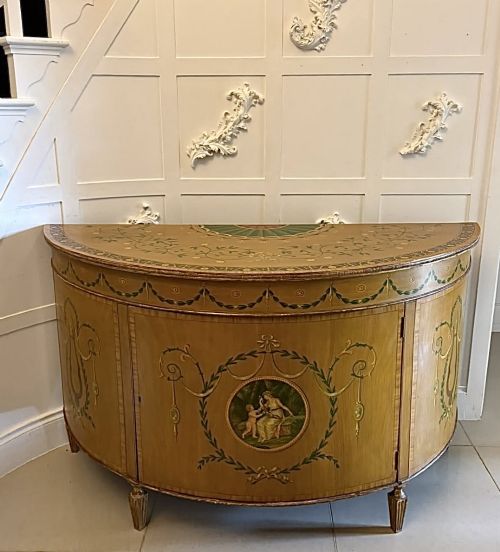
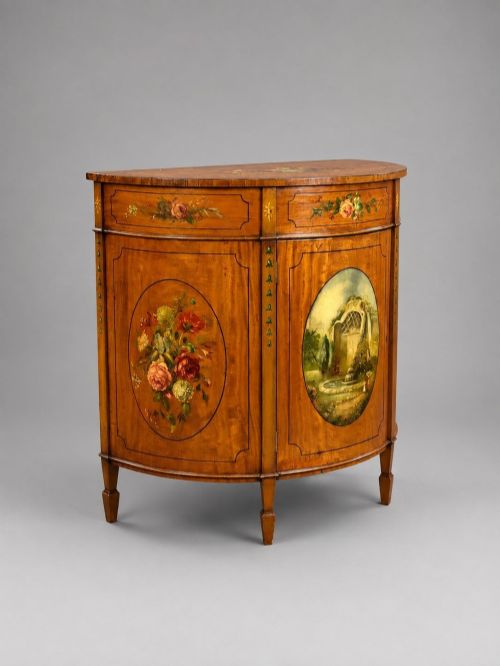
A painted satinwood sideboard is typically encountered as a demi-lune cabinet, bow-front commode, or side cabinet dating from the nineteenth and early twentieth centuries. These pieces appear primarily within Victorian, Edwardian, and Sheraton Revival styles, reflecting an enduring taste for classical symmetry and refined surface decoration.
The form adapts easily to various interior spaces, functioning as a sideboard, side cabinet, or commode whilst providing concealed storage behind curved doors. Makers of the period drew heavily on Adam and Neoclassical vocabularies, employing graceful proportions and sweeping curves to showcase the timber and pigment.
When searching for a painted satinwood sideboard, buyers encounter items ranging from compact side cabinets to larger credenzas. The selection on this page demonstrates the prevalence of demi-lune shapes and delicate painted panels executed during the late nineteenth and early twentieth centuries.
How they were made
Construction relies on a foundation of timber, principally satinwood and mahogany, shaped into curved demi-lune or bow-front profiles. Artisans applied hand-painted details and classical panels directly onto the wood, often pairing the bright satinwood ground with contrasting boxwood and brass fittings.
The decorative schemes rely on skilled brushwork, featuring floral motifs and classical scenes rendered in muted palettes. Cabinetmakers combined timber inlay with pigment, securing longevity through traditional joinery suited to curved door fronts and structural carcases.
Painted Satinwood Sideboard Retail Price Guide 2026
Typical asking prices for painted satinwood sideboard among the pieces listed under this phrase on Sellingantiques today, from the lower quarter to the upper quarter. They describe what is for sale here now, not the wider market.
Materials recorded across these cabinets include satinwood, mahogany, and boxwood, complemented by hand-painted details and brass hardware.
What varies in quality
The standard of a painted satinwood sideboard is determined by the crispness of the hand-painted panels and the selection of the timber grain. Finer examples display meticulous brush control in the classical figures and floral details, avoiding stiff or heavy-handed application.
Construction details also separate standard production from superior cabinetwork, particularly in the fit of curved doors and the subtlety of boxwood inlay. The integration of brass hardware and the preservation of the original painted surface dictate the standing of an individual piece.
Maple and Co.·Kaufman
The Painted Satinwood Sideboard Glossary
- Demi-lune
- Having the shape of a half-moon, describing cabinets and commodes designed to sit flush against a wall with a curved front. This profile became especially popular during the Sheraton Revival period.
- Satinwood
- A dense, lustrous tropical timber with a natural golden sheen that takes a high polish. It serves as the primary ground for painted decoration in late nineteenth-century cabinetmaking.
- Sheraton Revival
- A late nineteenth-century design movement inspired by the neoclassical furniture of George Sheraton. Pieces in this style feature light timbers, painted panels, and classical symmetry.
- Bow-front
- A convex curving front contour found on side cabinets and chests. This shape softens the room's geometry and allows for wider internal storage capacity.
- Inlay
- A technique where pieces of contrasting wood, such as boxwood, are inserted into recesses within the primary timber surface to create linear or geometric patterns.
Painted Satinwood Sideboard: Frequently Asked Questions
Where should I place a painted satinwood sideboard?
These cabinets suit dining rooms, hallways, or drawing rooms where their curved profiles and bright finishes can be appreciated. Their shallow depth often makes them practical for narrower circulation spaces.
Keep them away from direct sunlight and strong heat sources to protect the delicate painted panels and the underlying satinwood veneer from fading or drying out.
How do I care for the painted surface?
Dust the cabinet gently with a soft, dry cloth and avoid modern chemical polishes that can damage aged varnishes and pigments. Moisture should be kept away from the timber at all times.
Professional conservation advice is recommended if the painted panels require cleaning or stabilization, as household cleaning agents will strip historic finishes.
What is the difference between a commode and a side cabinet?
Historically, a commode refers to a low cabinet with drawers or doors designed for storage, often featuring a decorative top surface. Side cabinets serve a similar function in dining and living spaces but may lack the specific drawer configurations of a commode.
In nineteenth-century revival furniture, the terms often overlap, with makers using them interchangeably for curved demi-lune forms.
How can I tell a Victorian piece from an Edwardian one?
Victorian examples often display heavier proportions and rich, dark contrasts, whereas Edwardian pieces tend towards lighter framing and airier neoclassical painted panels. Revival periods frequently overlapped in their design vocabulary.
Examining the internal secondary timbers and construction methods helps clarify the era of manufacture when stylistic cues alone are ambiguous.