
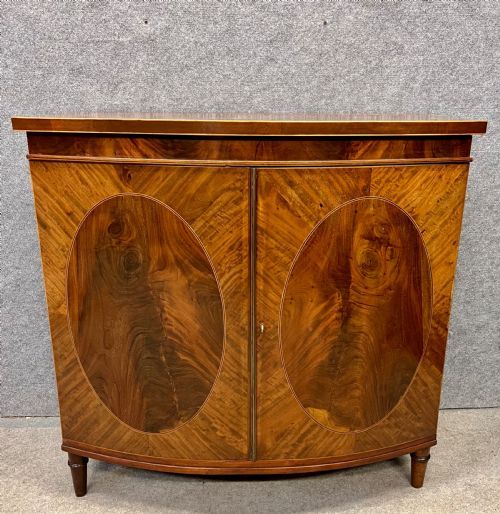
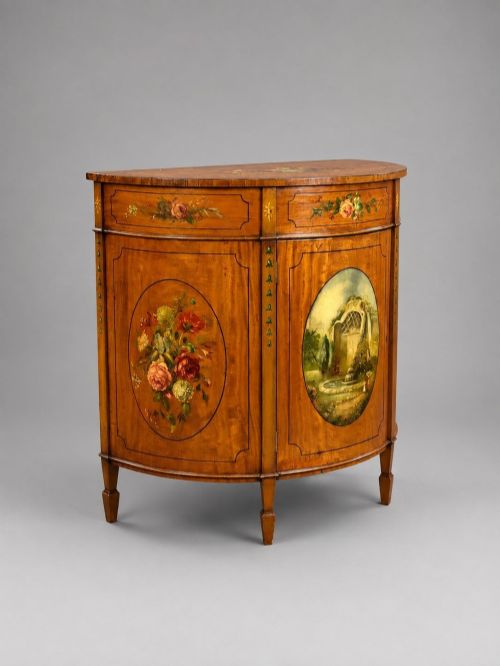
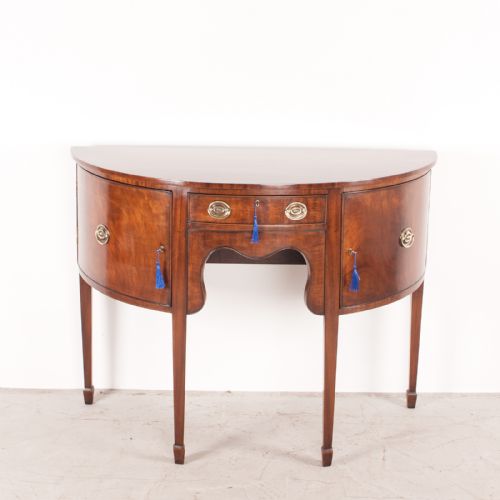

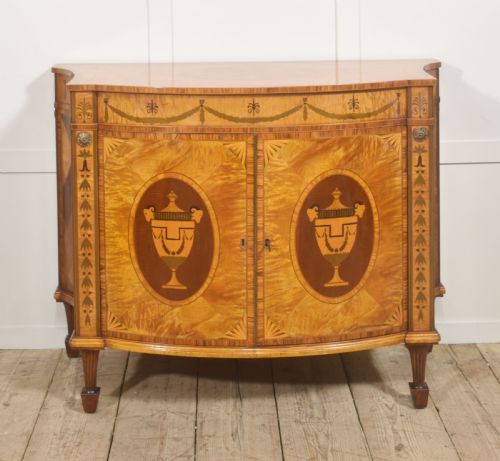


Edwardian Demi Lune Sideboard
An Edwardian demi lune sideboard brings understated curve and refined marquetry to a dining room, offering compact storage with classical elegance.
Edwardian Demi Lune Sideboard
An edwardian demi lune sideboard takes the shape of a half-circle, designed to sit flush against a wall while saving floor space in narrower rooms. These pieces combine the curved frontage of a commode with the storage capacity of a traditional serving cabinet.
Most examples found on this page date from the Edwardian era and the early twentieth century, drawing heavily on eighteenth-century revival aesthetics. Alongside authentic Edwardian pieces, buyers encounter related items spanning the nineteenth century up to the nineteen-thirties, including Georgian and Victorian interpretations.
The form appears under various overlapping descriptions in the trade, such as side cabinets, commodes, and sideboards and buffets. Regardless of the specific nomenclature, each piece shares the characteristic curved top and semi-circular footprint.
How they were made
Cabinet makers built the primary carcass using timber such as mahogany and satinwood, often applying detailed wood inlay, boxwood stringing, and marquetry to the curved surfaces. Brass hardware provided functional mounts for doors and drawers.
Surface decoration frequently involved hand painting, featuring classical panels and floral motifs directly onto the satinwood background. Selected pieces incorporated burr elm and burr yew wood to create rich natural grain patterns across the curved front.
Listings feature satinwood and mahogany alongside painted finishes, brass hardware, and intricate boxwood inlay.
What varies in quality
The distinction between standard production and superior craftsmanship rests in the execution of the inlay and the choice of primary timbers. Finely figured satinwood and intricate marquetry demand advanced technical skill from the cabinet maker, elevating the visual depth of the piece.
Painted panels exhibit notable variation in artistic execution, ranging from simple decorative borders to detailed classical compositions. The precision of the curved joints and the quality of the preserved timber surfaces ultimately determine the standing of each cabinet.
The Edwardian Demi Lune Sideboard Glossary
- Demi-lune
- French for half-moon, describing furniture built with a flat back and a semicircular front. This shape allows the cabinet to stand neatly against a wall.
- Marquetry
- The art of applying pieces of veneer to a structure to form decorative patterns and pictures. Craftsmen use varied woods to create tonal contrast without paint.
- Satinwood
- A durable tropical timber known for its golden lustre and smooth grain. It serves as a primary canvas for painted and inlaid Edwardian furniture.
- Sheraton Revival
- A late nineteenth and early twentieth century design movement that reinterprets the neoclassical furniture style of George Sheraton. Pieces feature light wood inlay and classical symmetry.
- Stringing
- Thin strips of contrasting wood inlaid into channels cut into the surface of a furniture piece. It provides fine linear borders around drawer fronts and tabletops.
Edwardian Demi Lune Sideboard: Frequently Asked Questions
Where should I place a demi lune sideboard?
These semicircular cabinets suit entrance halls, dining rooms, and drawing rooms where floor space is limited. Their flat back allows them to rest securely against a wall while the curved front softens room angles.
Because of their shallow depth compared to rectangular sideboards, they function well in hallways without obstructing pathways.
How do I care for antique satinwood?
Keep satinwood furniture away from direct sunlight and radiators to prevent the timber from drying out and the painted panels from fading. Regular dusting with a soft, dry cloth maintains the polished finish.
Avoid using silicone-based polishes or household cleaners, which can damage the historic varnish and delicate surface artwork.
How do I distinguish Edwardian from Georgian pieces?
Edwardian revival pieces often display machine-cut precision in their inlay and lighter, brighter satinwood finishes compared to eighteenth-century originals. Eighteenth-century furniture typically shows deeper patination and hand-wrought construction marks inside the carcass.
Examining the secondary woods inside drawers and the style of the hardware helps confirm the actual period of manufacture.
What is the difference between a commode and a sideboard?
Historically, a commode refers to a low decorative cabinet with drawers or doors, whereas a sideboard is typically larger and designed for dining room service. In modern trade terminology, the terms often overlap when describing semicircular cabinet forms.
Both serve similar decorative and storage functions within traditional domestic interiors.