


Painted Satinwood Credenza
A painted satinwood credenza brings refined classical ornament and luminous timber tones to a sophisticated interior, offering a grand statement piece for storage.
Painted Satinwood Credenza
A painted satinwood credenza represents a sophisticated category of decorative cabinetry, encompassing side cabinets, commodes, and sideboards designed to anchor a formal room. Buyers seeking this search phrase encounter pieces predominantly from the nineteenth century, including Victorian and Edwardian periods, alongside revival eras such as Sheraton and Adam.
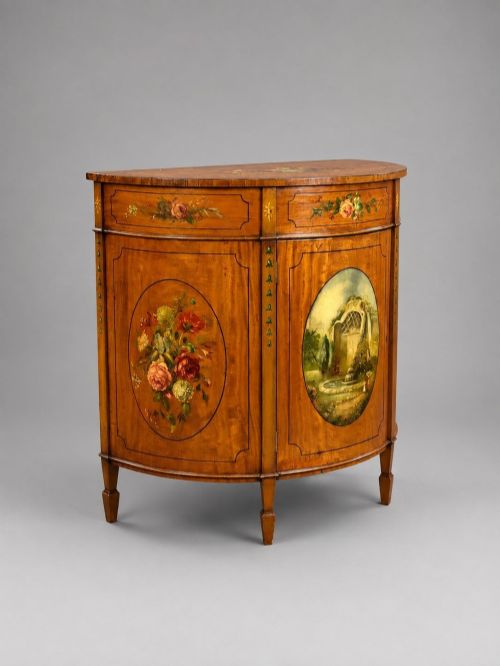
The most common form on this page is the demi-lune cabinet, shaped with a graceful curved front that sits neatly against a wall while displaying delicate painted panels. These items combine timber surfaces with classical motifs, floral artwork, and finely figured wood grains to create an imposing yet elegant presence.
How they were made
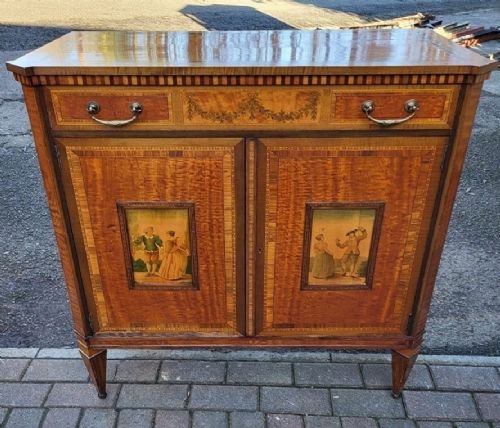
Construction relies upon a timber substrate, often incorporating mahogany or general timber framing, overlaid with figured satinwood veneers. Artisans shaped these cabinets into bow fronts, serpentine outlines, and half-moon curves, applying boxwood stringing and intricate brass hardware to define the edges and doors.
Decoration centres on hand-painted detail and classical panels, executed with precision directly onto the timber or onto applied medallions. These painted elements draw on neoclassical motifs, floral garlands, and figural scenes, requiring steady brushwork that integrates smoothly with the polished wood surface.
Cabinetmakers occasionally hid spare boxwood stringing inside the carcass drawers, leaving tiny wooden puzzles for future restorers to discover.
What varies in quality
Quality in a painted satinwood credenza rests upon the crispness of the hand-painted detail and the selection of timber veneers. Superior examples display subtle shading in the classical panels and tight, lustrous grain across the satinwood surfaces, whereas simpler versions rely on heavier, less nuanced brushwork.
The structural harmony of the piece also dictates its standing, particularly in the joinery of curved doors and the crisp execution of boxwood inlay. Cabinets that maintain balanced proportions and sharp, undisturbed painted ornamentation demonstrate the highest level of workshop execution.
Maple and Co·Kaufman
The Painted Satinwood Credenza Glossary
- Demi-lune
- Half-moon shape in furniture design, frequently used for commodes and side cabinets that fit flush against a wall. This profile became especially popular during revival periods for its elegant economy of space.
- Satinwood
- A lustrous tropical timber known for its golden colour and reflective, shimmering grain. It provides a pale, glowing ground ideal for painted decoration and contrasting inlay.
- Sheraton Revival
- A late nineteenth-century design movement inspired by the neoclassical furniture of George Sheraton. It is characterised by slender proportions, satinwood veneers, and classical painted motifs.
- Adam Revival
- A decorative style drawing on the eighteenth-century neoclassical designs of the Adam brothers. Pieces typically feature symmetrical urns, husks, and classical medallions.
- Boxwood stringing
- Thin inlay lines of pale boxwood set into contrasting darker timber to outline panels and borders. This technique defines the architectural geometry of the cabinet.
Painted Satinwood Credenza: Frequently Asked Questions
What rooms suit a painted satinwood credenza?
These cabinets work well in formal dining rooms, drawing rooms, and spacious hallways where their decorative painted panels can catch the light. They function effectively as serving surfaces or display cabinets while offering discreet enclosed storage.
Because of their refined aesthetic, they pair naturally with period interiors but also serve as a striking focal point in contemporary spaces that benefit from classic timber tones.
How do I care for satinwood furniture?
Satinwood benefits from stable indoor environments away from direct sunlight and severe temperature fluctuations, which can dry out the timber and affect the painted details. Regular dusting with a soft, dry cloth keeps the surface clean without needing heavy polishes.
Avoid placing damp items or harsh chemical cleaners directly on the wood, as moisture can penetrate the polished finish and damage the hand-painted artwork beneath.
How do I tell Victorian from Edwardian pieces?
Victorian examples often display bolder proportions and richer wood tones, sometimes combining maple or mahogany with satinwood veneers. The painting tends to incorporate dense floral motifs or classical revival themes executed with nineteenth-century gravitas.
Edwardian pieces generally lean towards lighter constructions, brighter satinwood grounds, and airier neoclassical designs reflecting the Sheraton and Adam revivals of the early twentieth century.
What is the difference between a credenza and a commode?
A credenza traditionally refers to a long, low sideboard or side cabinet designed for display and storage in a dining room. A commode is typically a more compact cabinet or chest with doors or drawers, often featuring a decorative curved front.
In nineteenth-century revival terminology, these terms sometimes overlap depending on the proportions of the specific cabinet and its intended placement against a wall.