


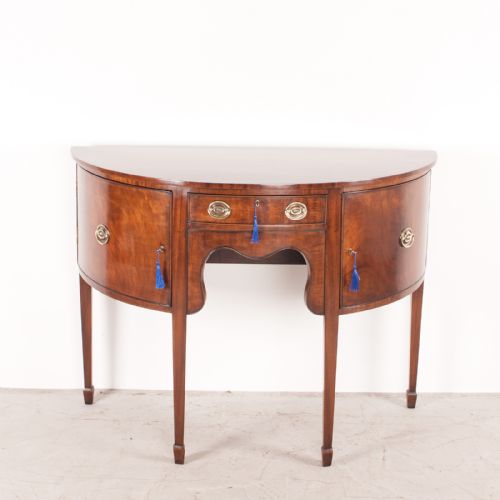


Demi Lune Sideboard
A demi lune sideboard offers a curved, half-moon silhouette designed to anchor a dining room or hallway with classical proportion and compact storage.
Demi Lune Sideboard
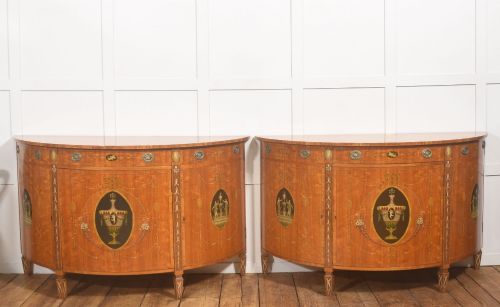
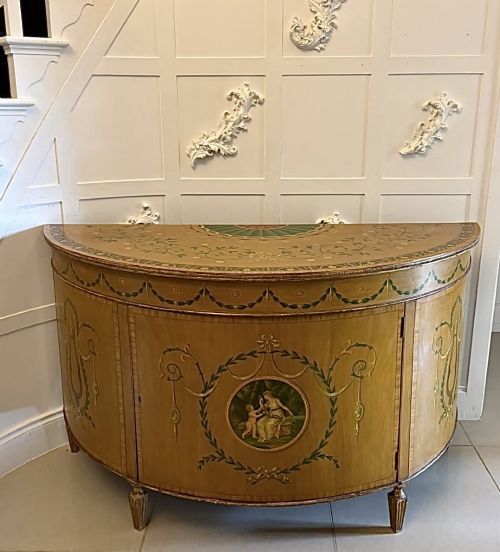
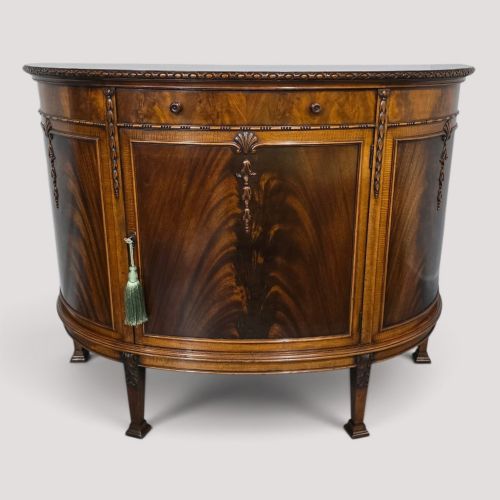
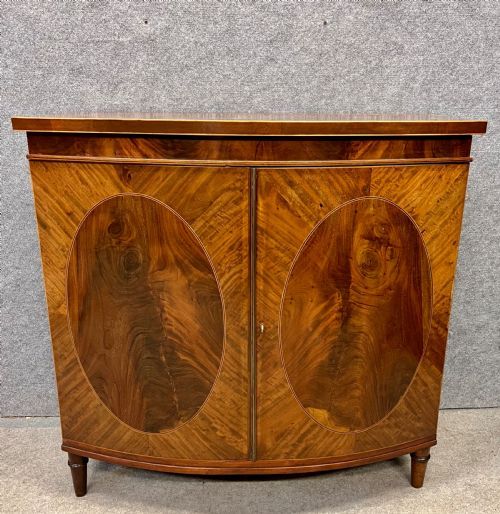
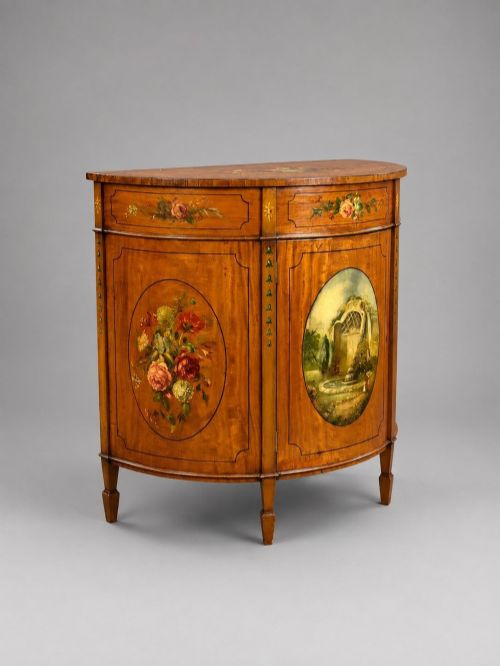
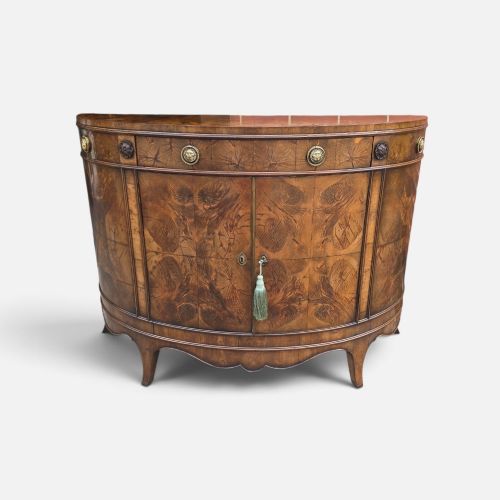
A demi lune sideboard appears most frequently in forms ranging from Georgian and George III origins through to Edwardian and Sheraton Revival interpretations. These half-moon cabinets function as sideboards, commodes, and side cabinets, fitting flush against a wall while projecting a softened curved front.
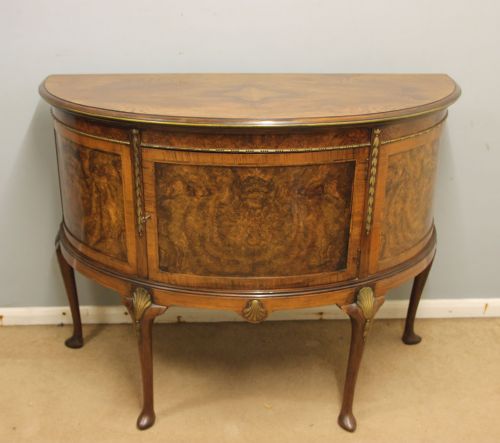
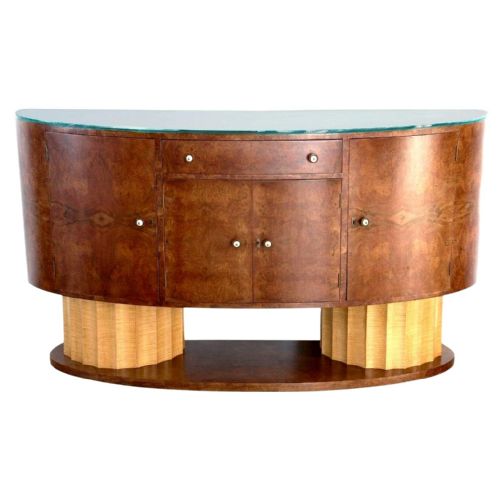
The pieces seen here span the eighteenth century up to the art deco era of the 1930s, encompassing English, French, and Italian workshops. Buyers encounter mahogany and satinwood structures alongside burr walnut and decorated painted panels.
Edwardian and revival iterations dominate the selection, offering accessible interpretations of earlier neoclassical designs with delicate inlay work. Earlier eighteenth-century examples provide deeper patination and timber figuring for formal interior settings.
Materials and construction
Cabinetmakers constructed these semicircular frames using solid timbers such as mahogany, oak, and walnut, frequently applying fine veneers of satinwood, burr elm, and burr yew. The curved geometry required specialist bending techniques and precise framing to support the sweeping top surfaces.
Decoration relied heavily on marquetry and satinwood inlay, incorporating classical motifs, painted panels, and brass mounts. Marble tops appear on specific specimens, while tambour doors and fitted drawers provide functional interior storage within the restricted radius.
Demi Lune Sideboard Retail Price Guide 2026
Typical asking prices for demi lune sideboard among the pieces listed under this phrase on Sellingantiques today, from the lower quarter to the upper quarter. They describe what is for sale here now, not the wider market.
Listings feature mahogany, satinwood, and walnut timbers, with periods stretching from the eighteenth century through to art deco revival pieces.
Design integrity and execution
Quality rests upon the precision of the curved joinery and the selection of figured veneers used across the sweeping top and front panels. Superior examples exhibit tightly matched grain patterns, crisp marquetry, and well-executed brass hardware rather than stamped or mass-produced embellishments.
The refinement of painted panels and the depth of the timber's natural patina separate standard production pieces from exhibition-grade work. Original interior linings, such as oak drawer boxes, indicate careful regional craftsmanship and longevity.
Hille·Pietro Ferrario
The Demi Lune Sideboard Glossary
- Demi-lune
- Half-moon shape. This French term describes furniture with a semicircular front and a flat back designed to stand against a wall.
- Marquetry
- Decorative veneer work. Craftsmen arrange thin slices of coloured wood to form pictorial or geometric patterns on the cabinet surface.
- Commode
- Low storage cabinet. The term frequently applies to formal decorative chests featuring drawers or doors.
- Tambour
- Sliding wooden shutter. Thin slats glued to a canvas backing allow doors to curve around the semicircles of the cabinet.
- Satinwood
- Luminous hardwood. This timber yields a pale, golden-yellow surface favoured in neoclassical and revival furniture design.
Demi Lune Sideboard: Frequently Asked Questions
Where should a demi lune sideboard be placed?
These curved cabinets suit hallways, dining rooms, and drawing rooms where a traditional rectangular sideboard projects too far into the floor space.
The shallow profile provides a surface for lamps and decorative objects without obstructing household movement.
How do you date a demi lune sideboard?
Dating relies on examining the secondary timbers inside the drawers, the style of the inlay, and the construction methods used for the curved frame.
Eighteenth-century pieces typically feature hand-cut dovetails and native oak linings, whereas Edwardian revival items display more uniform machine-sawn elements.
What is the difference between a commode and a sideboard?
A commode generally refers to a decorative chest of drawers with a finished top, often associated with French or neoclassical cabinetmaking.
A sideboard is traditionally longer and designed specifically for dining room service, though the terms overlap frequently in half-moon furniture.
Are marble top demi lune cabinets practical?
Marble surfaces provide a durable, heat-resistant top that tolerates serving dishes, drinks, and daily decorative use.
These heavy stone slabs rest directly on the wooden framing, adding substantial weight and a distinct neoclassical aesthetic.