




Half Moon Cabinet
A half moon cabinet offers a flat back to hug the wall and a curved front that softens a room.
Half Moon Cabinet
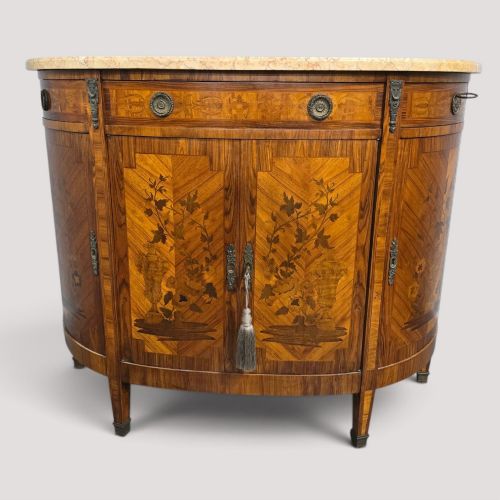
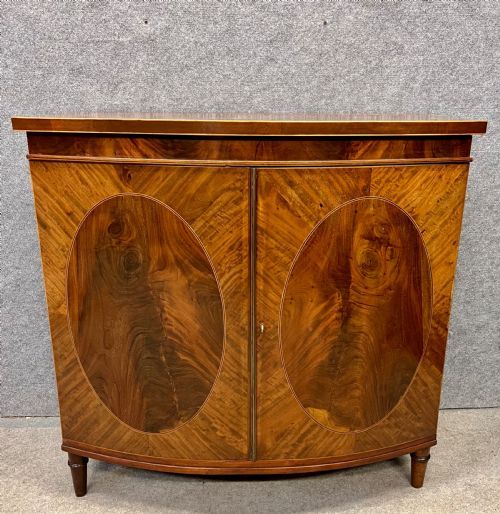
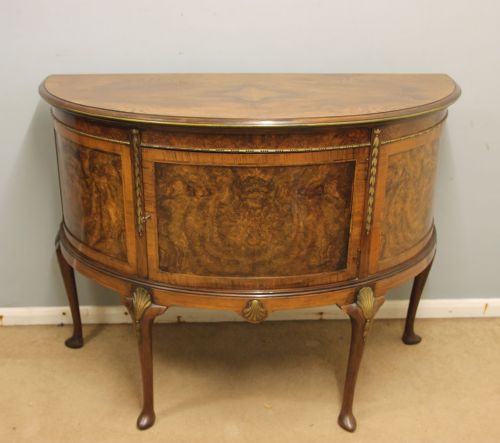
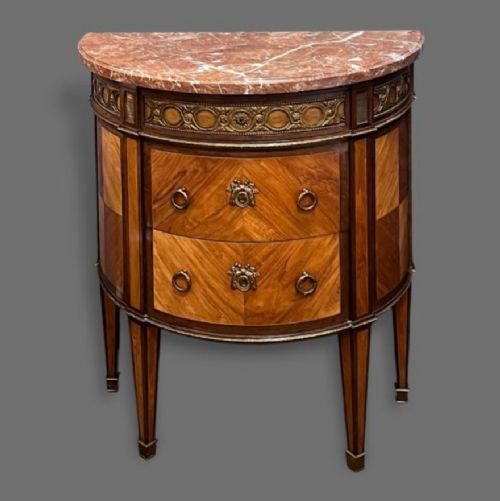
A half moon cabinet is designed to fit flush against a wall while presenting a curved, semicircular front to the room. When you search for a half moon cabinet, you encounter side cabinets, commodes, and console tables spanning from the eighteenth century through the twentieth century.
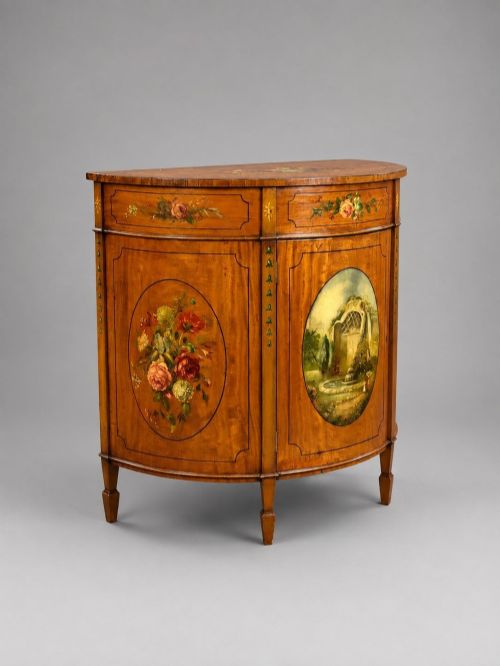
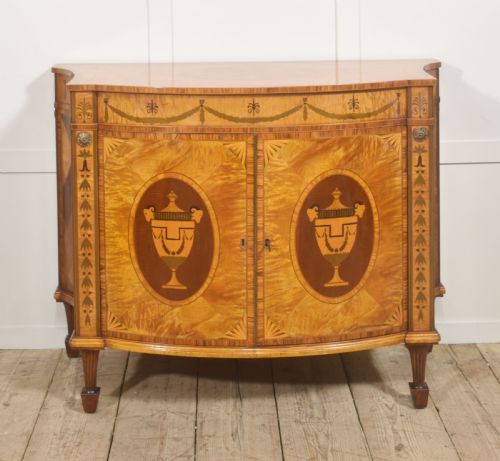
The pieces on this page appear in various timber veneers and painted finishes, often adopting styles such as Sheraton Revival, Edwardian, and Neoclassical. These items function practically as storage or display surfaces while taking up less visual weight than rectangular furniture.
Most examples you meet are either Edwardian satinwood pieces or nineteenth-century French marquetry items, alongside earlier Georgian commodes. They serve as focal points in hallways, drawing rooms, or dining spaces where depth is limited.
Materials and construction
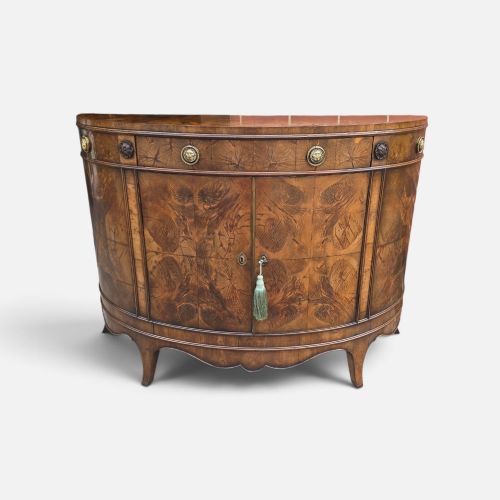
Cabinet makers constructed the curved carcase of a half moon cabinet using layered timber or shaped framing to support delicate veneers. Satinwood, mahogany, walnut, and yew wood provide the primary surfaces, frequently enhanced by boxwood stringing and floral marquetry.
Many French and English examples incorporate marble tops, brass mounts, and hand-painted panels alongside traditional joinery. Tambour doors and glazed display sections appear on specific forms, requiring precise fitting to follow the radius of the curve.
Listings feature satinwood, mahogany, walnut, and marble across styles from eighteenth-century Georgian to twentieth-century revival.
Judging quality in semicircular furniture
Quality rests upon the selection of timber veneers and the precision of the marquetry inlay across a curved surface. Master craftsmen ensured that grain patterns matched symmetrically and that stringing followed the radius without buckling.
The integration of secondary materials such as figured burr woods, heavy marble slabs, and finely chased brass hardware separates standard production from exceptional pieces. Structural integrity in the legs and the smooth action of curved drawers or doors indicate superior workshop standards.
James Hicks·Pietro Ferrario·Kaufman
The Half Moon Cabinet Glossary
- Demi-lune
- A French term meaning half-moon, describing furniture with a semicircular shape and a flat back. This term frequently appears interchangeably with half moon in historical listings.
- Marquetry
- The art of applying pieces of veneer to a structure to form decorative patterns and pictures. Craftsmen utilise contrasting timbers like satinwood and boxwood to achieve detailed motifs.
- Commode
- A decorative chest of drawers or cabinet originating in France. These pieces often feature marble tops and elaborate painted or inlaid surfaces.
- Stringing
- Thin lines of contrasting wood inlaid into the surface of furniture to create a border. It defines the edges and geometric panels on revival and Georgian pieces.
- Sheraton Revival
- A late nineteenth and early twentieth century style inspired by the neoclassical designs of Thomas Sheraton. It relies heavily on satinwood, painted details, and classical symmetry.
Half Moon Cabinet: Frequently Asked Questions
Where should I place a half moon cabinet?
These cabinets suit narrow spaces like hallways, landings, or entryways because their flat backs allow them to sit flush against the wall while the curved front projects less into traffic paths.
They also work effectively in living rooms or dining rooms as serving surfaces or display pieces beneath a mirror or painting.
What is the difference between a demi-lune and a half moon cabinet?
There is no functional difference, as demi-lune is simply the French term for half-moon. Both describe furniture built with a flat rear edge and a semicircular front.
English makers often used the English translation in descriptions, while continental pieces or revival styles more frequently retain the French designation.
How do I identify a Georgian piece from a revival piece?
Georgian pieces from the eighteenth century display structural ageing, hand-cut secondary timbers, and construction methods characteristic of pre-industrial workshops. The patination on the wood develops a deep, organic warmth over centuries of use.
Revival pieces, such as those from the Edwardian era or the early twentieth century, utilise machine-sawn elements and standardised hardware even when employing traditional hand-inlay techniques.
Can I use a half moon cabinet for storage?
Yes, many variations include cupboards, drawers, or commode interiors designed to hold tableware, linens, or household items. Display variants feature glass doors intended for porcelain and glassware.
Because the internal depth varies due to the curved shape, the storage space accommodates smaller items more readily than bulky objects.