


Painted Satinwood Commode
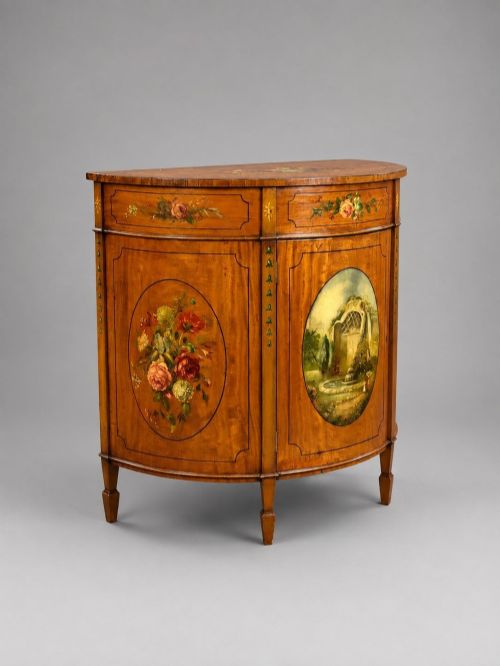
A painted satinwood commode brings luminous timber and delicate classical motifs into a room, offering both surface display and refined storage.
Painted Satinwood Commode
When you search for a painted satinwood commode, you encounter sophisticated case furniture designed primarily during the nineteenth and early twentieth centuries. These pieces span the Victorian, Edwardian, and 1930 periods, reflecting sustained enthusiasm for earlier neoclassical design principles.
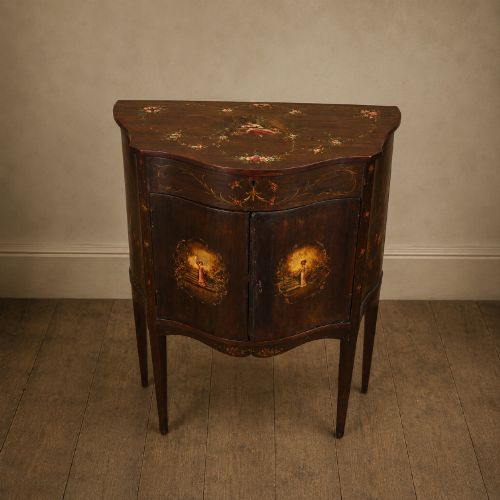
The dominant forms on this page are demi-lune cabinets, serpentine chests of drawers, and bowed side cabinets. Makers of these works drew heavily upon Sheraton Revival and Adam Revival idioms, favouring curved facades that showed off figured timber and painted decoration.
Origins range from British revival workshops to French cabinet makers, yielding side cabinets and commodes that functioned as decorative focal points in drawing rooms and principal bedchambers. Most examples date from the nineteenth century through to about 1900, with occasional later interpretations.
How they were made
Construction relies upon a foundation of timber such as mahogany, faced with satinwood veneers to create a lustrous, golden ground. Cabinet makers shaped these woods into curved demi-lune and serpentine profiles that required precise joinery.
Surfaces received hand-painted detail and hand-painted enamel, often depicting classical panels, swags, and urns. Brass hardware such as handles and escutcheons completed the construction, complementing the painted and polished surfaces.
Listings here feature Edwardian, Victorian, and 1930 periods, constructed from satinwood, mahogany, and timber with hand-painted enamel details.
What varies in quality
Quality rests significantly upon the fineness of the hand-painted detail and the selection of the satinwood veneer. Finer examples display crisp classical panels and harmonious proportions, whereas simpler pieces rely on more mechanical or sparse decoration.
The architectural form itself dictates distinction, with serpentine and demi-lune shapes demanding complex cabinet work. The integration of brass mounts and the preservation of the original painted surface further separate standard production from exceptional revival works.
Wright and Mansfield
The Painted Satinwood Commode Glossary
- Satinwood
- A dense, lustrous timber native to the tropics, prized for its golden, reflective sheen that mimics satin. It served as the primary veneer for late eighteenth-century revival furniture.
- Demi-lune
- A half-moon shape used for the plan of commodes and side cabinets. This curved profile allowed furniture to sit flush against a wall while offering a softer silhouette.
- Serpentine
- A cabinet front featuring a concave centre flanked by convex curves, or the reverse. Executing this flowing line required considerable skill from the cabinet maker.
- Sheraton Revival
- A late nineteenth-century design movement inspired by the furniture forms of Thomas Sheraton. It is characterised by neoclassical restraint, painted satinwood, and tapered legs.
- Adam Revival
- A decorative style looking back to the neoclassical interiors of the Adam brothers. It incorporates classical motifs such as urns, husks, and delicate painted panels.
Painted Satinwood Commode: Frequently Asked Questions
What is a painted satinwood commode?
A painted satinwood commode is a decorative cabinet or chest featuring a golden satinwood veneer adorned with hand-painted classical motifs. These pieces typically date from the nineteenth and early twentieth centuries.
They combine practical storage with refined artistic surfaces, serving as focal points in period interiors.
Where were these commodes used?
Historically, these cabinets stood in formal drawing rooms, parlours, or principal bedchambers where hosts entertained guests. Their finished backs and curved facades allowed them to occupy prominent wall spaces.
Today, they function similarly in domestic interiors, holding lamps, porcelain, or linens while displaying their painted panels.
How do I distinguish revival periods?
Sheraton Revival and Adam Revival pieces borrow design vocabulary from the eighteenth century but were manufactured decades later. Examining the secondary timbers, construction methods, and hardware helps clarify the true age.
Most examples on this page reflect Victorian and Edwardian interpretations of these classical styles.
How should I care for painted satinwood?
Satinwood and delicate painted details require gentle maintenance away from direct sunlight and heat sources. Sunlight can fade the golden tones of the timber and alter the hand-painted enamel.
Dusting with a soft, dry cloth is generally sufficient to preserve the polished and painted surfaces over time.