




Demi Lune Commode
A demi lune commode brings architectural curve and refined timber to a hallway or drawing room.
Demi Lune Commode
A demi lune commode offers a distinctive half-moon silhouette designed to sit flat against a wall while saving floor space. These pieces function as decorative side cabinets, console tables, or bedside chests across various historical periods.
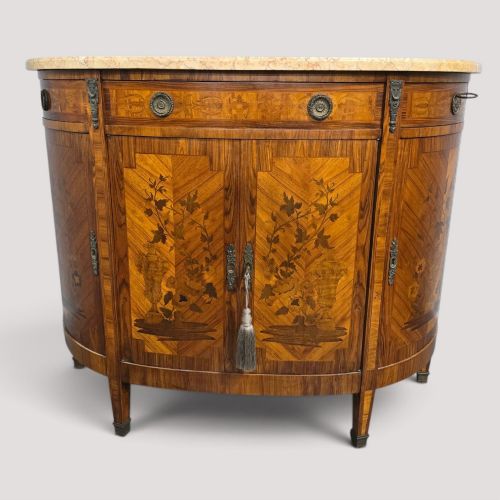
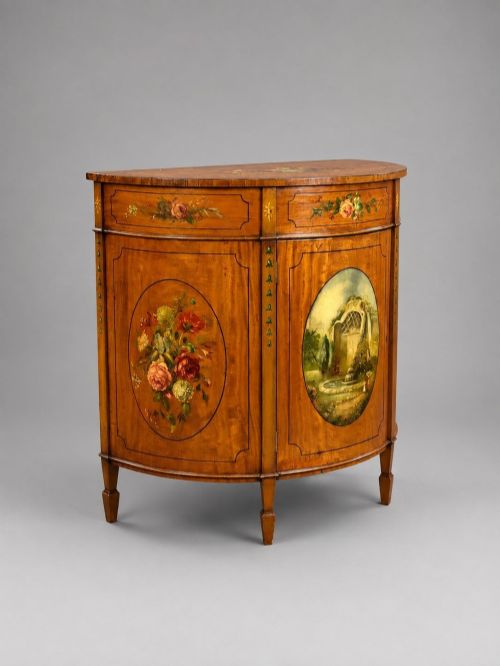
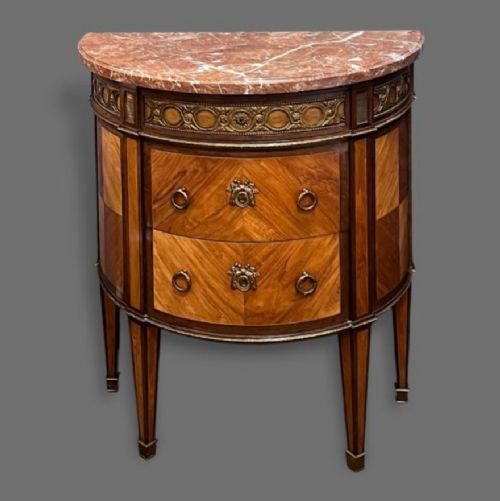
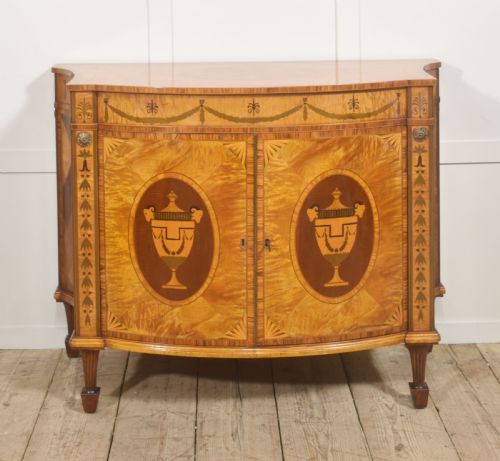
The version most commonly met on this page is the satinwood or mahogany revival piece, often detailed with marquetry inlay or painted classical panels. Eighteenth-century originals in burr elm or mahogany also appear alongside French marble-topped variants.
Proportions range from compact bedside petit commodes to substantial exhibition pieces intended for grand reception rooms. Each iteration retains the signature curved front that defines the form.
Materials and Construction
Cabinetmakers constructed the curved carcase using flexible underlying timbers faced with choice veneers such as satinwood, burr walnut, mahogany, and burr yew wood. Marquetry inlay and boxwood stringing frequently articulate the semicircular top and front panels.
Slab marble tops in white or coloured varieties provide a durable and decorative surface on many continental and English examples. Hand-painted classical motifs and floral swags adorn the satinwood surfaces of Edwardian and revival pieces.
Brass handles and mounts complete the hardware, following the neoclassical or Louis XVI taste for symmetry and restrained ornamentation.
Listings feature satinwood, mahogany, and burr walnut alongside decorative paint and marble tops.
Judging Quality
The distinction between ordinary and exceptional work lies in the precision of the veneer matching along the tight curve of the frame. Superior examples display seamless marquetry where timber grains flow naturally around the semicircular perimeter.
Painted decoration reveals the hand of a skilled artist through fine brushwork and balanced composition, whereas lesser pieces rely on mechanical transfer or stiff execution. Drawer linings in secondary timbers such as oak or pine indicate the care taken with internal construction.
Pietro Ferrario·Cowtan and Sons·Druce and Co·Maple and Co·Waring and Gillow
The Demi Lune Commode Glossary
- Demi-lune
- A half-moon shape characteristic of tables and cabinets built with a flat back and a curved front. This outline allowed furniture to hug the wall closely in narrow spaces.
- Marquetry
- The art of forming decorative patterns by fitting together small pieces of wood veneer of different colours and grains. It differs from inlay by assembling the pattern across the entire surface before application.
- Satinwood
- A durable hardwood prized for its golden yellow sheen and lustrous grain, widely utilised in eighteenth-century and revival furniture. It accepts paint and marquetry with distinct clarity.
- Neoclassical
- A style drawing inspiration from classical antiquity, featuring urns, swags, and strict symmetry. This aesthetic dominated late eighteenth-century design and later revival periods.
- Commode
- A low chest of drawers or cabinet developed in France and adopted throughout Britain for domestic storage. The term covers both formal drawing-room pieces and bedside tables.
Demi Lune Commode: Frequently Asked Questions
Where should I place a demi lune commode?
These cabinets suit hallways, entrance foyers, and narrow landings where a rectangular chest might obstruct foot traffic. Their curved profile softens rigid corners in a dining room or drawing room.
They also function effectively as bedside tables or console surfaces beneath a wall mirror.
How do I care for a marble top?
Wipe marble surfaces with a soft, damp cloth and neutral soap to avoid scratching the polished stone. Acidic liquids such as wine or citrus juice can etch the surface if left unattended.
Apply a specialist stone wax periodically to preserve the sheen and protect against staining.
Are these pieces suitable for daily use?
Period cabinets provide practical storage within drawers and cupboards, though antique timbers require gentle treatment. Avoid placing them in direct sunlight or beside heat sources to prevent veneer shrinkage.
Routine dusting with a dry lint-free cloth keeps the polished finish in stable condition.
How can I tell an eighteenth-century piece from a revival?
Examination of internal secondary timbers, hand-cut dovetails, and the natural ageing of the varnish help indicate the true period. Eighteenth-century pieces show authentic wear patterns and construction methods specific to their era.
Revival furniture from the Edwardian or late Victorian periods often utilises machine-sawn elements alongside period revival styling.