


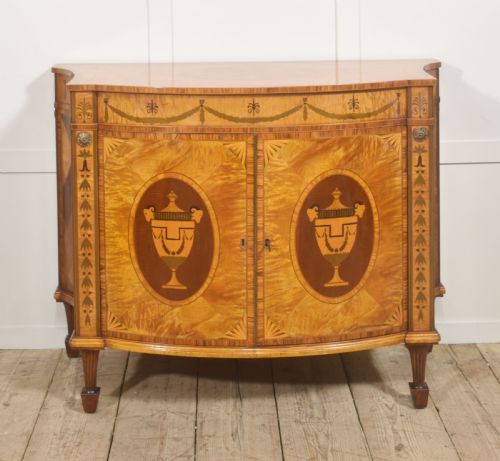


Demi Lune Cupboard
A demi lune cupboard offers a curved crescent profile that fits neatly against a wall while bringing refined storage to a room.
Demi Lune Cupboard
A demi lune cupboard presents a distinct half-moon shape designed to economise on space without sacrificing surface area or presence. Buyers pursuing a demi lune cupboard encounter various configurations ranging from compact bedside tables and commodes to larger display cabinets and sideboards.
The selection spans several centuries and revival movements, with Edwardian and early twentieth century interpretations appearing alongside eighteenth and nineteenth century pieces. Makers adapted this graceful silhouette across multiple traditions, creating versatile items suited for hallways, living rooms and bedrooms.
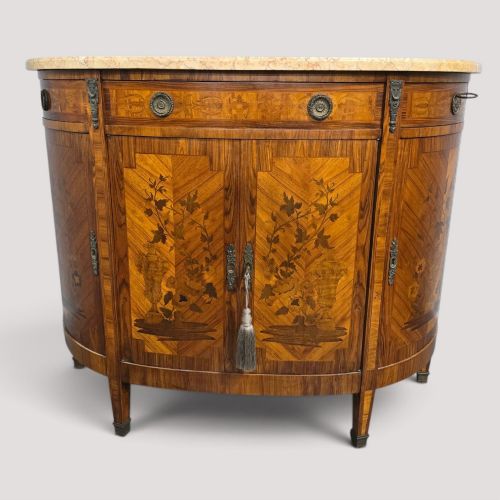
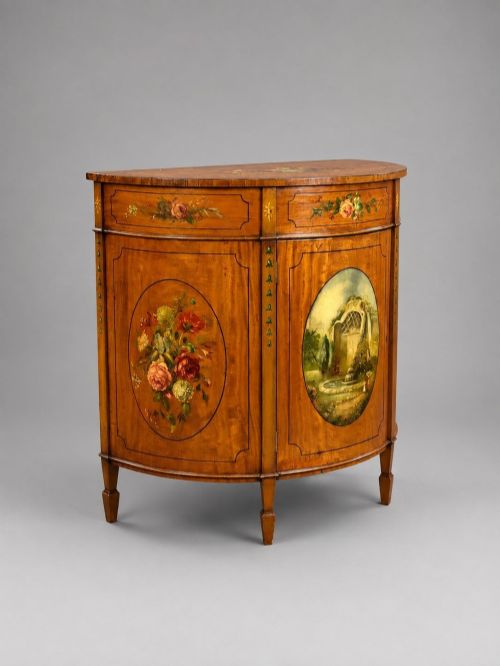
Surviving examples showcase a variety of functional designs, including tambour front cupboards, glazed display enclosures and open console tables. Walnut, mahogany and satinwood form the backbone of these pieces, often enhanced by decorative painting or marquetry.
Materials and Construction Methods
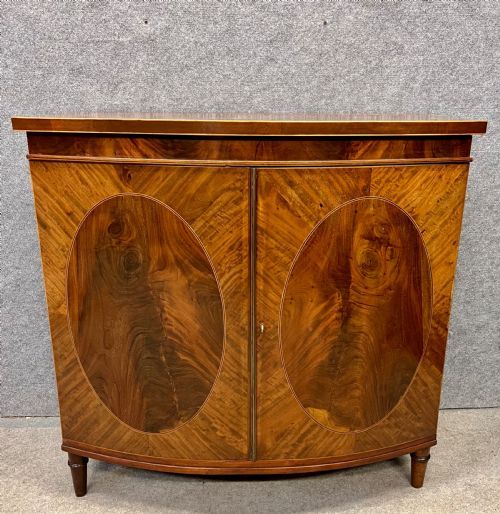
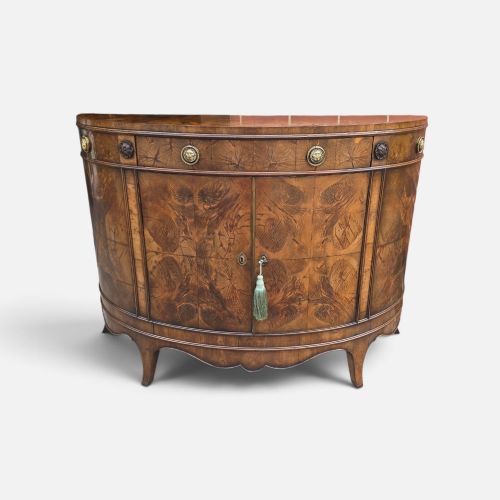
Cabinetmakers constructed these crescent carcases using dense timbers such as mahogany, walnut and yew, frequently applying fine satinwood veneers to the curved surfaces. Boxwood stringing and intricate marquetry details add linear definition and contrast to the main body of the furniture.
Many items incorporate contrasting elements like marble tops for added durability and luxury, alongside cast brass feet and handles. Painted finishes and classical panels appear on numerous satinwood and French pieces, demonstrating skilled brushwork across curved wooden panels.
Some tambour front cupboards roll their wooden shutters entirely out of sight, proving that nineteenth-century desks had nothing on clever curved storage.
Qualities That Separate the Fine from the Ordinary
The sophistication of the timber figure and the precision of the veneer work dictate the visual hierarchy among these crescent cabinets. Finer items display meticulously matched burr elm, burr yew or figured mahogany that follows the sweeping radius of the frame without buckling.
Execution of decorative details marks the difference between standard production and master craftsmanship. Crisp marquetry inlay, hand-painted classical panels and heavy marble slabs signify superior workmanship compared to simpler veneered alternatives.
Pietro Ferrario
The Demi Lune Cupboard Glossary
- Demi-lune
- A half-moon or crescent shape applied to tables, commodes and cabinets designed to stand flush against a wall.
- Marquetry
- Decorative patterns formed by fitting together thin veneers of wood, shell or ivory onto a structural carcase.
- Tambour
- A flexible shutter made of narrow vertical strips of wood glued to canvas, allowing curved doors to slide open smoothly.
- Commode
- A low standing cabinet or chest of drawers, often highly decorative and standing on relatively tall legs.
- Stringing
- A narrow strip of contrasting wood inlaid into the surface of furniture to create a fine border or outline.
Demi Lune Cupboard: Frequently Asked Questions
Where should I place a demi lune cupboard?
These crescent pieces fit comfortably in narrow hallways, tight corners or against flat walls where a rectangular cabinet might protrude too far into the floor space.
Their shallow depth makes them practical surfaces for lamps and decorative objects without obstructing household traffic.
How do I identify a Sheraton Revival piece?
Sheraton Revival furniture from the late nineteenth and early twentieth centuries mimics the lighter proportions and neoclassical ornamentation popular in the eighteenth century.
Look for satinwood veneers, painted classical panels, tapered legs and delicate boxwood stringing.
What is the difference between a commode and a side cabinet?
A commode typically refers to a low chest of drawers or a cabinet with door enclosures, often built with high decorative ambition for formal reception rooms.
Side cabinets and credenzas serve broader storage functions, sometimes incorporating glazed display areas or open shelving alongside enclosed cupboards.
Are marble tops original to these cabinets?
Marble tops frequently appear on continental European commodes and console tables, providing a durable and cool surface for serving or display.
British examples more commonly feature polished timber tops, though marble inserts do occur on specific neoclassical and French revival pieces.