
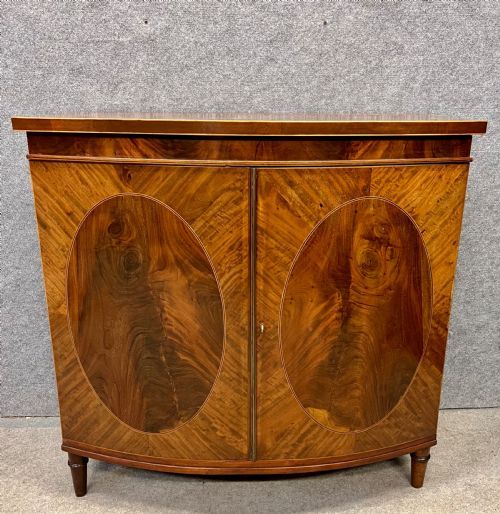


Mahogany Demi Lune Cabinet
A mahogany demi lune cabinet offers a graceful curved silhouette that fits neatly against a wall, combining useful storage with refined decorative presence.
What They Are
A mahogany demi lune cabinet provides a semicircular profile designed to stand flush against a wall while saving floor space in a hallway or drawing room. These pieces appear in forms ranging from console tables and sideboards to commodes and display cabinets.
The pieces on this page span the eighteenth century, nineteenth century, and early twentieth century, incorporating later revivals. Buyers frequently encounter Edwardian interpretations alongside robust George III period examples and Continental designs.
Origin and stylistic influence vary across the selection, featuring Louis XVI style, Neo-Classical, Sheraton Revival, and Dutch Neoclassical aesthetics. Each era brings distinct proportions and decorative vocabulary to the half-moon shape.
How They Were Made
Cabinet makers utilised solid mahogany and flame mahogany veneers applied to structural carcasing, often selecting timber with rich figuring for prominent surfaces. Construction methods involve curved rails and bespoke framing to achieve the distinctive half-circle geometry.
Surface enrichment relies on detailed embellishments including brass fittings, satinwood and boxwood stringing, and elaborate marquetry inlay. Certain Continental pieces incorporate marble tops and tambour front elements requiring precise joinery.
Retail Price Guide 2026
Typical UK retail prices for mahogany demi lune cabinet, calculated from the Sellingantiques database of over a million retail prices indexed since 2003. This retail price guide relies exclusively on Sellingantiques data; no external sources or auction records are used, so the figures do not describe the wider market.
The inventory includes examples featuring satinwood inlay, brass feet, and marble tops across eighteenth and nineteenth-century periods.
What Varies in Quality
The grade of the timber and the selection of veneer figure dictate much of the visual distinction between examples. Superior pieces display carefully matched grain patterns that follow the curve of the semicircular top without interruption.
The refinement of the decorative inlay and the execution of brass mounts reveal the maker's hand. Higher-end work demonstrates crisp floral marquetry, precise crossbanding, and well-balanced proportions that elevate the piece beyond standard utility.
Maple & Co
The Mahogany Demi Lune Cabinet Glossary
- Demi lune
- Half-moon shape in plan, describing furniture designed with a flat back and a curved front.
- Marquetry inlay
- Decorative patterns formed by fitting small pieces of varied coloured wood veneer into a prepared ground.
- Commode
- A decorative low cabinet or chest of drawers, often used in principal reception rooms.
- Tambour
- Flexible sliding shutter formed of narrow vertical strips of wood glued to canvas.
- Crossbanded
- Bordered with a strip of veneer laid across the grain to frame the central panel.
Frequently Asked Questions
Where should I place a demi lune cabinet?
The flat back allows these cabinets to sit flush against a wall, making them well suited for narrow hallways, landings, or smaller reception rooms where floor space is limited.
Their shallow depth provides a surface for lamps or ornaments without obstructing walkways, while the internal shelving holds tableware or books.
How do I care for mahogany surfaces?
Protect the wood from direct sunlight to prevent the rich reddish-brown tones from fading over time. Regular dusting with a soft, dry cloth maintains the finish.
Avoid placing damp items directly on the polished surface and apply traditional beeswax sparingly when the timber appears dry.
What is the difference between a commode and a side cabinet?
A commode typically refers to a low decorative cabinet featuring drawers or doors, originating from French furniture traditions. Side cabinets often include glass panels for display or internal shelves for storage.
Both share the same semicircular footprint but serve different interior functions depending on whether display or enclosed storage is preferred.
How can I tell an eighteenth century piece from a later revival?
Early pieces from the Georgian or Dutch Neoclassical periods show hand-cut joinery, native timber framing, and ageing consistent with daily use over centuries. Revivals from the Edwardian era or the nineteen-twenties often employ machine-cut elements and standardised hardware.
Examining the secondary woods inside the carcass and the nature of the drawer linings helps clarify the true age of the construction.