
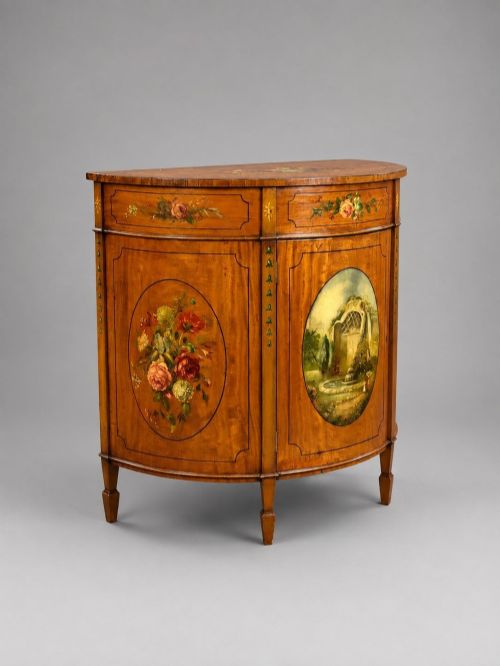
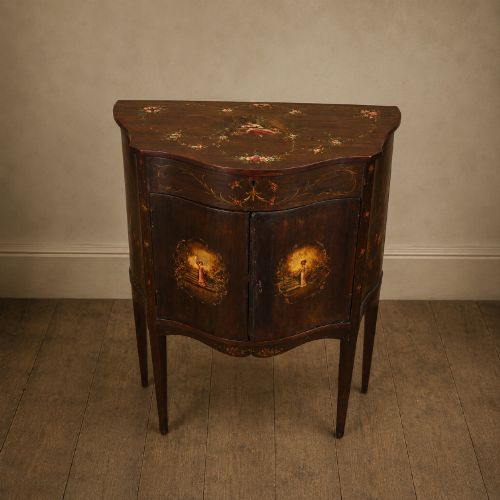
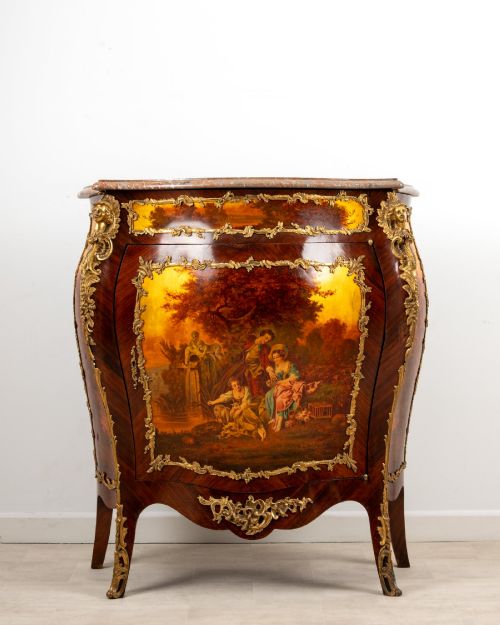


Hand Painted Commode Cabinet
A hand painted commode cabinet brings vibrant colour and decorative charm to a room, offering surface space and enclosed storage.
Hand Painted Commode Cabinet
When you search for a hand painted commode cabinet, you encounter a diverse selection of storage furniture ranging from serpentine side cabinets and demi-lune shapes to chests of drawers and cupboards. These pieces bridge utility and ornamentation, serving as focal points in hallways, bedrooms, and reception rooms.
The pieces listed here span several centuries and stylistic revivals, with particular emphasis on Sheraton Revival satinwood designs, French Louis XV styles, and vernacular painted pine pieces. You will find items originating from England, France, Holland, Hungary, and Venice, showing both refined cabinetmaking and rustic folk traditions.
Forms vary from curved bombé profiles with marble tops to upright cupboards and low chests, all unified by hand-applied decoration. Whether finished in pale cream, Swedish grey, or intricate lacquerwork, each item provides functional storage alongside distinct artistic character.
How they were made
Makers utilised a variety of woods as foundations for painted decoration, employing fine timbers such as satinwood, mahogany, and kingwood alongside structural pine and ash. Solid carcases and curved panels provided the stable canvases necessary for detailed brushwork and lacquering.
Decoration was applied directly to the wood or over prepared grounds using oil or water-based paints, frequently enhanced with japanning, Vernis Martin techniques, or delicate floral motifs. Ormolu mounts, brass handles, and shaped marble tops were integrated to elevate the more formal French and revival pieces.
Listings feature materials including satinwood, kingwood, mahogany, pine, and marble, spanning the eighteenth, nineteenth, and early twentieth centuries.
What varies in quality
The distinction between ordinary and exceptional pieces lies in the execution of the painted surface and the refinement of the underlying cabinetry. Skilled brushwork, sophisticated colour harmony, and well-proportioned woodwork elevate a piece far beyond standard decorative items.
Material selection and hardware integration also dictate grade, with matched timber veneers, fire-gilt or quality brass mounts, and heavy slab marble tops marking out the upper tier of French and Sheraton Revival production.
The Hand Painted Commode Cabinet Glossary
- Demi-lune
- A half-moon shape in furniture design. Cabinets and commodes with this profile fit flat against a wall while projecting a curved front.
- Vernis Martin
- A simulated Japanese lacquer technique developed in eighteenth-century France. It involves multiple layers of varnish to create a translucent, luminous surface.
- Ormolu
- Gilded bronze mounts used for decorative enrichment on furniture. It appears frequently on French and revival pieces from the nineteenth century.
- Japanning
- A European imitation of East Asian lacquerwork. Craftsmen built up layers of varnish and applied painted or gilded motifs onto wood.
- Serpentine
- A furniture contour featuring a wavy line. The front curves outward in the centre and inward at the sides, or vice versa.
Hand Painted Commode Cabinet: Frequently Asked Questions
Where should I place a painted cabinet?
These cabinets suit hallways, living rooms, and bedrooms where their decorative surfaces can be appreciated. Their storage capacity makes them practical for stashing smaller items while displaying lamps or ornaments on top.
Because they range from compact demi-lune shapes to larger chests, measure your available wall space carefully before choosing a specific form.
How do I identify a revival piece?
Revival items, particularly those from the nineteenth and early twentieth centuries, emulate earlier eighteenth-century designs such as Sheraton or Louis XV styles. Look at the construction methods, timber choice, and wear patterns to help determine the actual age.
Many pieces on this page date from the Edwardian era or around nineteen hundred, capturing historical aesthetics using contemporary manufacturing techniques of their day.
What is the difference between a commode and a side cabinet?
A commode traditionally refers to a low chest of drawers or a cabinet with doors, originating as a formal French furniture form. Side cabinets and cupboards offer similar enclosed storage but can take taller, narrower upright proportions.
Both terms frequently overlap in antique descriptions, so focus on the specific dimensions and internal layout of the piece rather than the label alone.
Are painted finishes original?
Some pieces retain their original eighteenth or nineteenth-century paintwork or lacquer, while others have been redecorated by hand at a later date in decorative colours such as Swedish grey or pale cream. Listings specify whether decoration is original or renewed.
Examine the integration of the paint with the underlying wood to understand the history of the surface finish.