
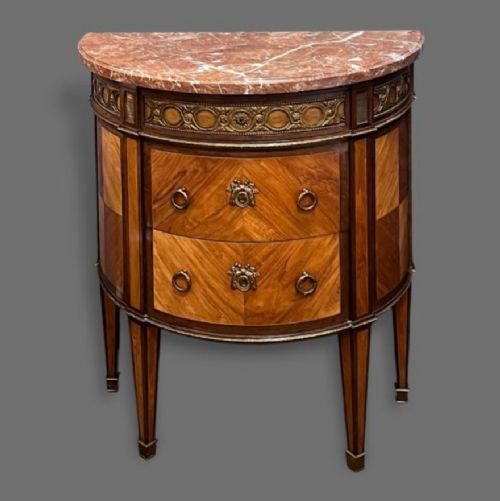

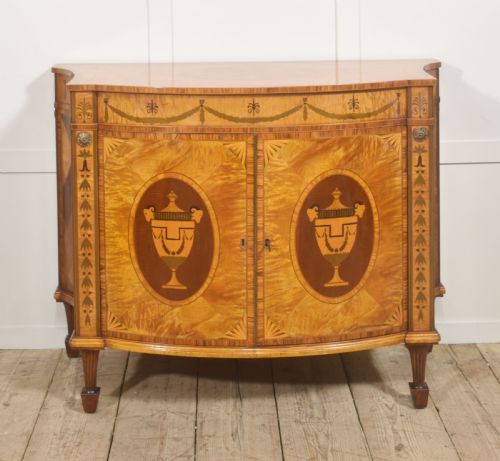


Neoclassical Demi Lune Cabinet
These neoclassical demi lune cabinet pieces bring curved elegance and classical proportion to a room, offering both refined display space and useful storage.
Neoclassical Demi Lune Cabinet
A neoclassical demi lune cabinet presents a distinctive semicircular footprint designed to sit flat against a wall, making it a versatile choice for entrance halls and principal reception rooms. When searching for a neoclassical demi lune cabinet, buyers encounter forms ranging from sophisticated side cabinets and commodes to sophisticated sideboards and display cabinets.
The pieces on this page emerge from several distinct periods, spanning the Georgian and Victorian eras alongside the early twentieth century revival movements. Stylistic influences draw heavily on Sheraton Revival, French Louis XVI, and Dutch Neoclassical traditions, combining architectural restraint with delicate decorative motifs.
How they were made
Cabinetmakers constructed these semicircular carcases using substantial timbers such as mahogany, walnut, and satinwood, frequently enriched with contrasting boxwood stringing and elaborate marquetry. Many examples incorporate polished marble tops, while others rely on finely painted decorative surfaces.
Fine brass and gilt bronze mounts appear across various pieces, accentuating key structural lines and drawer pulls. Tambour doors and panelled cupboards demonstrate advanced woodworking techniques required to achieve the smooth curved profile.
What varies in quality
The distinction between standard production and the finest work lies in the precision of the timber matching and the intricacy of the marquetry inlay. Superior examples display seamless curved joints and hand-painted detailing that remains crisp and deliberate across the semicircular surface.
Hardware selection also differentiates the cabinet tiers, with heavier, finely chased gilt bronze mounts indicating superior workshop origins compared to simpler brass fittings.
Pietro Ferrario
The Neoclassical Demi Lune Cabinet Glossary
- Demi-lune
- A half-moon shape characteristic of tables and cabinets designed to stand flush against a wall. This profile became particularly popular during the neoclassical period.
- Marquetry
- The art of applying pieces of veneer to a structure to form decorative patterns and pictorial designs. Cabinetmakers used contrasting timbers like satinwood and boxwood to achieve tonal depth.
- Tambour
- Flexible strips of wood glued to a canvas backing to form sliding doors that can navigate a curved track. This technique allowed access to enclosed spaces without swinging doors.
- Commode
- A low chest of drawers or cabinet originating in France. In a neoclassical context, these pieces often feature marble tops and painted finishes.
Neoclassical Demi Lune Cabinet: Frequently Asked Questions
Where should I place a demi-lune cabinet?
These semicircular pieces suit narrow hallways, landings, or reception rooms where a standard rectangular cabinet would project too far into the floor space.
Their shallow depth provides a surface for lamps and decorative objects without obstructing movement through the room.
How do I identify a Sheraton Revival piece?
Sheraton Revival furniture dates from the late nineteenth and early twentieth centuries, drawing inspiration from late eighteenth-century classical designs.
Look for satinwood veneers, painted floral swags, tapered legs, and delicate boxwood stringing.
Are marble tops original to these cabinets?
Many nineteenth-century French and Italian commodes and side cabinets were designed specifically to accommodate fitted marble slabs. These tops added weight, durability, and a cool surface for serving or display.
Plain wooden tops are more typical of English Georgian and later revival pieces.
How do I care for satinwood veneer?
Satinwood requires protection from direct sunlight to prevent the timber from fading and losing its natural golden shimmer.
Dust gently with a dry cloth and avoid silicone-based polishes that can degrade the aged finish over time.