


Japanese Decorative Porcelain Set
A japanese decorative porcelain set brings coordinated colour and traditional pattern into a room, offering matched plates, dishes, or vases shaped for display.
Japanese Decorative Porcelain Set
A japanese decorative porcelain set comprises matched groups of plates, dishes, or vases designed to be displayed together as matching pairs, trios, garnitures, or larger collections. Buyers searching for this phrase encounter pieces dating from the nineteenth century through the early twentieth century, spanning the Edo, Meiji, and later periods.
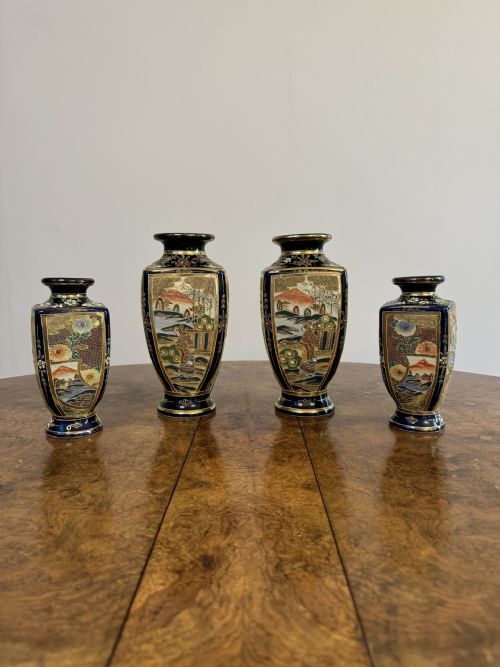
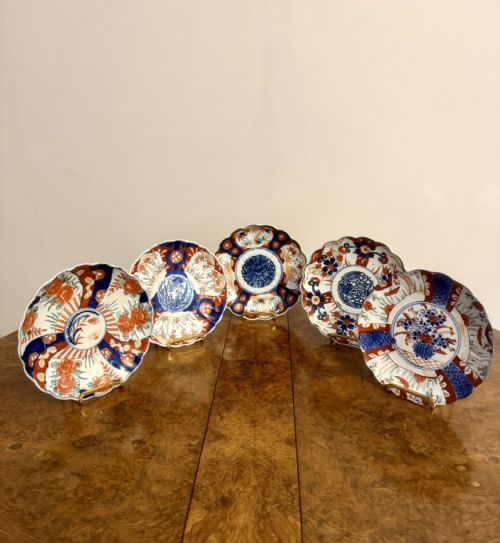
The forms on this page include garnitures of three or four vases, lidded vases, shaped dishes, and plate collections numbering up to fourteen matching items. These sets bring coordinated visual weight to a mantelpiece, cabinet, or wall arrangement through uniform motifs and complementary sizing.
The styles represented in the current selection lean heavily towards Japanese Imari and Satsuma work, alongside Kutani porcelain pieces. Such groupings allow a collector to acquire a complete decorative arrangement in a single purchase rather than piecing together individual items over time.
Materials and construction
The foundation of every piece in these sets is ceramic material, specifically porcelain and earthenware, shaped into plates, dishes, and vessels. Potters then applied glazes to seal the body before adding detailed ornamentation.
Decoration relied on cobalt blue pigments, enamel colours, and gold leaf applied by hand to create the intricate patterns characteristic of Imari and Satsuma wares. Metal elements also appear on certain items to accent the ceramic bodies and lidded vessel mounts.
Listings feature items from the nineteenth century, nineteen hundred, and nineteen thirty, utilising porcelain, earthenware, enamel, gold leaf, and cobalt.
Distinctions in quality
Quality in these sets depends upon the precision of the hand-painted details and the uniformity across the entire group of pieces. Sets that maintain consistency in pattern application, colour saturation, and gilding from the largest vase or plate down to the smallest member command higher regard.
The complexity of the decorative scheme and the crispness of the cobalt and enamel work distinguish finer garnitures and plate collections from simpler production. Preservation of the original gold leaf and enamel surfaces without heavy rubbing also separates superior sets from heavily worn examples.
The Japanese Decorative Porcelain Set Glossary
- Garniture
- A coordinated set of three or more vases designed for symmetrical display on a mantelpiece or cabinet. These groupings typically feature a central larger vessel flanked by matching smaller counterparts.
- Imari
- A traditional style of Japanese porcelain featuring a distinct palette of underglaze cobalt blue, iron red, and gold overglaze. The patterns frequently incorporate floral and brocade motifs.
- Satsuma
- A type of Japanese earthenware characterised by a crackle glaze and ornate polychrome enamel decoration finished with gilding. These pieces often depict figural scenes and dense floral patterns.
- Kutani
- A style of Japanese porcelain known for bold pictorial designs executed in vibrant enamel colours. Green, purple, red, yellow, and blue frequently dominate the palette.
- Meiji Period
- The historical era in Japan spanning from eighteen sixty-eight to nineteen twelve, noted for the production of decorative arts destined for export. Work from this period displays exceptional technical refinement.
Japanese Decorative Porcelain Set: Frequently Asked Questions
What is a garniture set?
A garniture set is a matched group of three, four, or more vases created to be displayed together as an ornamental arrangement. The pieces share identical decorative themes and complementary proportions designed for a mantel or sideboard.
Historically, these sets provided balanced symmetry in formal interiors, with a taller central vessel anchoring shorter companion pieces on either side.
How do Imari and Satsuma differ?
Imari pieces are made of hard porcelain and utilise a palette dominated by cobalt blue, iron red, and gold leaf. Satsuma items are typically earthenware with a distinct crackle glaze beneath detailed enamel paintings.
Imari relies on crisp geometric and floral patterns, whereas Satsuma frequently incorporates figurative scenes and dense, textured ornamentation.
How should I display these sets?
These ceramic sets work best when grouped together on a sturdy mantelpiece, inside a glass-fronted display cabinet, or arranged across a dedicated console table. Keeping the pieces of a set together preserves their intended visual impact and collective symmetry.
Avoid placing them in areas prone to direct sunlight or heavy foot traffic where accidental knocks might damage the enamel or gilding.