

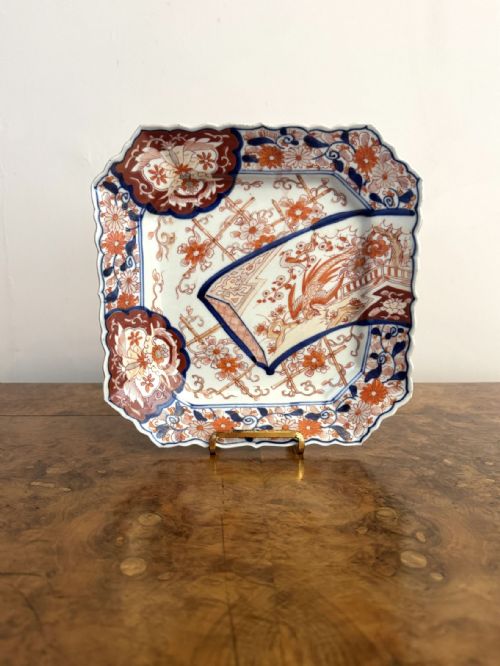


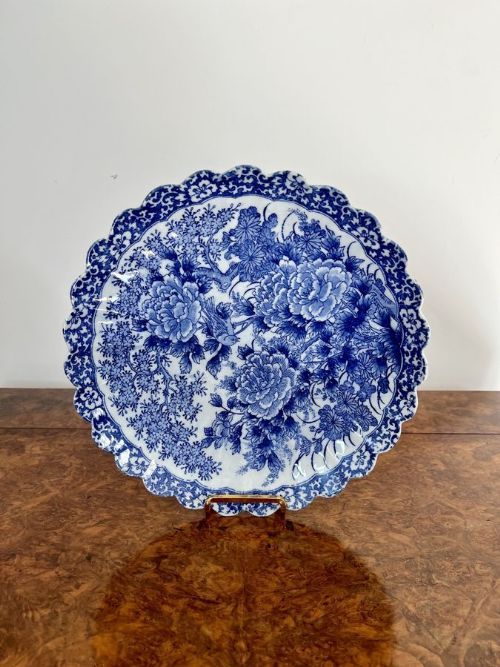


Imari Ware Decorative Plate
These imari ware decorative plate examples bring striking cobalt glaze and iron red palettes straight to a wall display or table.
Imari Ware Decorative Plate
An imari ware decorative plate brings centuries of Japanese ceramic tradition into a room, spanning from the Edo period through the Meiji period and into the early twentieth century. You encounter standard round dishes alongside larger chargers, square shapes, scalloped edges, and clam shell forms.
The objects listed here originate primarily from Japanese kilns, with Arita serving as the central production hub. Most examples date from the nineteenth and twentieth centuries, though earlier pieces from the seventeenth and eighteenth centuries appear among the selection.
How they were made
Porcelain forms provide the solid foundation for these dishes, shaped by hand or wheel before receiving cobalt blue underglaze decoration. Artisans then apply enamel colours, gilt, and gold leaf highlights over the glaze in intricate floral and bird designs.
Firing takes place in high-temperature kilns to fuse the mineral pigments and glazes into the ceramic body. Subsidiary decorating steps add the characteristic iron red and gold accents that define the palette.
Among the round dishes and chargers, a few pieces take the unexpected form of clam shell dishes.
What varies in quality
The precision and detail of the hand-painted brushwork dictate the visual impact of an individual dish. Crisp cobalt definitions and carefully applied gilding separate finer historical specimens from standard commercial output.
Complexity of form also plays a role, as scalloped rims, hexagonal edges, and square shapes demand greater skill from the potter than simple circular profiles. Preservation of the overglaze enamels and gold leaf across centuries maintains the artistic integrity of the piece.
The Imari Ware Decorative Plate Glossary
- Imari
- Japanese porcelain produced in the town of Arita and exported through the port of Imari, traditionally recognised by a palette of cobalt blue, iron red, and gold.
- Charger
- A large ornamental plate intended for display on a wall or sideboard rather than for dining use.
- Cobalt glaze
- A blue mineral pigment applied under the glaze before firing, capable of withstanding high kiln temperatures without losing intensity.
- Aka-e
- Japanese term for red-painted picture decoration, often combined with gold on porcelain wares.
- Edo period
- The historical epoch in Japan lasting from sixteen hundred and three to eighteen hundred and sixty-seven, known for the flourishing of domestic arts.
Imari Ware Decorative Plate: Frequently Asked Questions
How do I display an imari charger safely?
Large chargers require sturdy wall hangers designed specifically for heavy porcelain plates to prevent slipping. Alternatively, heavy-duty display stands support them securely on flat surfaces.
Ensure the display location avoids direct sunlight and heavy foot traffic to protect the overglaze enamels and gold leaf from accidental damage.
Can I use these antique plates for food?
These historical ceramics are intended strictly for decorative display rather than culinary use. The overglaze enamels and gold leaf can wear down with regular handling and washing.
Modern detergents and acidic foods may also cause permanent chemical damage to the historic pigments and glaze surfaces.
How do I tell an Edo period piece apart from later ones?
Edo period items often display a softer, more organic potting style with subtle asymmetries in the porcelain body. Pigments on earlier wares can show distinct depth within the cobalt blue underglaze.
Later nineteenth and twentieth-century examples frequently exhibit sharper, more uniform industrial standardisation in both shape and painted motifs.
What causes the craquelure in the glaze?
Fine network lines in the glaze, known as craquelure, develop naturally during the cooling process in the kiln or through centuries of thermal expansion and contraction. This phenomenon is a normal characteristic of historical ceramics rather than a structural fault.
It does not affect the stability of the porcelain body, provided the plate has no structural cracks.