

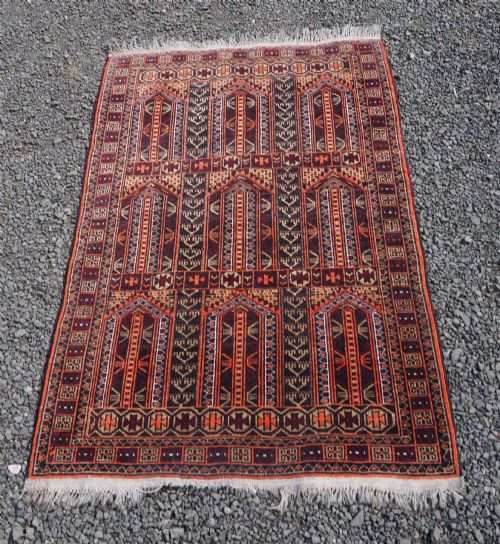

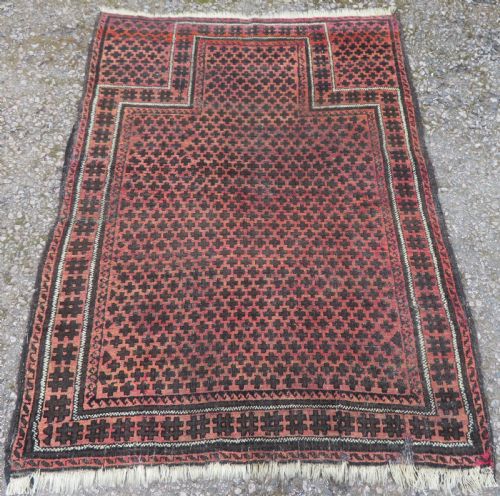


Hand Woven Prayer Mat
When you handle a hand woven prayer mat, you trace generations of nomadic and village artistry through wool, knot and mihrab.
Hand Woven Prayer Mat
A hand woven prayer mat is a portable textile designed for personal devotion, typically distinguished by an architectural arch or mihrab motif that indicates the direction of prayer. These pieces originate from regional weaving traditions across the Caucasus, Anatolia and tribal Afghanistan, spanning the mid nineteenth century into the early twentieth century.
Buyers encountering this selection will frequently find Baluch tribal rugs, Caucasian village pieces from areas such as Kazak and Dagestan, and Turkish formats like Ghiordes and Kirsehir. Each region utilises distinct formats, ranging from single arched mihrab fields to repetitive multi-mihrab layouts and tree of life compositions.
Formats vary from compact square dimensions to elongated village runners, reflecting the specific domestic or nomadic requirements of the makers. The visual language relies heavily on geometric medallions, floral lattices and characteristic border guards unique to each tribal group.
Materials and Construction
The foundation of these textiles relies upon natural animal fibres, predominantly hand-spun wool manipulated to yield resilient pile surfaces, frequently paired with cotton or wool warps and wefts. Certain specific tribal groups incorporated camel hair within the pile or foundation to impart natural undyed tones.
Weavers depended on natural dyes derived from plants and minerals, achieving rich palettes of indigo blues, madder reds and soft ivory grounds that mellow gracefully over decades of light exposure. The structural integrity depends entirely on hand-knotting techniques executed on vertical or horizontal looms without mechanical assistance.
Listings incorporate nineteenth century and early twentieth century examples, featuring wool, cotton, silk, camel hair and natural dyes across Caucasian, Anatolian and Afghan tribal styles.
Assessing Quality and Merit
Quality in these textiles rests upon the density of the knotting, the crispness of the geometric or floral drawing, and the depth achieved by natural dyestuffs. Tightly packed knots provide structural longevity, while skilled dye work ensures harmonious tonal ageing across the field.
The integrity of the original borders, the preservation of the pile height, and the clarity of the mihrab design separate standard examples from superior artistic achievements. Pieces retaining their complete outer guard stripes and untouched ends command greater regard among collectors.
The Hand Woven Prayer Mat Glossary
- Mihrab
- The arched architectural niche depicted on the field of the textile, symbolising the direction toward Mecca. This central motif defines the functional purpose of the weaving.
- Madder
- A natural red dye derived from the root of the Rubia tinctorum plant, extensively utilised across Anatolian, Caucasian and Afghan weaving traditions to produce durable reds and terracotta tones.
- Warps
- The vertical threads stretched tightly on the loom before knotting begins, forming the foundational skeleton of the rug. The exposed ends often terminate in visible fringes.
- Wefts
- The horizontal threads passed between rows of knots to bind the structure together firmly. They dictate the supple or rigid handle of the finished textile.
- Seh Mihrab
- A triple arch design layout frequently encountered in Baluch and Afghan tribal weaving. This specific variant displays three distinct prayer niches across the upper field.
Hand Woven Prayer Mat: Frequently Asked Questions
What is a prayer rug?
A prayer rug is a small portable textile created for individual worship, traditionally featuring a distinct niche or arch pattern known as a mihrab.
These pieces served a practical function in nomadic camps and village homes, providing a clean surface for daily prayers before being rolled up and stored.
How do I identify a Baluch rug?
Baluch rugs typically display deep indigo and dark brown grounds, often incorporating camel hair, geometric octagons and repeat motifs associated with nomadic groups of Afghanistan and Persia.
Their handle tends to be supple, and the palette relies heavily on rich natural dyes that yield subtle abrash variations across the wool pile.
What does Ghiordes mean?
Ghiordes refers to a historic town in West Anatolia renowned for traditional village weaving, as well as a specific symmetric knotting technique used widely in carpet production.
Pieces bearing this attribution usually exhibit refined floral lattices, distinctive prayer arches and balanced border arrangements characteristic of Turkish village work.
How should I care for an antique rug?
Antique wool textiles require gentle treatment, avoiding direct harsh sunlight and excessive moisture to preserve the natural lanolin and historic natural dyes within the pile.
Routine maintenance involves careful suction vacuuming without a beater bar, alongside professional periodic cleaning by specialists experienced in antique tribal rugs.