
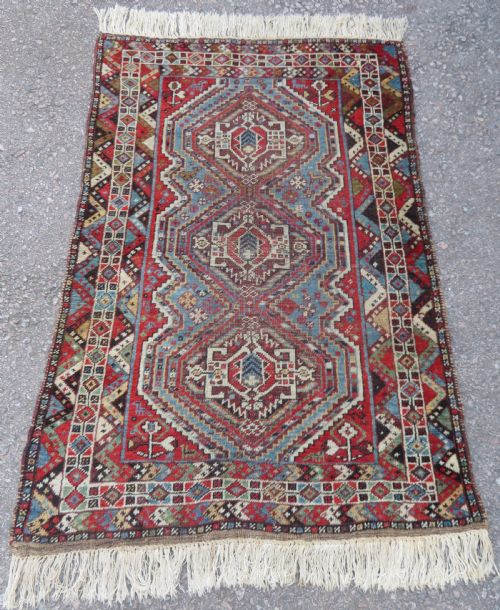
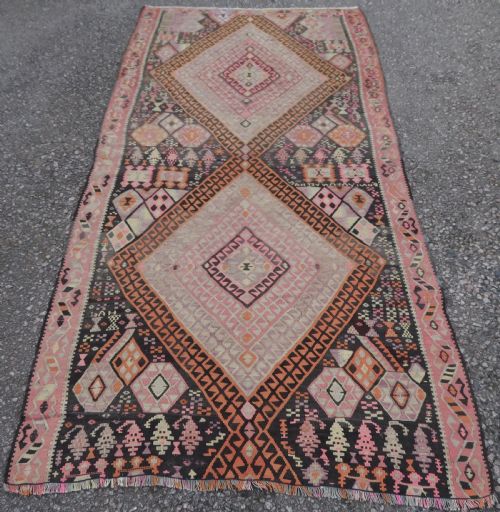
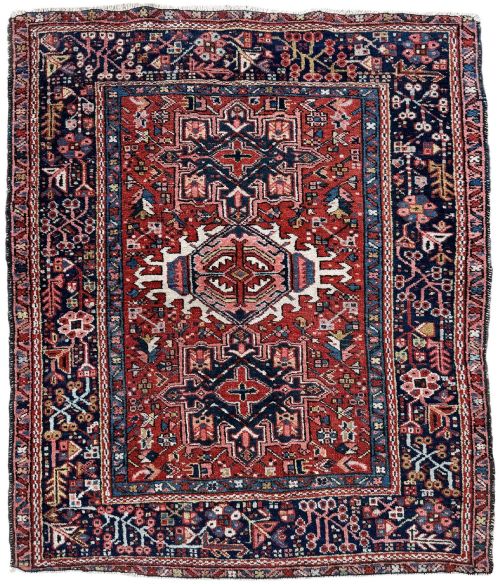
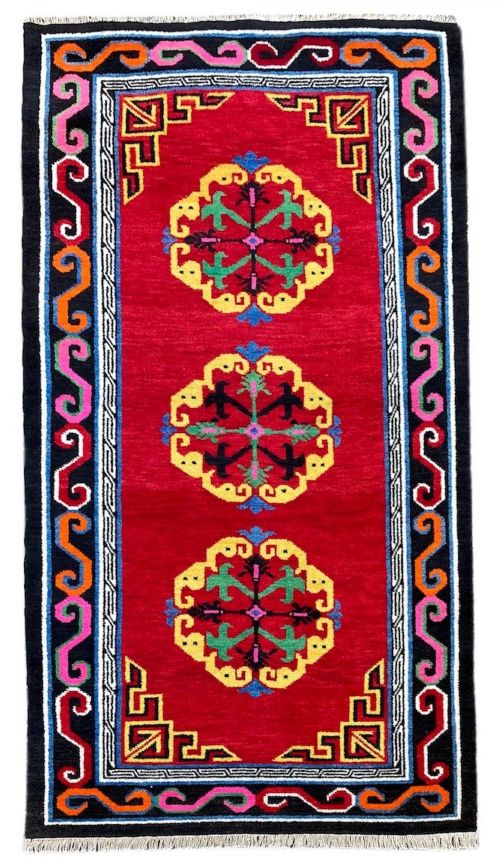
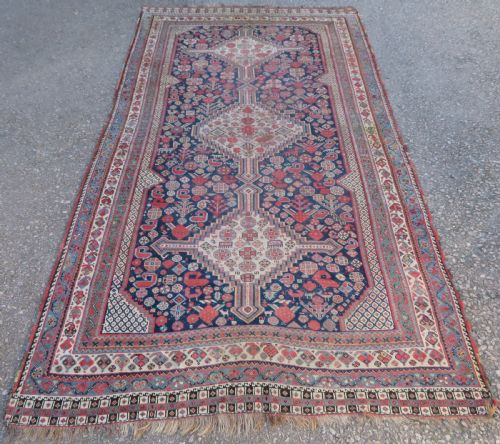
Antique Tribal Rugs
Wool rugs, bags and flatweaves made by nomadic and village weavers across Persia, the Caucasus, Anatolia and Central Asia, woven on portable looms for the weavers' own floors, tents and animals rather than for the workshop export trade.

Antique Tribal Rugs
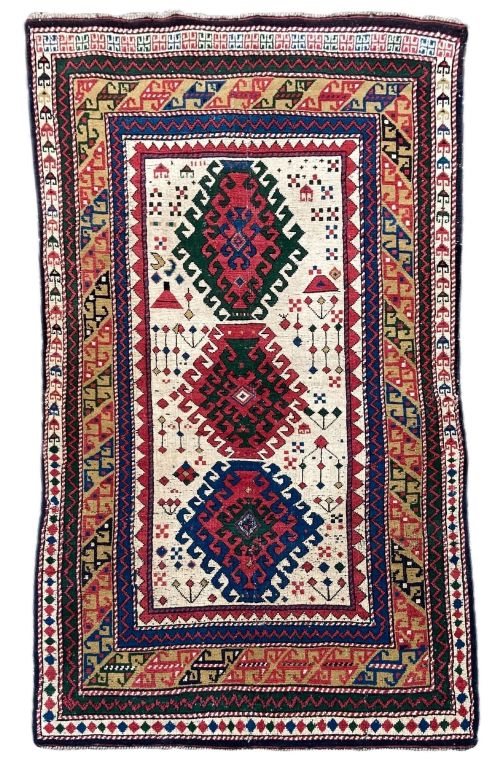
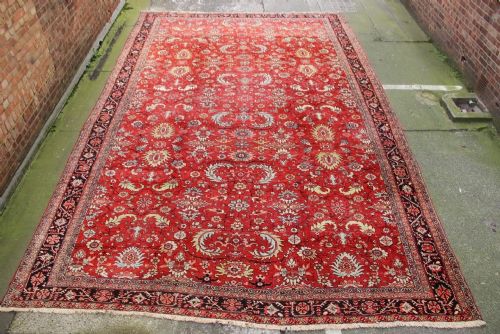
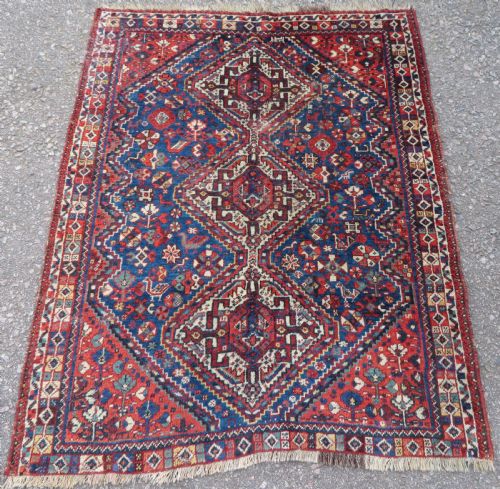
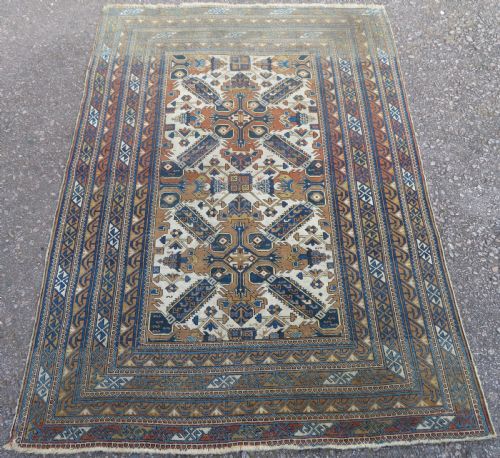
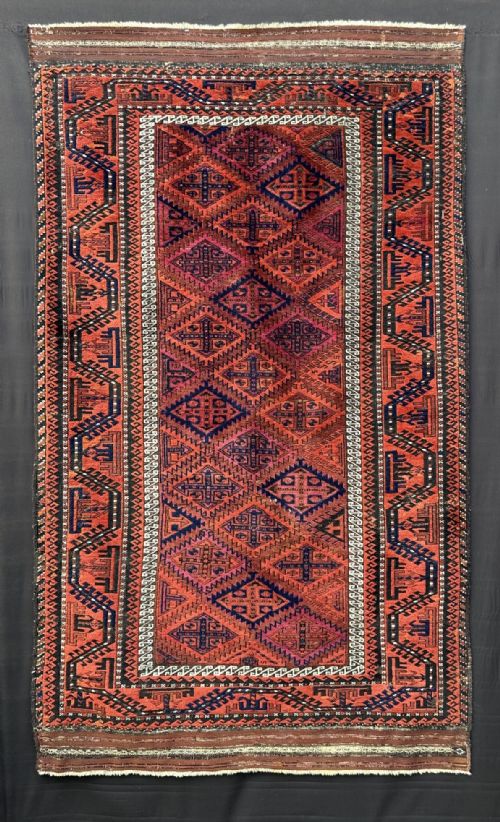
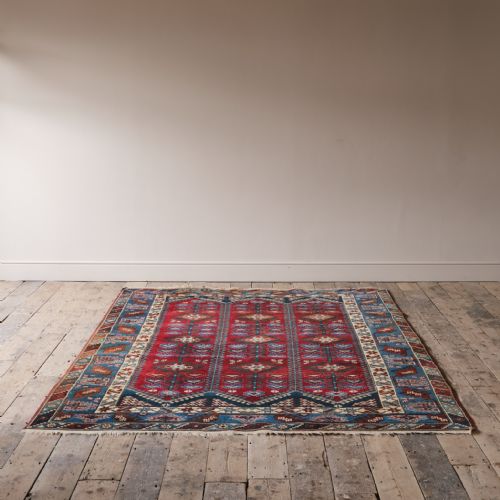
The typical listing is a small-to-medium wool pile rug named for a tribe or a weaving region, with the size quoted in the title. Sampled pieces cluster between roughly 130 x 90cm and 230 x 150cm. Names do the heavy lifting: Persia, Turkmen, Caucasian, Baluch, Afshar, Khamseh, Qashqai, Afghan, Kurdish, often pinned further by province.
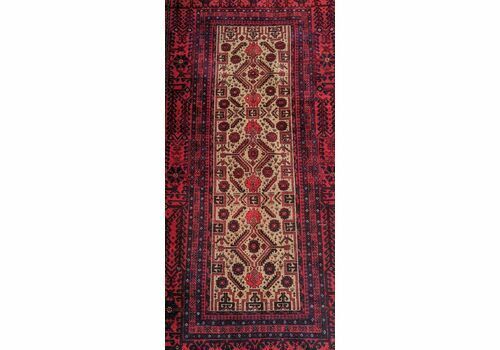
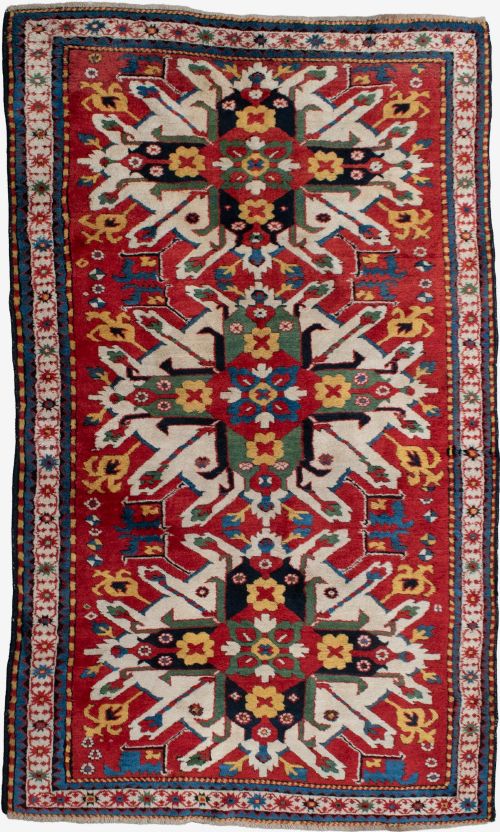
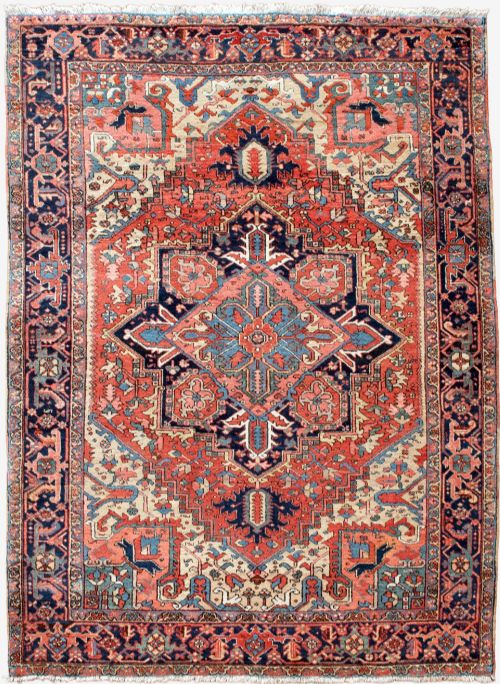
Persian tribal and village weaving is the largest block, roughly a third of listings, taking in the south-west confederacies alongside Kurdish, Bakhtiari, Shahsavan, Malayer, Heriz and Bidjar work. Turkmen and Central Asian weaving is about a fifth, Baluch and Afghan around one listing in eight, and Caucasian rugs, long rugs and runners about one in ten.
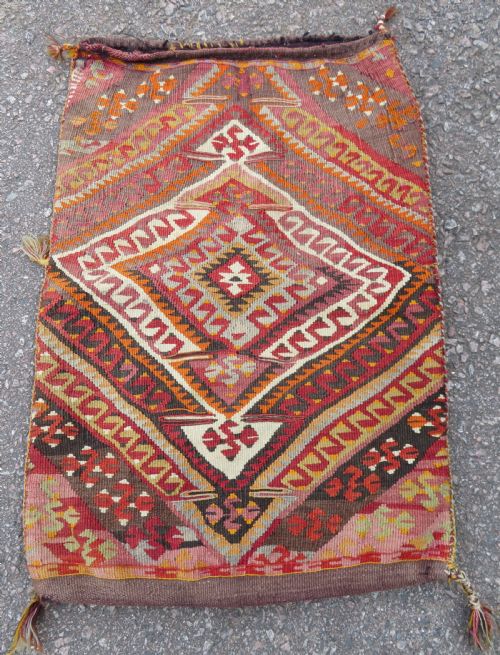
Floor rugs are only part of it. The nomadic bag repertoire runs right through the category: chuval, torba, mafrash, khorjin, saddlebags and detached bag faces, plus kilims, soumaks and Uzbek embroideries. Sizes stretch from bag faces of 29 x 70cm to carpets of 220 x 566cm, and a pair of runners quoted at 1294cm long.
Dates run 1750 to 1960, with the mass sitting between 1880 and 1930. Woven dates exist but are the exception, a handful of sampled titles among them '1326' read as 1908 and an inscribed 1892, so a decade attached to a tribal rug is usually the dealer's estimate. Around 208 pieces are listed on Sellingantiques in a year across 45 dealers.

Where The Range Splits
Attribution is the clearest divider. The upper part of the range carries strings like 'Qashqa'i Confederacy, Darrehshuri Tayefeh, Fars Province' or 'Khamseh Confederacy, Baharlu Sub-Tribe', naming tribe, sub-tribe and district. The bottom is where 'Vintage Oriental Rug' and 'Traditional Handwoven Runner' sit, with no group named at all.
Date pushes the same way. Titles reading mid-19th century, circa 1800-1850 or 'circa 1880 or earlier' sit well up, while 1920s and 1930s pieces gather at the lower end. Design counts alongside it: named and scarce patterns, and unusual ground colours in ivory, yellow, aubergine or camel, carry a piece further than a standard field.
For bags and trappings, completeness decides a lot. A chuval with its plain-weave back, a saddlebag set still joined, a matched pair of torba faces or asmalyks all sit above a single detached face, a half khorjin or a fragment. Weave fineness runs through both ends, as does size, with room-size carpets and kelleh formats at one extreme and small, finely woven dowry pieces at the other.
Antique Tribal Rugs Retail Price Guide 2026
Typical UK retail prices for tribal rugs, calculated from the Sellingantiques database of over a million retail prices indexed since 2003. This retail price guide relies exclusively on Sellingantiques data; no external sources or auction records are used, so the figures do not describe the wider market.
One-offs from the archive: a Tibetan meditation rug, a Moroccan cactus-silk kilim, a Thracian kilim and a Karakalpak dowry weaving.
The Antique Tribal Rugs Glossary
- Bag face
- The decorated front panel of a storage bag, cut or separated from its plain woven back. 'Face' appears in 68 titles, often sold on its own.
- Chuval
- A large Turkmen storage bag, named in 43 titles. Sometimes offered complete with its back, sometimes as the pile face alone.
- Torba
- A shallower, wider Turkmen tent bag, hung inside the yurt. Named in 48 titles.
- Kilim
- Flatwoven with no pile, 113 titles, running from Anatolian and Qashqai examples through to Uzbek and Turkmen panels.
- Kelleh
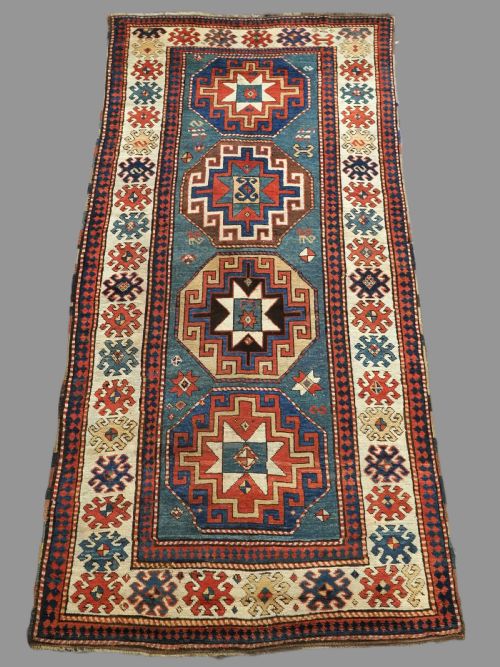
- A long-format carpet, much longer than it is wide. Recurs in Kurdish, Bidjar, Khamseh and Kuba listings, and overlaps with the runner and long rug formats that account for another large slice of titles.
- Gul
- The repeated octagonal or lozenge medallion of Turkmen weaving. 42 titles name one by type, among them Salor, Kepse, Dyrnak, Ertmen, Aina and Memling.
Antique Tribal Rugs: Frequently Asked Questions
What counts as a tribal rug?
Hand-knotted and flatwoven wool made by nomadic, semi-nomadic and village weavers, rather than in a commercial workshop. The weaving regions are Persia, the Caucasus, Anatolia, Central Asia and Afghanistan.
The heading covers more than floor coverings. Storage bags, tent trappings, animal covers, eating cloths and prayer rugs all sit under it.
How old are these rugs usually?
The dated field spans 1750 to 1960, and the weight of it falls between 1880 and 1930. The 1900s are the single biggest decade, followed by the 1880s and 1920s.
Only a small number are dated to the 1850s or 1860s, and nothing in the samples goes past the 1940s. A further group carries the label '19th Century' rather than a year.
Why do so many titles say design?
'Design' appears in 339 titles, nearly a fifth of them, which makes it the main descriptor in this category. Dealers name the pattern before they name a measurement or a colour.
Herati, Mina Khani, boteh, Memling gul, tree of life, mihrab and ikat all turn up as named designs.
Are tribal bags collected separately from rugs?
They are a branch in their own right. 72 titles say 'bag', 68 say 'face', 48 'torba' and 43 'chuval'.
The sampled forms run well beyond storage: salt bags, vanity bags, spindle bags, okbash, tubreh, wheat sacks and gapylyk. Whether a bag keeps its back, tassels or its pair changes where it sits in the range.
Do tribal rugs carry woven dates?
Rarely. A handful of sampled titles cite one, including '1326' read as 1908, '1288' read as 1871, an inscribed 1892 and a 1921.
Everything else is estimated, which is why decades on tribal rugs are given as circa.
What Central Asian pieces turn up here?
Turkmen weaving is about a fifth of the category, with Tekke, Ersari and Yomut the recurring groups, plus ensi door rugs, asmalyks and tent bands.
Uzbek work appears in 51 titles and is the one place where embroidery rather than weaving carries the piece: Lakai dowry hangings, silk-on-cotton suzani and silk ikat panels.