
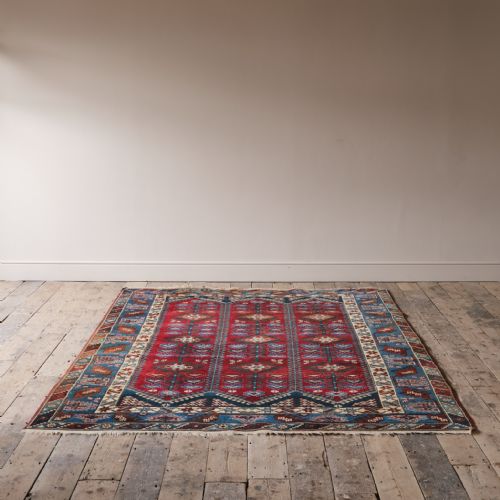
Antique Area Rugs
A hand-knotted wool rug or carpet, woven in Persia, the Caucasus, Anatolia, Central Asia or further east, made to cover a floor and named for the place or tribe that wove it.
Antique Area Rugs
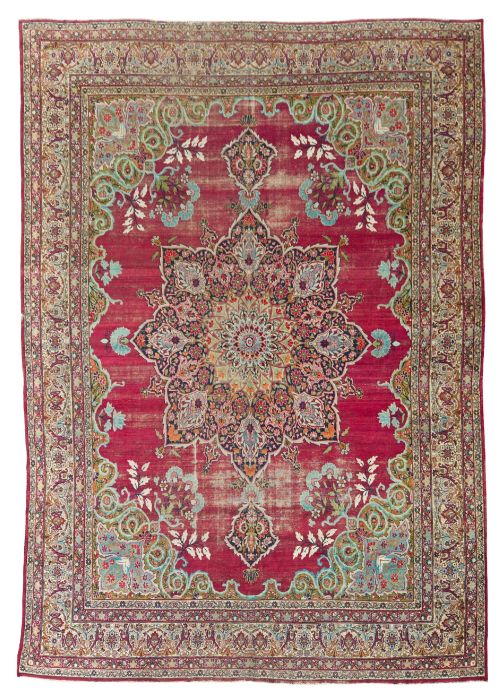
These are floor weavings listed by origin rather than by maker. A title gives you a weaving place or a tribe and a date, and that is the identity of the piece. Pile rugs outnumber flatweaves by a wide margin, and the word "carpet" appears in over a third of titles, usually for the larger room-size pieces.
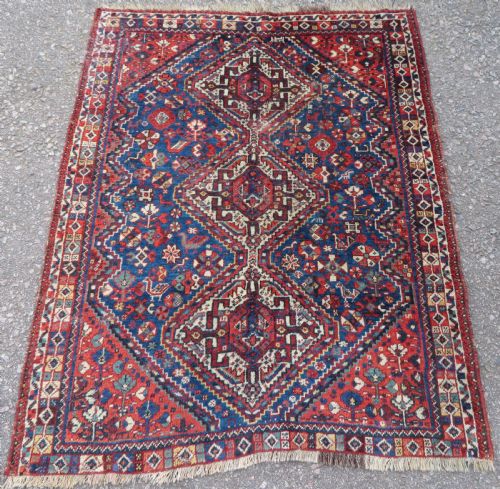
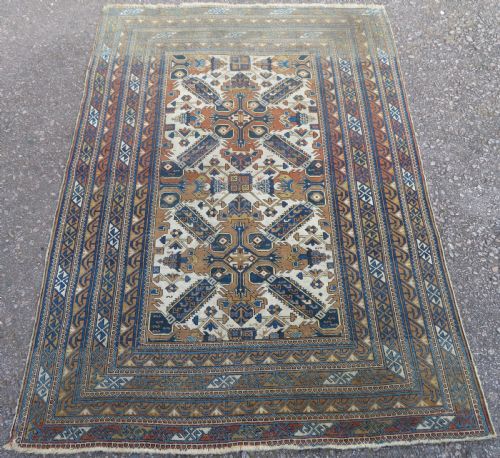
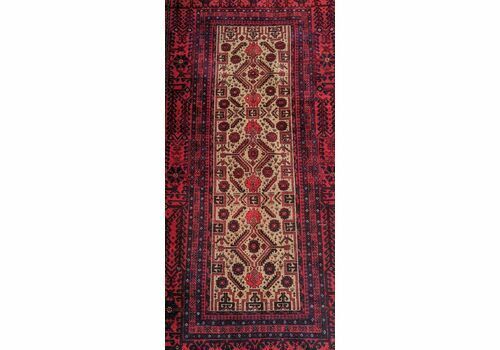
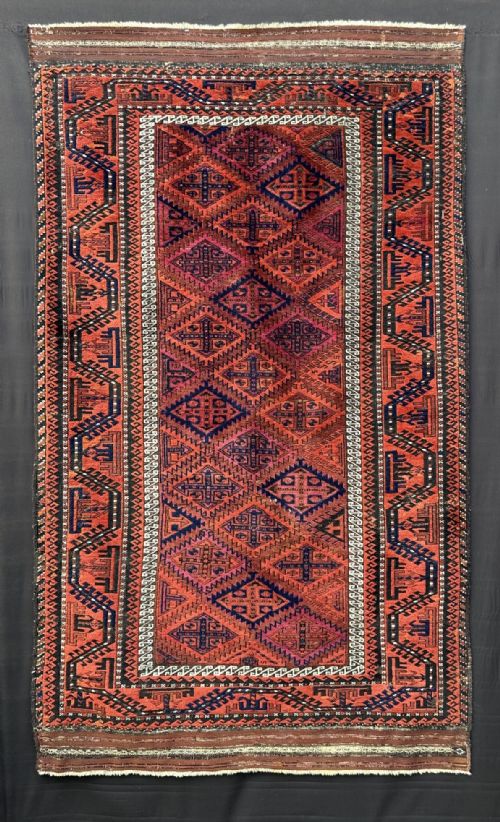
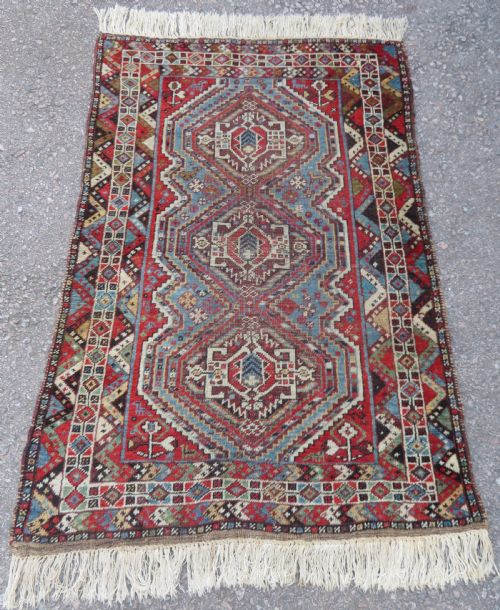
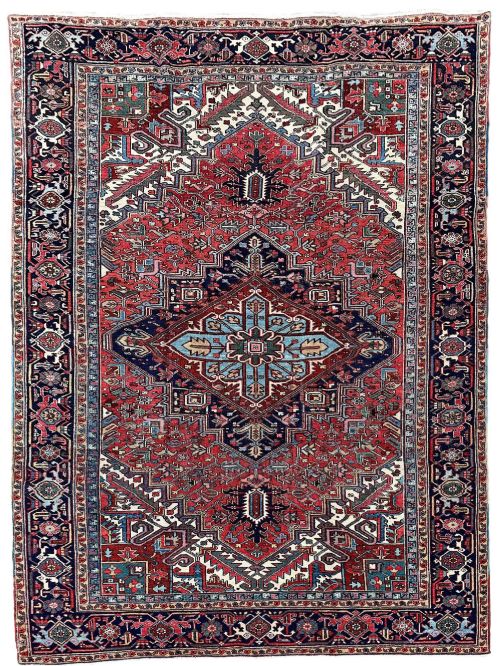
Persian town and workshop carpets make up roughly a third of what turns up, and Heriz is the most-named origin of all, with Mahal, Tabriz, Kashan, Sarouk and Isfahan behind it. The largest block by count, though, is tribal and village weaving: Baluch, Qashqai, Afshar, Khamseh, Kurdish, Malayer and Hamadan. Caucasian rugs run to about one in twelve, Turkmen and Central Asian work about one in fifteen.
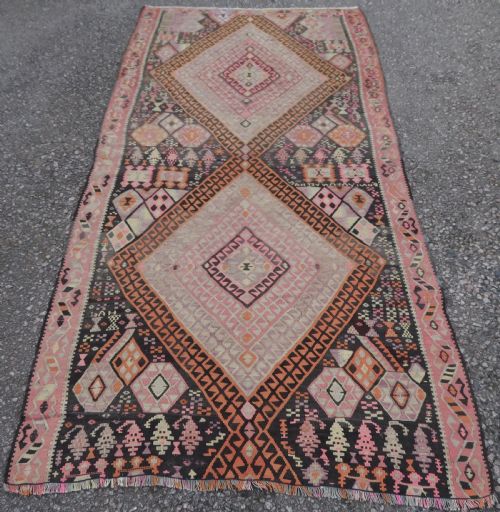
Anatolian pieces bring in Turkish village and prayer rugs alongside Ushak carpets, and flatweaves run as a steady undercurrent throughout: kilims, soumaks, chuvals and saddle-bag faces sold flat. Prayer rugs and kilims each account for roughly one title in twenty-five. Sizes run from small tribal rugs around 1.2 by 0.8 metres up to carpets past six metres long.
The dated span is 1750 to 1940, but the weight of it sits between 1880 and 1930, with the 1900s the fullest decade and the 1940s the thinnest. Earlier pieces thin out fast. Some titles date more precisely than the field does, quoting a woven date such as 1347 AH or 1936. Around 188 are listed on Sellingantiques a year, handled by 47 dealers.
What Moves Value
Size does more work here than anything else. Oversize and room-size carpets sit at the top of the range, and the biggest recorded run past six metres in a single dimension. Small tribal rugs under a metre and a half sit at the other end. Seventy-two titles say "large" against forty-three saying "small", and the pattern holds.
Naming matters almost as much. A title that gives a specific workshop group, Sultanabad, Serapi, Bakshaish, Farahan, Ushak or Mahal, clusters high. Titles that stop at "Persian rug" or "Large Woolen Carpet" sit low. The same wool, the same age, but the identification carries the piece.
After that it comes down to what is uncommon. Twenty-two titles use the word "scarce", most often of a ground colour or a design rather than the origin: a green ground, a yellow ground, an unusual border, a square format. Ivory, camel and white grounds recur among the higher-placed workshop carpets, and the thinly represented pre-1870 end carries markers like "Early" and "Ancient".
Antique Area Rugs Retail Price Guide 2026
Typical UK retail prices for area rugs, calculated from the Sellingantiques database of over a million retail prices indexed since 2003. This retail price guide relies exclusively on Sellingantiques data; no external sources or auction records are used, so the figures do not describe the wider market.
The most expensive area rug ever sold on Sellingantiques was a large Karaja or Heriz carpet, circa 1900, sold in September 2016.

The Antique Area Rugs Glossary
- Kilim
- Flatwoven rug with no knotted pile, made across the same regions as the pile weaving. Sixty-six titles are kilims, including Bessarabian, Pirot and Sharkoy examples.
- Prayer rug
- A rug with a directional niche, or mihrab, set into the field. Sixty-seven titles use the term, and a few carry a seh-mihrab, meaning three niches.
- Ground
- The field colour sitting behind the design. Forty-one titles specify one, most often ivory, camel, yellow or white.
- Boteh
- The teardrop or paisley motif, used as a repeat across a whole field. Herati is the other field pattern named in titles, an all-over rosette and leaf design.
- Gul
- The repeating octagonal motif of Turkmen weaving, with named forms including Tekke, dyrnak, kepse and tauk nuska. A main carpet is the large central weaving of a Turkmen tent group.
- Kelleh
- A long narrow carpet, roughly three times as long as it is wide. Ensi is the Turkmen door hanging, often with elem panels, the plain or patterned bands at each end.
Antique Area Rugs: Frequently Asked Questions
Which origin turns up most often?
Heriz. It is named in 121 titles, and 80 of those are explicitly a Heriz carpet rather than a rug, so the group leans large.
Caucasian is next, then Persian, Baluch, Turkmen and Turkish. Mahal and Ushak follow, both again weighted towards carpet sizes.
How old are these rugs usually?
The dated field runs from 1750 to 1940, with 1,293 listings carrying a clean year. The concentration is 1880 to 1930.
The 1900s decade is the fullest, the 1920s and 1890s close behind. The 1940s holds only ten. A further seventy are dated simply as 19th century, which is a bracket rather than a year.
Are there any named makers?
No. These are listed by weaving place or tribe, and the evidence carries no workshop master, designer or signing hand.
One exception exists in the samples: a Caucasian Karabagh village rug described as signed by its weaver.
What counts as a flatweave here?
Anything without a knotted pile. Kilims account for 66 titles, and soumaks, chuvals, saddle-bag faces and needlepoint pieces make up the rest of the non-pile group.
They come from the same regions and the same tradition as the pile rugs, just built differently. Bessarabian, Pirot and Sharkoy kilims, and Yomut palas soumak, all appear.
How big do these carpets get?
The largest recorded pass six metres in one dimension: a Mahal at 597 by 345cm, an Oushak at 369 by 595cm and a Heriz at 375 by 575cm.
At the other end, small tribal pieces come in around 1.2 by 0.8 metres. Everything between the two turns up somewhere in the range.
Do any unusual origins appear?
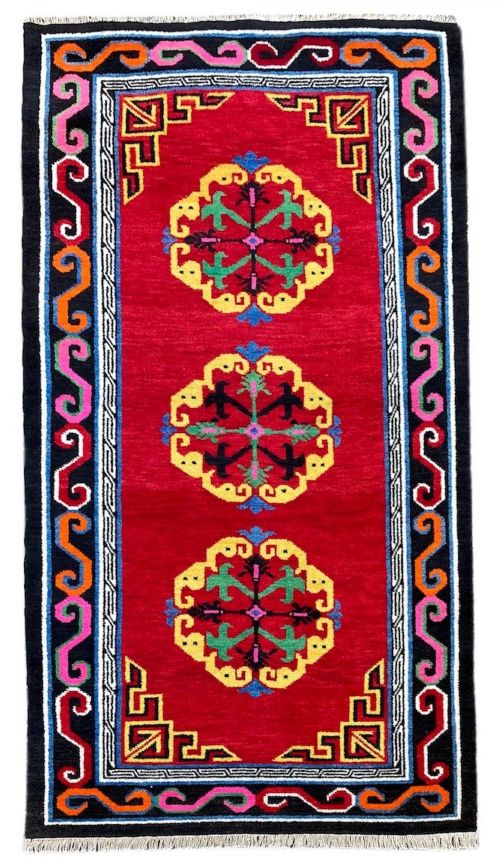
Yes, though only once or twice each. Nepalese, Tibetan khaden, Chinese Ningxia and Pao Tao, Spanish Cuenca, Portuguese needlepoint, French Aubusson and Irish Donegal have all been listed.
India contributes Amritsar and Agra carpets, along with a Mughal fragment from the north.