



Antique Oushak Rugs
Hand-knotted wool carpets from the Oushak weaving district of western Anatolia, woven in room sizes for European and American floors in the late nineteenth and early twentieth centuries.

Antique Oushak Rugs
Oushak, also spelled Ushak, is a town and weaving district in western Anatolia with a carpet trade going back to the fifteenth century. What reaches the market now comes from the commercial period at the end of the nineteenth century and the start of the twentieth, when the district wove for export. Both spellings run side by side on Sellingantiques, and a good many titles hedge with "Oushak or Ushak".
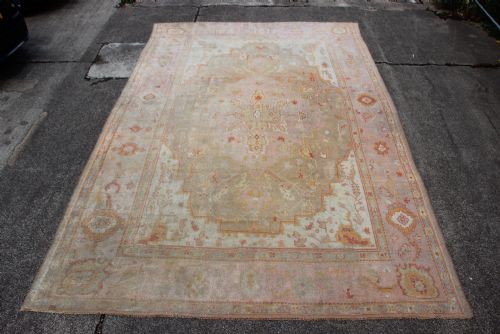
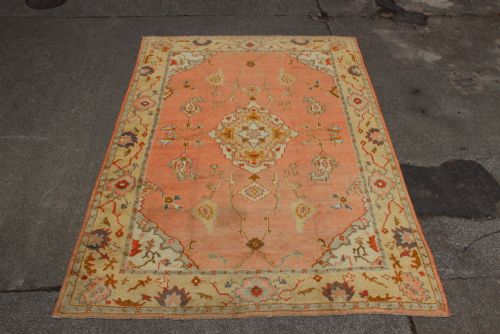
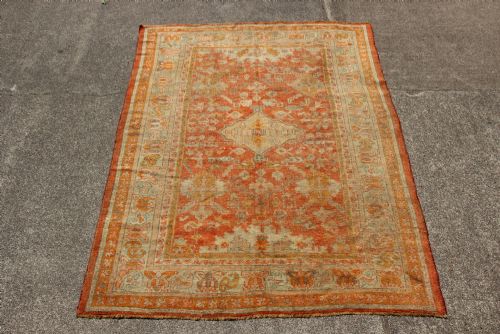
The piece you are most likely to meet is a large room-size carpet. The word "carpet" appears in around two thirds of titles, and sampled dimensions cluster from roughly 250 by 300cm up to 400 by 500cm, with the largest sampled piece at 485 by 550cm. Titles tend to be plain: the word antique, the place name, the format, sometimes a year.
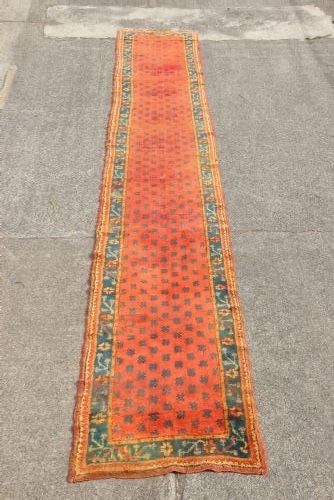
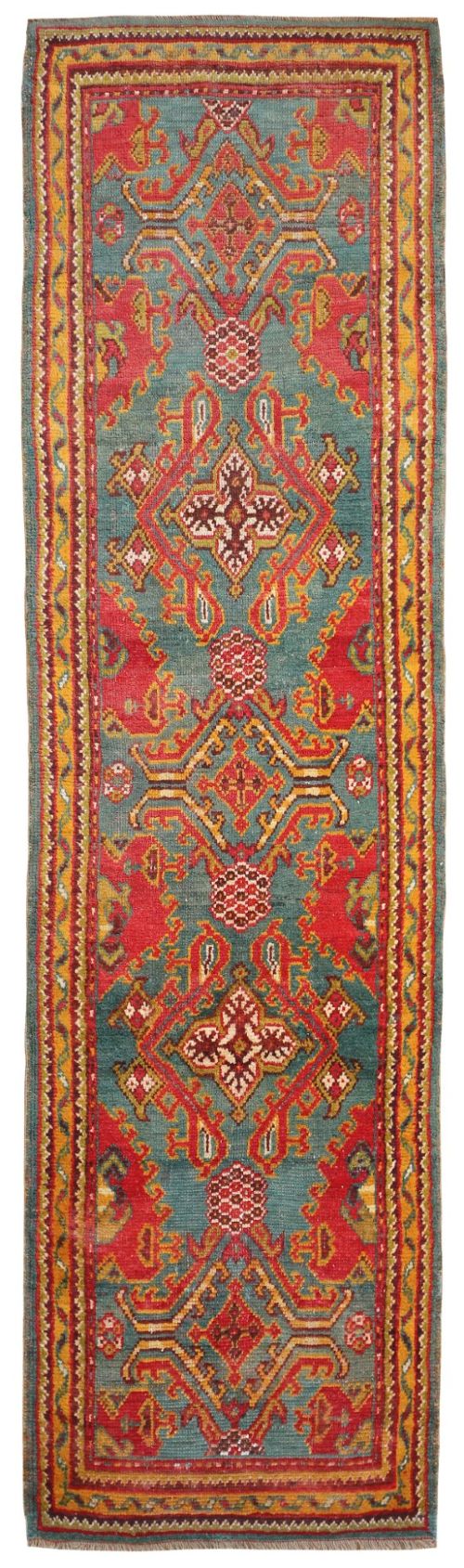
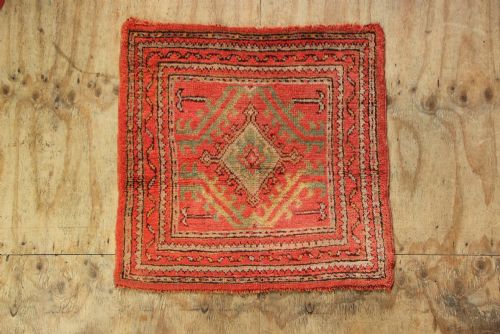
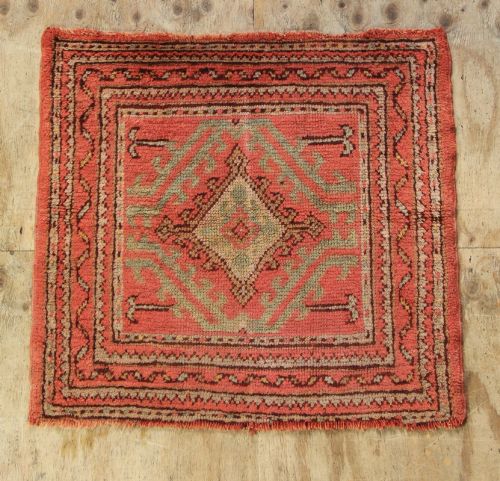
Runners are the second format, under a tenth of listings, from about 3.5m to 5.5m long and under 1.2m wide, and three sampled listings offer them as matched pairs. Below that sit small rugs, mats and near-square pieces under a metre. Angora Ushak is a titled sub-type in about one listing in sixteen, and sub-district names, Kula, Ghiordes and Borlu, account for only a handful between them.
Dating runs from 1870 to 1930, with a single piece at each end. The weight sits in the 1900s, 1890s and 1880s. Some of that dating is a bracket rather than a year, since several listings read "circa 1900/20" or "late 19th century" while the recorded date is one figure.
What Sets Them Apart
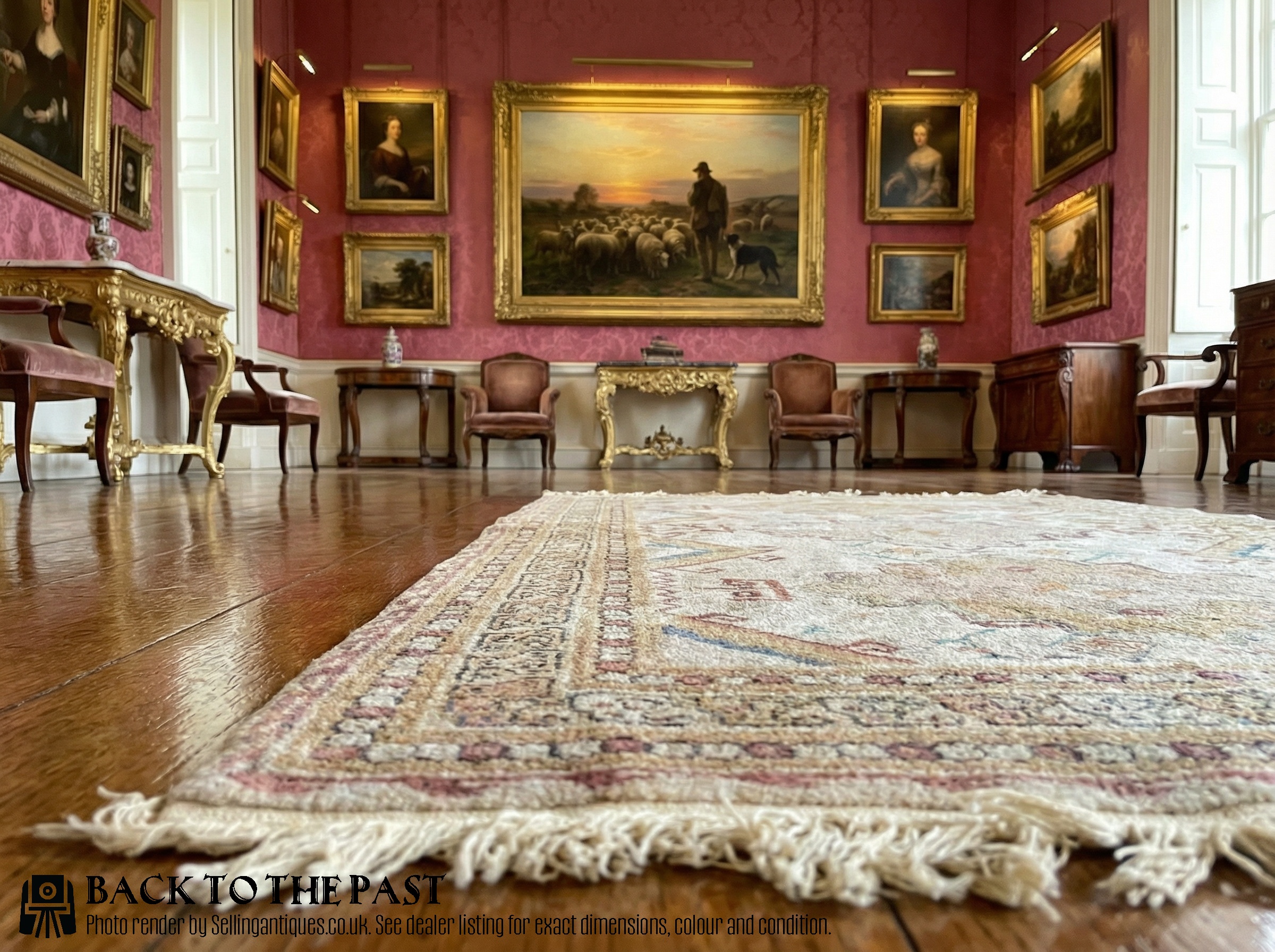
Size does most of the work. The upper reaches of the range are held by carpets of 3.5 by 4.5 metres and beyond, one titled "Giant" and another "Enormous", while mats and squares under a metre sit at the bottom. A room-size Oushak was made for a room, and the market still pays for the acreage.
After size comes colour. Dealers reach for the ground when a piece stands out, and titles single out green fields, ivory grounds, pink grounds and pale blue. Green in particular is twice described as scarce or unusual. Those calls cluster in the upper half of the range, while the plain end of the category says nothing more than "Antique Ushak carpet" and a year.
Two smaller things pull upward. Angora wool appears from mid-range to the very top of the sample, including the highest-priced sampled piece, which is unusual for a sub-type that normally sits in one band. A named design does the same: willow tree, Star Ushak, medallion and Caucasian designs all sit high, where "traditional design" sits low. Earlier dates follow the same pattern, with 1880s and 1890s pieces above the 1910s and 1920s.
Antique Oushak Rugs Retail Price Guide 2026
Typical UK retail prices for oushak rugs, calculated from the Sellingantiques database of over a million retail prices indexed since 2003. This retail price guide relies exclusively on Sellingantiques data; no external sources or auction records are used, so the figures do not describe the wider market.
The most expensive Oushak ever sold on Sellingantiques was an antique Oushak carpet, in July 2021.
The Antique Oushak Rugs Glossary
- Oushak / Ushak
- Two spellings of the same western Anatolian weaving town and district, used interchangeably in titles and often together in one heading.
- Carpet vs rug
- In these listings "carpet" signals a room-size piece and "rug" a smaller one, and the split runs roughly two to one in favour of carpets.
- Runner
- A long narrow format, here from about 3.5m to 5.5m long and under 1.2m wide, occasionally sold as a matched pair.
- Field
- The main ground inside the borders. Descriptions call out green, ivory, pink and pale blue, and those colours are the ones dealers put in the title.
- Angora Ushak
- A titled sub-type of Oushak weaving that turns up in about one listing in sixteen, at every level of the range.
- Star Ushak
- A traditional Oushak pattern named as a design description, appearing once in the sample alongside willow tree and medallion designs.
Antique Oushak Rugs: Frequently Asked Questions
Is Oushak the same thing as Ushak?
Yes. They're two spellings of one western Anatolian town and weaving district, and both run right across the archive on Sellingantiques.
Ushak appears in a little over half of titles, Oushak in the rest. Plenty of listings cover themselves by writing "Oushak or Ushak" in the same heading.
How big are these carpets usually?
Large. Two thirds of titles use the word "carpet", and where dimensions are given they cluster around 250 to 400cm by 300 to 500cm.
The largest sampled piece measures 485 by 550cm and is described as giant. At the other end sit mats and near-square pieces under a metre.
What dates do these carpets carry?
The dated field runs 1870 to 1930, with one piece at each end of that span.
The mass falls in the 1880s, 1890s and 1900s, with the 1920s and 1910s behind. Some listings give a bracket, such as "circa 1900/20", where the recorded date is a single year.
Are there makers' names on Oushak carpets?
No. Nothing in this category carries a workshop or maker name, and titles don't attempt one.
What titles do carry is size, colour, format and district. That is how these pieces are identified and how they are sorted on Sellingantiques.
Which colours turn up in the fields?
Green, ivory, pink and pale blue are the grounds dealers name in titles, and green is twice described as scarce or unusual.
Those colour calls tend to sit in the upper half of the range. Listings at the plain end often give no colour at all, just the place name, the format and a year.
Does anything besides pile carpets appear?
Occasionally. The sample holds a single Ushak kilim, which is flatwoven rather than knotted, and a single prayer rug from the Oushak region with a niche at one end.
Beyond those, the outliers are small: a couple of near-square mats under a metre. Everything else is knotted wool pile.