
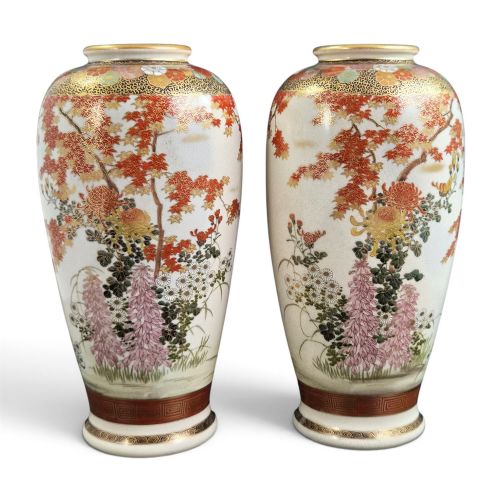
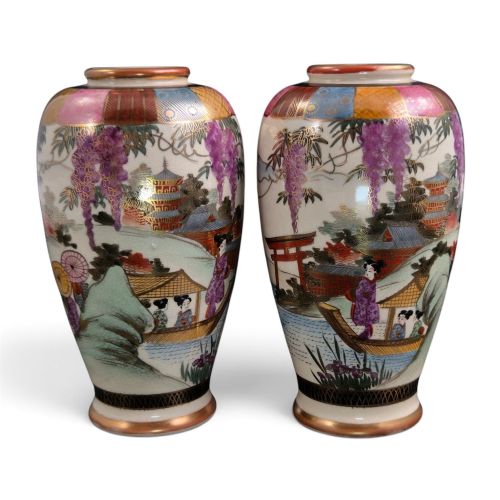
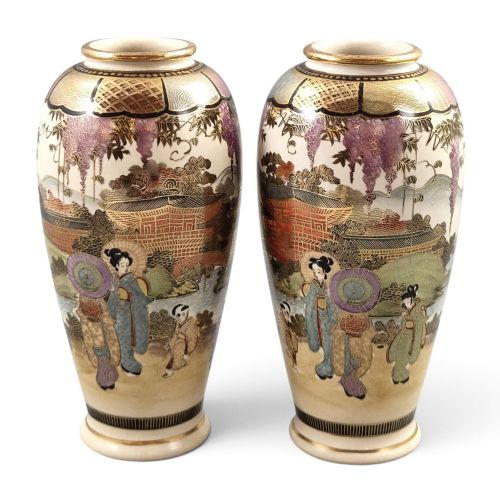
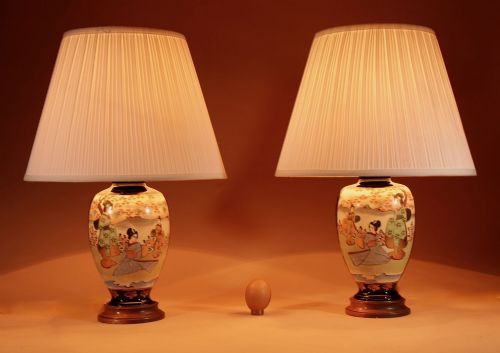


Hand Painted Satsuma Pair
These hand painted satsuma pair items are earthenware vessels adorned with intricate enamel and gold leaf, offering collectors a striking glimpse into traditional Japanese export art.

Hand Painted Satsuma Pair
When searching for a hand painted satsuma pair, buyers encounter decorative vases and table lamps originating primarily from the Meiji period, Edwardian era, and Victorian times. These matching vessels showcase Japanese craftsmanship designed largely for export, spanning various sizes from small ornaments to large floor vases.
The objects typically take the form of paired vases depicting landscapes, wisteria gardens, and figures such as women and children. Examples range from compact cabinet pieces to monumental thirty-eight-inch floor vases.
How they were made
Maker workshops utilised earthenware and ceramic bodies, applying a fine crackle glaze that formed the base for subsequent ornamentation. Artisans then built up the surface using coloured enamel and gold leaf to create intricate pictorial scenes.
Painting techniques involved delicate brushwork to render figures, floral motifs like wisteria, and lake landscapes. Gilt highlights were carefully placed to accentuate specific details within the overall composition.
Listings feature earthenware and porcelain materials spanning the Victorian, Edwardian, and Meiji periods.
What varies in quality
Quality in these pieces depends on the precision of the hand-painted brushwork and the complexity of the figural or floral scenes. Finer examples display meticulous detail in the enamel work and generous use of gold leaf.
The reputation of the workshop or maker also influences the standing of a piece, with recognised names commanding greater attention. Additionally, the overall preservation of the delicate glaze and enamel surfaces dictates the distinction between standard and exhibition quality.
Maruni Kobe·Shozan·Hakusan·Kinkozan·Hododa
The Hand Painted Satsuma Pair Glossary
- Satsuma Ware
- A type of Japanese earthenware traditionally characterised by an ivory-coloured crackle glaze and elaborate enamel decoration. It became widely produced for Western export during the late nineteenth and early twentieth centuries.
- Meiji Period
- The era in Japanese history spanning from 1868 to 1912, marked by the opening of trade with the West. Many export ceramics found on the market originate from this transformative period.
- Enamel
- A glassy substance fused to the ceramic surface through firing, providing vibrant colours for detailed pictorial designs. Artisans layered these pigments over the glaze to build up scenes.
- Gilt
- A thin application of gold or gold leaf used to highlight decorative elements and borders. It adds a reflective quality that distinguishes finer export pieces.
- Shimazu Mon
- The family crest of the Shimazu clan, who ruled the Satsuma domain and sponsored local ceramic production. Its presence indicates a connection to the traditional origin of the ware.
Hand Painted Satsuma Pair: Frequently Asked Questions
How do I identify genuine Satsuma ware?
Authentic pieces generally feature a characteristic earthenware body covered in a fine crackle glaze, decorated with hand-painted enamel and gold leaf. Many items also bear workshop signatures or family crests on the base.
Examining the precision of the brushwork and the integration of the enamel into the glaze helps distinguish traditional export pieces from later reproductions.
What periods do these vases come from?
The pieces predominantly originate from the Meiji period, stretching into the Edwardian and Taisho eras as production continued for Western markets. Victorian-era examples also appear among earlier export goods.
Matching the stylistic markers and historical dates helps place specific items within these late nineteenth and early twentieth-century timeframes.
How should I display a pair of vases?
These matched vessels work well on mantelpieces, sideboards, or dedicated display tables where their painted scenes can be viewed clearly. Larger floor vases suit entrance halls or corners with adequate clearance to protect their fragile surfaces.
Keeping them away from direct sunlight preserves the vibrant colours of the enamel and the integrity of the gold leaf.
Are all Satsuma pairs matching in design?
While sold as pairs, individual vases sometimes feature complementary rather than identical scenes, such as opposing landscape views or paired figures. This balanced asymmetry was a common convention in Japanese decorative arts.
Reviewing the specific motifs on each vessel reveals how the pair was composed to balance visual weight.