


Japanese Satsuma Figures Vase
These japanese satsuma figures vase examples bring together elaborate ceramic craftsmanship and detailed hand-painted court scenes from late nineteenth and early twentieth century Japan.

Japanese Satsuma Figures Vase
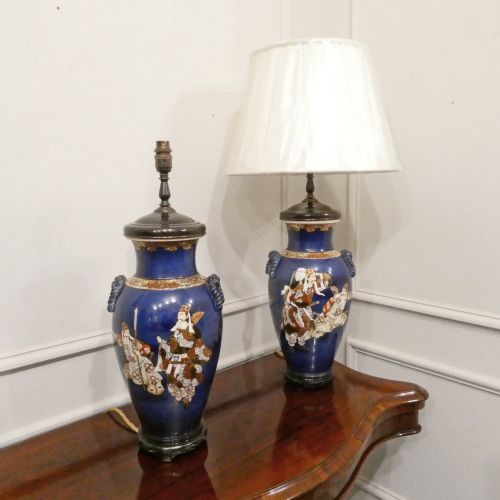
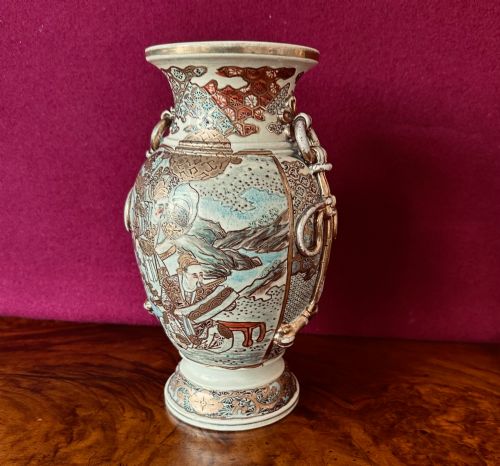
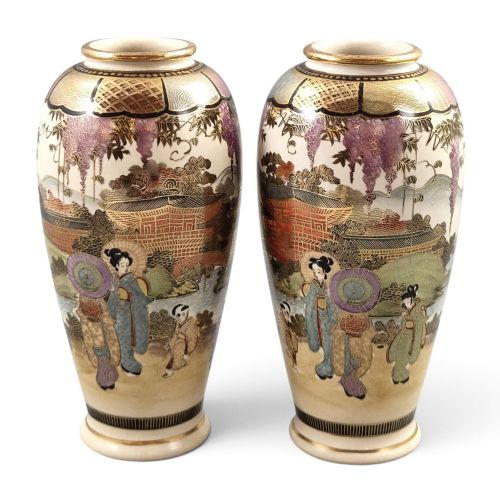
When you search for a japanese satsuma figures vase, you find earthenware and ceramic vessels decorated with figures such as women, children, Rakan, and court groups.
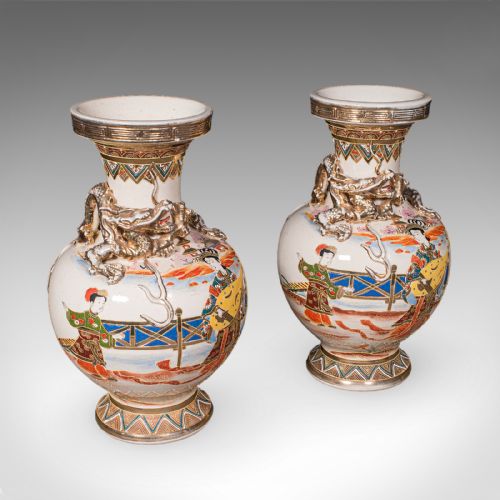
The pieces on this page appear mainly as pairs and single large decorative vases, originating from the Meiji, Meiji-Taisho, and Victorian periods.
Makers and regional styles such as Shozan and Kyoto appear alongside standard baluster and hexagonal forms, showing the diversity of these ceramic items.
How they were made
Artisans built these vessels using earthenware and porcelain, shaping them into baluster, hexagonal, and polygon forms with applied handles.
Makers applied enamel, gold leaf, and glaze to create intricate hand-painted surfaces, incorporating cobalt grounds and raised moriage decoration.
Several vases feature Rakan alongside dragons, proving that ancient holy figures occasionally needed scaly companions.
What varies in quality
The finesse of the hand-painted figures and the precision of the gold leaf application distinguish finer vessels from simpler production.
Garnitures and large matched pairs demonstrate greater ambition in scale and decorative program than single smaller vases.
Shozan
The Japanese Satsuma Figures Vase Glossary
- Satsuma
- A type of Japanese earthenware traditionally featuring a crackle glaze and elaborate enamel and gold decoration. It originated in Satsuma Province and became popular for export during the Meiji period.
- Moriage
- A decorative ceramic technique using raised slip or enamel to create textured patterns and dimensional details. It often highlights the robes and borders on figural vessels.
- Meiji Period
- The era in Japanese history spanning from 1868 to 1912, marked by opening trade with the West and a surge in decorative arts production. Many export ceramics date from this time.
- Baluster
- A vase shape with a rounded body that tapers toward the neck, resembling a traditional architectural baluster. This form frequently appears in Satsuma pottery.
- Rakan
- The Sanskrit term for enlightened disciples of Buddha, frequently depicted in Japanese art. They appear as holy figures on decorative vases.
Japanese Satsuma Figures Vase: Frequently Asked Questions
What is a Satsuma vase?
A Satsuma vase is a Japanese ceramic vessel made from earthenware, identifiable by its distinctive crackle glaze.
These pieces feature detailed hand-painted scenes using enamel and gold leaf, often depicting court figures, dragons, and traditional narratives.
How do I date a Satsuma vase?
Dating relies on examining the ceramic body, glaze characteristics, and stylistic markers associated with the Meiji and Victorian periods.
Most export pieces date from the late nineteenth and early twentieth centuries, spanning the Meiji to Taisho eras.
What are court figures on vases?
Court figures represent traditional Japanese nobility, attendants, and historic scenes painted onto the ceramic surface.
Artists used fine brushwork and gold highlights to render the elaborate robes and facial expressions of these characters.
Are Satsuma vases porcelain?
While some Kyoto pieces use porcelain, traditional Satsuma ware uses an earthenware body with an ivory-coloured crackled glaze.
This absorbent clay body provided an ideal ground for the dense enamel and gold leaf painting characteristic of the style.
How should I display a Satsuma vase?
These decorative vases suit prominent placement on mantelpieces, pedestals, or tables where their detailed hand-painted surfaces remain visible.
Pairs and garnitures look best displayed together to preserve the symmetry intended by the original makers.