
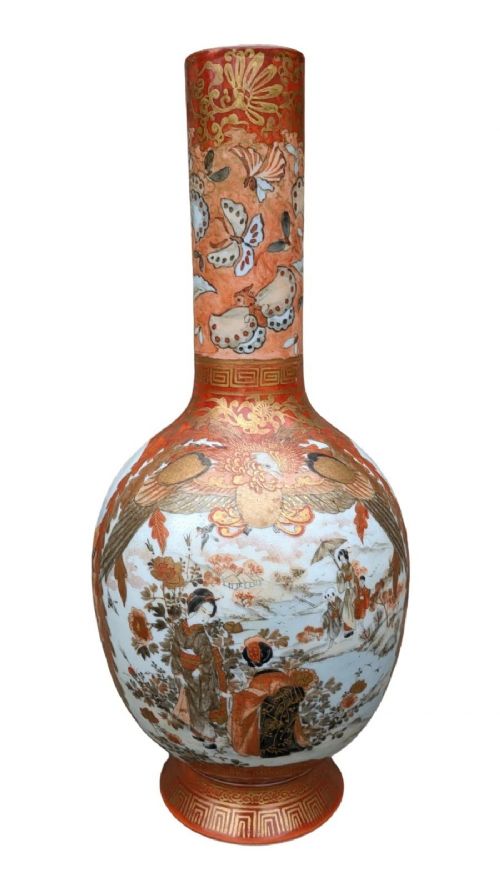


Hand Painted Kutani Urns
These hand painted kutani urns bring vibrant Japanese ceramic artistry to a room, offering rich colours and detailed historic scenes.
Hand Painted Kutani Urns
When you search for hand painted kutani urns, you encounter decorative Japanese vessels spanning the nineteenth and early twentieth centuries. These objects primarily take the form of vases, ginger jars, and floor vases originating from the Meiji and Taisho periods.
The pieces available here lean heavily towards pairs and single large vases, showcasing traditional forms like flared necks. Most examples date from the nineteenth century, including specific decades such as the 1870s, 1880s, 1890s, and 1900, alongside a few later pieces from around 1920.
Buyers seeking these items will find works produced for export as well as domestic markets, carrying distinct historical styles. The inventory reflects a strong concentration of nineteenth-century porcelain vessels rather than later decorative reproductions.
How they were made
Potters shaped these vessels from white porcelain before applying intricate hand-painted designs using rich enamels. Artisans frequently integrated gold leaf and heavy gilding to highlight specific motifs and borders across the surface.
The decorative schemes rely on detailed brushwork typical of Japanese export porcelain from the Meiji period and subsequent decades. Firing techniques fixed the enamel colours and gilt accents permanently onto the porcelain body.
One imposing pair stretches to fifty-four inches high, proving that nineteenth-century potters possessed serious ambition alongside steady hands.
What varies in quality
Quality in these ceramics rests upon the precision of the hand painting and the crispness of the enamel work. Superior examples display exceptionally fine brush detail in the figural or floral scenes.
The application and preservation of the gold leaf or gilt details also distinguish finer vessels from standard production pieces. Larger formats, such as fifty-four inch floor vases and matched pairs, represent the more ambitious end of the manufacturing scale.
The Hand Painted Kutani Urns Glossary
- Kutani
- A style of Japanese porcelain traditionally characterised by colourful hand-painted enamels and extensive use of gold. It originated in Ishikawa Prefecture and gained significant popularity during the Meiji period.
- Meiji Period
- The era in Japanese history spanning from 1868 to 1912, marked by the opening of trade with the West. Many export ceramics found on the market today date from this time of artistic exchange.
- Ginger Jar
- A high-shouldered ceramic vessel originally designed for storing spices and herbs. In decorative contexts, they often appear as matched pairs with fitted lids.
- Gilding
- The application of gold leaf or gilt paste to the surface of a ceramic object. It accentuates rims, panels, and decorative borders.
- Taisho Period
- The historical era following the Meiji period, lasting from 1912 to 1926. Ceramics from this time continue traditional decorative techniques while introducing slightly later stylistic shifts.
Hand Painted Kutani Urns: Frequently Asked Questions
How do I date these porcelain vases?
Dating relies on stylistic markers, historical periods such as the Meiji or Taisho eras, and manufacturing characteristics recorded in the listings. Nineteenth-century examples often display distinct export traits and specific regional painting styles.
Examining the base, the composition of the porcelain body, and the ageing of the enamel and gold leaf helps narrow down the production decade between 1800 and 1920.
Were these vessels made for export?
Many Japanese ceramics from this era were produced specifically for international markets following the opening of trade during the nineteenth century. These export pieces often catered to Western tastes while retaining traditional Japanese motifs.
The inclusion of Japanese export designations alongside Meiji period markers highlights this cross-cultural production background.
How should I display large floor vases?
Large floor vases require stable placement on solid flooring away from heavy foot traffic to ensure safety. Positioning them in entryways or corners allows their scale and detailed painted surfaces to become a focal point.
Paired vessels look striking when placed symmetrically flanking a fireplace or architectural feature.
What is the difference between vases and ginger jars?
Vases generally feature open necks designed for holding floral arrangements or standing alone as decorative objects. Ginger jars possess a distinct globular body with a high shoulder and traditionally include a matching lid.
Both forms utilise the same porcelain and enamel painting techniques within this tradition.