


Antique Japanese Vase Set
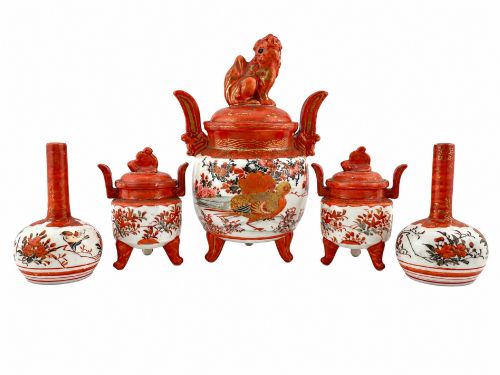
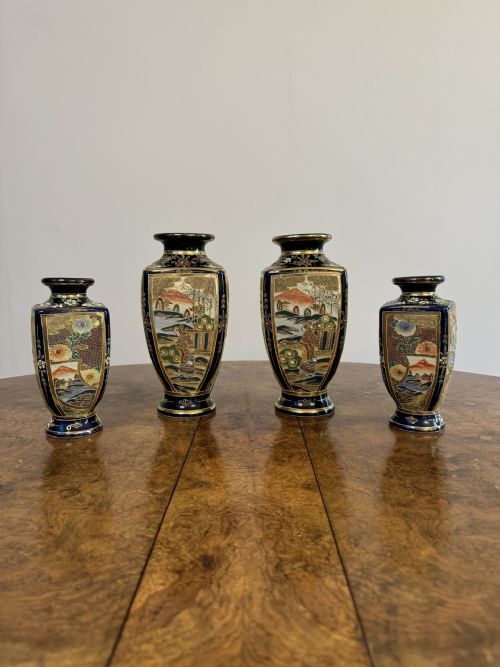
These antique japanese vase set pieces bring together matched groupings of Satsuma, Imari, and bronze work.
Antique Japanese Vase Set
An antique japanese vase set comprises matched groups of vessels intended to be displayed together on mantels or cabinets. These groupings appear as pairs, trios, and larger garnitures spanning several pieces.
The objects take the form of baluster urns, stem vases, and lidded vessels created in porcelain, earthenware, and bronze. Such groupings reflect the decorative traditions imported from Japan during the Edo, Meiji, and Victorian eras.
Buyers encounter sets decorated in the Imari palette alongside Satsuma earthenware and patinated bronze figures. These configurations range from small collections of seven vessels down to simpler pairs.
Materials and construction
Potters shaped porcelain and earthenware into vases before applying intricate glazes, enamel colours, and gold leaf highlights. Imari pieces utilise distinct cobalt blue and iron red pigments fired onto the ceramic body.
Bronze workers cast metal vessels using patination techniques to achieve darkened surfaces, often incorporating dragon motifs and candle holders. Satsuma pieces employ detailed enamel work over earthenware bases.
Listings feature pieces from the Victorian era, 1900, and the 18th century, alongside Meiji period works.
Distinctions in quality
The standard of an antique japanese vase set depends upon the precision of the hand-painted enamel and the preservation of the gold leaf. Pieces bearing maker attributions demonstrate finer detail in the brushwork and ceramic potting.
Garnitures that remain complete without mismatched replacements hold greater integrity as historic decorative objects. The depth of the cobalt in Imari pieces and the complexity of the bronze casting separate standard items from superior examples.
Kinkozan
The Antique Japanese Vase Set Glossary
- Garniture
- A matched set of three or more vases designed for symmetrical display on a mantelpiece or sideboard. These arrangements typically feature central urns flanked by smaller matching vessels.
- Imari
- A style of Japanese porcelain decorated in underglaze cobalt blue, iron red, and gold. The palette became immensely popular in Europe during the Edo period.
- Satsuma
- A type of Japanese earthenware featuring a crackle glaze decorated with polychrome enamels and gold leaf. These pieces were largely produced during the Meiji period.
- Baluster
- A vase shape characterised by a rounded body that tapers toward the base and swells near the lower centre. This form appears frequently in bronze and ceramic sets.
- Patinated Bronze
- Metalwork treated with chemical solutions to produce an aged surface colour. This technique accentuates the cast details on Japanese dragon vases.
Antique Japanese Vase Set: Frequently Asked Questions
What is a garniture set?
A garniture set consists of multiple matching vases designed to be displayed together as a decorative unit. These sets usually contain three, four, or five vessels of graduated sizes.
Historically, they were placed on mantels or above fireplaces in grand interiors. Each piece shares the same decorative palette and motif.
How do I care for these vases?
Dust these ceramic and bronze surfaces gently with a dry, soft cloth to protect the fragile gold leaf and enamel. Avoid using liquid cleaners or water on antique glazes.
Keep the pieces away from direct sunlight to prevent the enamel colours from fading over time.
What is the Imari palette?
The Imari palette relies on a distinct combination of underglaze cobalt blue and iron red, often augmented with gold leaf. Artisans applied these colours over a white porcelain base to create striking geometric and floral patterns.
This style originated in Japan during the Edo period and was widely exported to the West.
How do I identify Satsuma ware?
Satsuma ware is characterised by a distinctive ivory-coloured earthenware body covered in a fine, network-like crackle glaze. Artisans then applied dense polychrome enamel and raised gold leaf decorations over this surface.
Most surviving examples date from the Meiji period.