

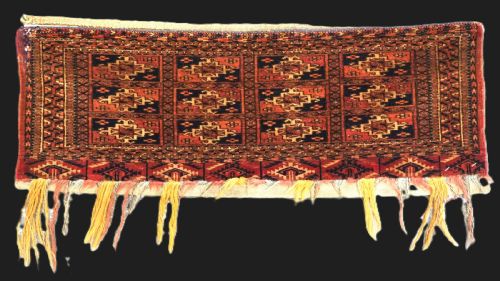


Hand Knotted Turkmen Textile
When you handle a hand knotted turkmen textile, you hold centuries of nomadic artistry woven into durable wool and dyed with rich natural tones.
Hand Knotted Turkmen Textile
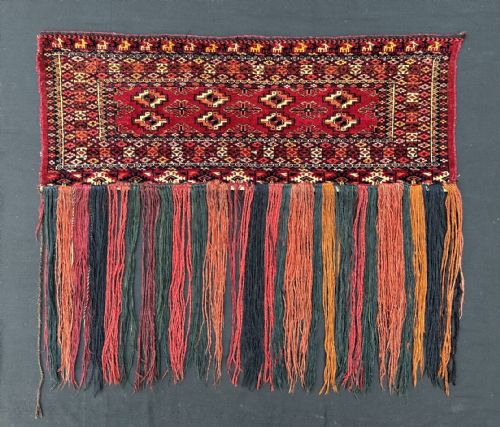
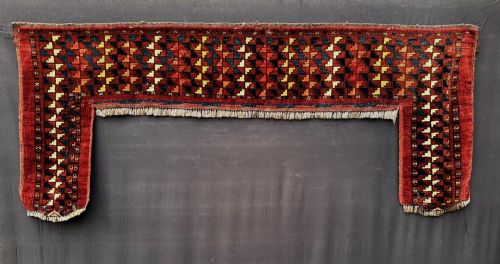
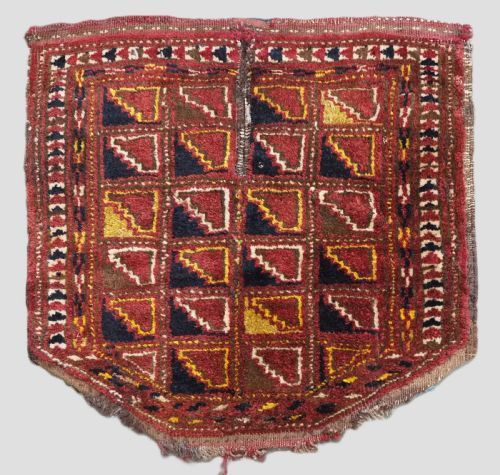
A hand knotted turkmen textile encompasses a variety of tribal forms including utilitarian storage bags, hanging door covers known as engsi, and floor rugs produced across Central Asia. These items originate from specific tribal groups such as the Tekke, Yomut, Ersari, and Saryk, reflecting distinct regional aesthetics within Turkmenistan and surrounding steppes.
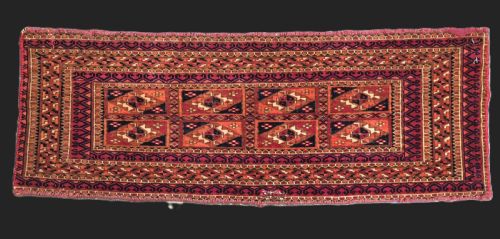
The objects available on this page lean heavily towards functional domestic weaving created for nomadic life, particularly torba face fragments, chuvals, and kaplyks. Dating largely from the nineteenth century, these pieces demonstrate the traditional tribal designs and structural formats passed down through generations of weavers.
Collectors encounter characteristic motifs like the repeating primary gul, secondary ornaments, and panel layouts that identify the specific tribal weaving tradition. Each survivor represents an expression of nomadic culture adapted for practical storage or interior tent decoration.
Assessing quality in tribal weaving
The standard of a hand knotted turkmen textile depends heavily on the density of the knotting and the crispness of the drafted design. Finer weaves allow complex tribal guls and secondary ornaments to appear with greater geometric precision.
Colour saturation and the skillful deployment of natural dye variations dictate the visual depth of the textile. Pieces exhibiting wide tonal variation within individual motifs and robust wool quality stand apart from simpler or more rigidly uniform examples.
Listings feature nineteen-century nomadic weavings constructed from hand-spun wool, cotton foundations, and natural dye palettes.
The Hand Knotted Turkmen Textile Glossary
- Gul
- The primary medallion or octagonal stamp motif repeated across the field of a tribal weaving. These major design elements often identify the specific clan or tribal group responsible for the piece.
- Torba
- A small utility bag used inside nomadic tents for storage. These rectangular faces frequently survive as independent decorative fragments.
- Chuval
- A large tent bag traditionally utilised for bedding and household storage. They display multiple primary guls arranged across the central field.
- Engsi
- A specialised wall hanging or tent door rug placed at the entrance of a nomadic dwelling. They typically feature a quartered field design separated by a candelabra motif.
- Asmalyk
- A pentagonal trapping often associated with camel processions during wedding ceremonies. Their distinctive shape and elaborate design make them sought-after collector pieces.
Hand Knotted Turkmen Textile: Frequently Asked Questions
How do I identify a Tekke piece?
Tekke tribal weavings generally feature precise octagonal primary guls arranged in orderly rows across a deep madder red field.
They are further distinguished by fine knotting and characteristic minor ornaments like the alem border at the base.
Where were these textiles made?
These pieces were produced across the Trans-Caspian steppes, Akhal oasis, and the Amu Darya region of Central Asia.
Different tribes occupied specific geographic zones, imbuing their work with local stylistic traits.
How should I display a textile?
Many collectors mount smaller bag faces and fragments securely onto neutral fabric backings for wall display.
Ensure pieces are kept out of direct sunlight to protect the natural wool dyes from fading.