


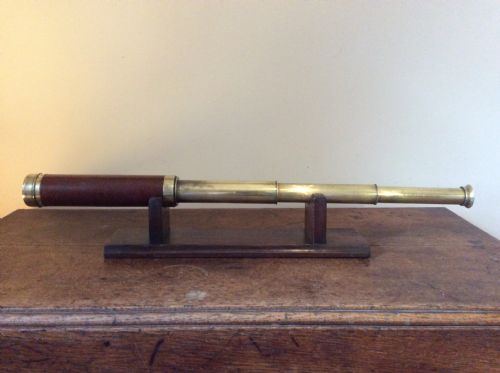


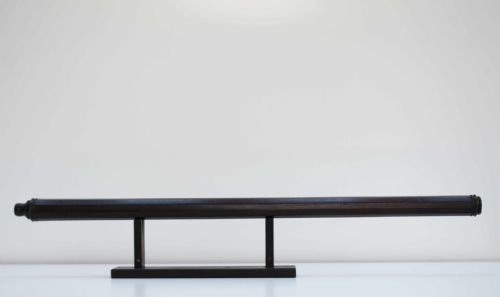
Georgian Brass Spyglass
These georgian brass spyglass items are precision optical instruments built for navigation and observation, prized by collectors for their period mechanics and polished metal finish.
Georgian Brass Spyglass
A georgian brass spyglass is a portable optical instrument designed for navigation, science, and domestic study during the eighteenth and nineteenth centuries. These pieces appear primarily as multi-draw telescopes housed in wood, leather, or cardboard cases.
Most examples originate from the Georgian and Regency periods, spanning the middle of the eighteenth century through to the early nineteenth century. Collectors will encounter library telescopes on stands alongside compact pocket versions intended for travel.
Makers from London dominate the selections, ranging from simple scientific tools to complex decagonal and nine-sided barrels. The forms vary from handheld three-draw configurations to heavy desk models mounted on wooden supports.
Materials and construction
Makers shaped the tubes from polished brass, often combining the metal with turned mahogany, walnut, or other dense woods. Some barrels incorporate leather wraps or cardboard layers to protect the inner sliding draws.
Opticians ground glass lenses to fit non-achromatic and Gregorian optical systems housed within the nested brass draws. Workshops utilised precision turning techniques to ensure each section slid smoothly without losing alignment.
Listings span the eighteenth and nineteenth centuries, featuring brass combined with mahogany, walnut, glass, leather, and cardboard.
Assessing quality and craftsmanship
Quality rests in the precision of the signed maker's inscription, the clarity of the glass, and the tightness of the draw fittings. Engraved signatures by established London instrument makers distinguish high-status pieces from unsigned workshop output.
The complexity of the barrel design influences desirability, such as decagonal or nine-sided geometries rather than standard round tubes. Original fitted wooden cases also separate complete surviving units from bare instruments.
Nairne & Blunt of London·W. & T. Gilbert London·Matthew Berge London·G.adams of london·John Gilbert
The Georgian Brass Spyglass Glossary
- Draw
- A sliding tube section that extends the length of the telescope. Multiple draws allow a long focal length to collapse into a compact portable cylinder.
- Gregorian
- A type of reflecting telescope utilising a concave secondary mirror. This design directs light back through a hole in the primary mirror to the eyepiece.
- Non-achromatic
- An early optical system that does not correct for chromatic aberration. Users see slight colour fringes around bright objects through these lenses.
- Decagonal
- A ten-sided geometric shape utilised for the outer barrel of certain telescopes. This unusual form required specialist hand-shaping by the maker.
Georgian Brass Spyglass: Frequently Asked Questions
How do you focus a telescope?
Users pull out the nested brass draws fully and then adjust the final small section near the eyepiece until the distant view sharpens.
Friction holds each draw in place when extended, so steady movement helps find the correct focal length.
Were these used at sea?
Many pocket and three-draw versions served naval officers and navigators for spotting landmarks and ships from deck.
Larger library instruments remained indoors on desks or stands for studying the horizon or the stars.
How do you clean brass barrels?
Light dusting with a dry cloth preserves the aged patina that collectors prefer on historic optical instruments.
Harsh metal polishes strip away the centuries of oxidation that authenticate an eighteenth-century finish.
How do you date a telescope?
Engraved signatures point directly to the working decades of the London makers recorded in trade directories.
Materials like mahogany and walnut, alongside multi-draw mechanics, help confirm whether a piece belongs to the Georgian or Victorian eras.