
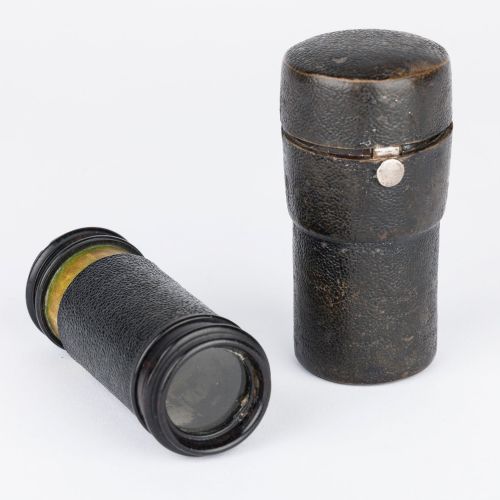


Vintage Maritime Telescope
A vintage maritime telescope brings the weight of brass, leather, and glass into the hand, offering a direct link to nineteenth-century navigation.
Vintage Maritime Telescope
When you search for a vintage maritime telescope, you are looking at optical instruments designed for use at sea, spanning periods from the eighteenth century through to the early twentieth century. The version you are most likely to meet on this page is the brass single-draw, two-draw, or three-draw telescope, often encased in leather or mahogany.
The selection ranges from pocket spyglasses to officer of the watch instruments and larger deck telescopes. Origins stretch across Georgian, Regency, Victorian, Edwardian, and early twentieth-century eras, with English makers strongly represented alongside continental European workshops.
These instruments functioned as essential navigational tools for naval officers, explorers, and mariners who required clear magnification at sea or in the field. Their forms vary from compact pocket-sized tubes to extended marine spyglasses intended for day and night use.
Materials and construction
Exterior surfaces often show precise maker signatures, period engravings, or presentation inscriptions directly into the brass draw tubes or eyepiece mounts. Cardboard interiors and internal spacers occasionally appear in period pocket spyglasses and earlier non-achromatic designs.
Listings feature brass, leather, wood, glass, and nickel across Victorian, Edwardian, Georgian, and Regency periods.
What separates examples
Quality rests in the precision of the optics, the crispness of the maker's signature engraved upon the brass, and the tightness of the draw tubes when extended. Superior examples retain their original focal clarity, smooth draw action, and unpolished patination on the brass and leather surfaces.
The reputation of the workshop, such as London makers Ross, Dollond, or W. & T. Gilbert, distinguishes standard utility instruments from signed presentation pieces. The integration of quality secondary materials, such as finely turned mahogany or supple leather, elevates an instrument beyond a basic working tool.
Ross of London·Voigtländer and Sohn AG·W and T Gilbert·Clarkson·Richardson·Newton and Co·A Hurlimann Paris·Broadhurst Clarkson and Co·Cary London·Negretti and Zambra·L Casella·Dollond·John Gilbert
The Vintage Maritime Telescope Glossary
- Draw
- A sliding tubular section of a telescope that pulls out from the main barrel to adjust the focus. Multiple draws allow the instrument to collapse down to a portable size.
- Spyglass
- A small, portable refracting telescope used historically by sailors and travellers. The term often describes pocket-sized instruments.
- Officer of the watch telescope
- A specialised marine telescope designed for naval watchkeepers to scan the horizon in varying light conditions. These often feature large objective lenses for enhanced visibility.
- Achromatic
- An optical lens designed to correct chromatic aberration, bringing light of different colours to the same focal point. This improvement allowed for sharper, colour-corrected images.
- Non-achromatic
- An earlier optical configuration that precedes the widespread adoption of color-correcting lenses. These instruments offer historic insight into eighteenth-century optical manufacturing.
Vintage Maritime Telescope: Frequently Asked Questions
How do I use a draw telescope?
Pull all the brass sections fully outward until the instrument is at its maximum length. Adjust the smallest eyepiece tube near your eye inward or outward until the distant view sharpens into focus.
Keep the lenses clean using appropriate optical cloths and avoid forcing the brass draws if they stick in damp conditions.
Can I still see through them clearly?
Most vintage maritime telescopes retain functional glass lenses capable of magnification. However, optical standards reflect the technology of their manufacturing period rather than modern glass.
Dust or minor ageing within the internal barrel tubes is common in instruments dating back to the Georgian and Victorian eras.
How do I tell a Georgian telescope from a Victorian one?
Georgian and Regency examples often feature distinct wood bodies like walnut or mahogany alongside simpler brass fittings and hand-engraved signatures. Victorian and Edwardian models frequently introduce standardised brass components, leather-dressed barrels, and multiple draw configurations.
Maker signatures and style cues within the listings provide the clearest indication of an instrument's specific period.
How should I display a cased telescope?
Display the telescope resting safely on a flat surface, either fully extended or collapsed beside its fitted case. Keep the instrument away from direct sunlight and extreme temperature fluctuations to protect any leather dressings and wood.
Occasional handling helps maintain the smooth action of the brass sliding draws.