
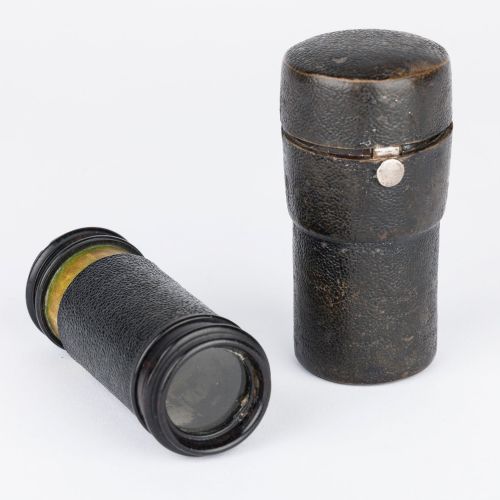


Maritime Spyglass Telescope
A maritime spyglass telescope is a portable optical instrument designed for distance viewing at sea, combining solid brass tubes with leather or wood grips.
Maritime Spyglass Telescope
A maritime spyglass telescope is an optical instrument designed for navigation and distance observation, primarily encountered here in multi-draw formats from the Victorian, Edwardian, and Georgian periods. These instruments range from compact pocket versions to substantial single-draw and multi-draw marine models housed in wood or leather.
The pieces appearing on this page span the eighteenth century through the early twentieth century, taking forms such as officer of the watch telescopes, tabletop variants, and simple extending spyglasses. Most examples utilise brass barrels alongside traditional materials like mahogany, walnut, or cardboard casing.
What varies in quality
Quality rests upon the optical clarity of the glass lenses and the mechanical precision of the sliding draws when fully extended. Finer instruments maintain a tight, aligned fit between the brass sections without excessive wobble or slack.
The reputation of the maker and the grade of materials employed distinguish standard production items from workshop pieces bearing signatures such as Ross of London or Dollond. Superior examples exhibit crisp barrel engraving, careful leather stitching, and well-seasoned timbers.
Listings feature instruments spanning from the mid-eighteenth century through the Edwardian era, constructed in brass, glass, leather, and wood.
Ross of London·Voigtländer and Sohn AG·W and T Gilbert·Clarkson·Newton and Co·Broadhurst Clarkson and Co·Cary London·L Casella·Davis of London·John Gilbert·W Harris
The Maritime Spyglass Telescope Glossary
- Draw
- A sliding tubular section of a telescope that extends outward to adjust the focal length. Multi-draw instruments collapse into shorter lengths for portability.
- Achromatic
- An optical lens designed to correct chromatic aberration, bringing light of different colours to the same focal point for clearer viewing. Many later maritime models utilised this technology.
- Single Draw
- A telescope comprising just two tubes, where one barrel slides within a single main body. This configuration offers greater rigidity than multi-draw alternatives.
- Officer of the Watch
- A specialised naval telescope utilised by deck officers for signalling and horizon scanning during watch duties. These frequently incorporate leather grips for wet conditions.
Maritime Spyglass Telescope: Frequently Asked Questions
How do I focus a maritime spyglass telescope?
Focusing is achieved by pulling the smallest draw completely out and then gently sliding the main eyepiece tube inward or outward until the distant horizon sharpens. Make small adjustments while sighting a clear, distant edge.
Ensure all sliding brass sections are fully extended and aligned straight to prevent internal shadows or distorted magnification fields.
Can I use an antique telescope for modern viewing?
These instruments function well for casual terrestrial viewing across fields or water, though magnification levels and fields of view differ from modern binoculars. Older lenses may show minor internal dust or natural ageing.
Keep in mind that historical optical designs prioritize portability and durability over high-power twilight clarity.
How do I determine the period of a telescope?
Dating relies on maker signatures, address inscriptions engraved on the draw tubes, and the choice of external materials like leather, walnut, or mahogany. Earlier eighteenth-century models often feature distinct taper profiles compared to standardised Victorian designs.
Examine the style of typography used on the maker's signature plate for chronological clues.