


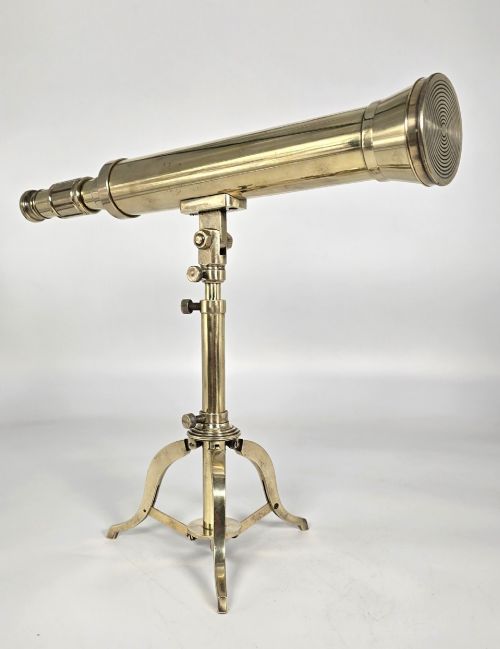


Antique Nautical Telescope
An antique nautical telescope brings the precision of maritime navigation into focus, offering brass barrels and leather grips that evoke centuries of ocean travel.
Antique Nautical Telescope
When searching for an antique nautical telescope, buyers encounter optical instruments designed for maritime use, surveying and stargazing. The selection spans periods from the Georgian era through the Victorian period and into the Edwardian age, reflecting the evolution of science and sea travel.
Most examples found in these listings are multi-draw brass telescopes, often complemented by leather or wood jackets. These portable spyglasses and larger library instruments represent the practical tools utilised by officers of the watch and explorers.
The objects originate primarily from English makers, alongside continental European workshops, taking forms such as marine telescopes, pocket spyglasses and table top instruments. Each piece demonstrates the mechanical ingenuity required for terrestrial and astronomical observation.
Materials and construction
Makers constructed these instruments using durable metals, predominantly brass, paired with glass lenses for precision optics. Many tubes feature protective coverings of leather, mahogany, walnut or fruitwood to improve grip and shield the metal from maritime environments.
Craftsmen assembled sliding draw tubes that allowed the barrels to extend smoothly for focusing. Additional stability was achieved through specialised stands in wood and brass, while inscriptions were often engraved directly onto the metal draw plates.
Some nineteenth-century officers kept day or night telescopes on deck, hoping to spot a friendly sail before the evening fog rolled in.
Evaluating craftsmanship and condition
Quality in an antique nautical telescope rests upon the clarity of the optics and the precision of the draw tubes. Smooth extension without binding indicates superior lathe work and careful fitting by the original maker.
The presence of signed maker engravings on the brass adds distinction, separating standard utility pieces from workshop-certified instruments. Furthermore, intact leather dressings and original wooden cases elevate the desirability of the piece.
Nairne & Blunt of London·Ross of London·Voigtländer & Sohn AG·Clarkson London·Steward of London·Newton & Co·Broadhurst Clarkson & Co·Cary London·L. Casella London·Alexander Adie of Edinburgh·Chadburn Brothers of Sheffield·John Gilbert
The Antique Nautical Telescope Glossary
- Draw
- A sliding section of a telescope barrel that extends to adjust the focal length. Multi-draw instruments collapse into compact lengths for travel.
- Spyglass
- A small, portable refracting telescope used for terrestrial viewing. These pocket-sized instruments were standard equipment for maritime officers.
- Achromatic
- A lens designed to correct chromatic aberration, bringing colours into focus together. This optical improvement became standard in scientific instruments from the eighteenth century onward.
- Terrestrial
- An optical configuration designed for viewing objects on land rather than stars. Most marine telescopes utilise this layout to provide an upright image.
- Altazimuth
- A mounting that allows an instrument to rotate in both altitude and azimuth axes. This system appears on larger library and scientific stands.
Antique Nautical Telescope: Frequently Asked Questions
What is a single draw telescope?
A single draw telescope consists of just two tubes sliding one within the other. This simpler mechanical design offers quicker deployment for quick sightings at sea.
Such configurations appear frequently among Victorian marine instruments and officer of the watch spyglasses.
How do I date an antique telescope?
Dating relies on maker signatures, material choices and mechanical styles recorded in the hardware. Georgian and Regency pieces often show simpler wood and brass pairings, whilst Victorian examples frequently incorporate multiple draw tubes and leather jackets.
Engraved signatures referencing specific trading addresses help narrow the production decade through historical trade directories.
Were these used exclusively at sea?
While many served as naval and marine instruments for navigation and signaling, others were built for land use. Library telescopes and astronomical table top models were designed for stationary terrestrial and star observation.
Officers of the watch carried portable versions on deck, whereas larger brass instruments on folding tripods remained fixed in domestic rooms or observatories.
What maintenance do brass telescopes need?
Preserving these instruments involves keeping the brass dry and occasionally dusting the glass lenses with care. Forcing tight draw tubes can damage the internal stops, so gentle handling during extension is essential.
Natural leather dressings can be applied sparingly to maintain the suppleness of nineteenth-century grips without harming the underlying wood or metal.