
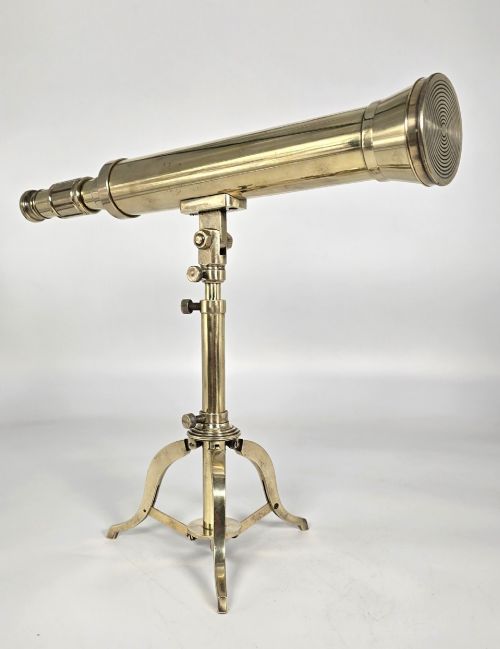


English Brass Telescope
An English brass telescope offers a tangible link to optical history, combining precision engineering with practical maritime and terrestrial use.
English Brass Telescope
When searching for an English brass telescope, buyers encounter optical instruments spanning the Georgian, Regency, Victorian, and Edwardian periods. These pieces range from compact pocket spyglasses and multi-draw officer of the watch models to large library and astronomical telescopes mounted on folding tripods.
The most common items on this page are three-draw and two-draw Victorian and Edwardian terrestrial telescopes. Many examples combine polished brass tubes with stitched leather, fruitwood, mahogany, or walnut body grips designed for field, marine, or navigational tasks.
Specialised variants also appear within the collection, including military campaign instruments, walking cane telescopes with bone or wood shafts, and day or night naval configurations. These objects reflect the widespread domestic and imperial demand for portable scientific equipment during the nineteenth and early twentieth centuries.
Materials and Construction
Makers constructed the primary optical tubes and draw sections from turned and polished brass, paired with objective and ocular glass lenses. Many cylindrical bodies received protective coverings of dark leather, while others exposed turned wooden sleeves of walnut, mahogany, fruitwood, or oak.
Internal components relied on multiple sliding brass draw tubes that allowed the focal length to expand and collapse. Finer details involved engraved maker signatures on the brass draw collars, occasional silvered metal dials, and fitted wooden transport cases.
Some Victorian gentlemen covertly surveyed the park through walking canes fitted with hidden brass optics and bone handles.
Evaluating Quality
Quality in these instruments rests upon the clarity of the optical glass and the precision with which the brass draw tubes slide and lock. Heavier gauge brass, robust leather stitching, and retained original lenses or tripods separate superior survivals from ordinary items.
Signed examples bearing the names of established makers or retailers command distinct attention from collectors. The presence of matching protective cases or original folding brass tripod stands also elevates the completeness of a piece.
Ross of London·Newton & Co·Broadhurst Clarkson & Co·Davis of London·Henry Hughes·J Sewill·Dollond·J H Steward·Rothwell, Manchester·Richardson·W&S Jones
The English Brass Telescope Glossary
- Draw
- A sliding tubular section of a telescope barrel. Multiple draws allow a long focal length to collapse into a portable size.
- Terrestrial
- Designed for viewing objects on land rather than astronomical bodies. These scopes utilise erecting lenses to ensure the image appears right side up.
- Spyglass
- A small, portable hand-held telescope. The term typically applies to simpler multi-draw pocket instruments utilised by travellers and naval officers.
- Refractor
- An optical telescope that uses a system of lenses to form an image. Light passes from the objective lens through to the eyepiece at the rear.
English Brass Telescope: Frequently Asked Questions
How do I use a multi-draw telescope?
To use a multi-draw telescope, pull each brass section fully outward until the internal stops engage and the tube is rigid. Sight the instrument on a distant terrestrial object and adjust the final eyepiece draw until the image sharpens.
Keep the lenses clean and avoid forcing stiff draws. When collapsing the telescope, push the smallest section inward first before moving to the larger barrels.
What is the difference between day and night telescopes?
Day and night telescopes feature larger objective lenses designed to gather maximum ambient light. This configuration allowed naval officers to maintain visibility during dawn, dusk, or heavy weather.
Standard daytime spyglasses offered narrower apertures suited to bright sunlight. Day or night variants are typically bulkier instruments with wider brass barrels.
How are periods identified on these telescopes?
Periods are determined through a combination of engraved maker signatures, typography styles, and construction materials. Georgian and Regency pieces often feature simple mahogany tubes and minimal markings, while Victorian and Edwardian examples frequently use leather grips and machine-threaded components.
Comparative study of recorded maker working dates helps narrow the timeline. Reference archives provide benchmark examples dated from the late eighteenth century onward.
Were these telescopes used exclusively at sea?
While maritime and naval applications dominated production, many telescopes served terrestrial and astronomical functions. Explorers, military officers, and naturalists relied on portable spyglasses for land navigation and reconnaissance.
Larger library instruments remained stationary inside homes for star gazing and landscape observation. Walking cane telescopes combined personal support with covert optical utility.