

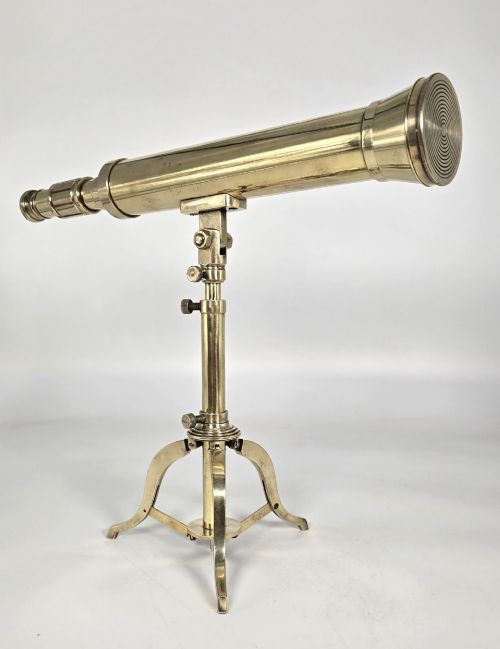


Victorian Brass Scope
A victorian brass scope brings history to your shelf, offering functional optics crafted from gleaming metal and warm timber.
Victorian Brass Scope
A victorian brass scope is a historical optical instrument designed for navigation, observation, or scientific study. When buyers search for this phrase, they encounter portable draw telescopes, substantial library models on stands, microscopes, and opera glasses.
The most common version on this page is the multi-draw terrestrial telescope. These pieces range from compact pocket spyglasses to larger instruments housed in fitted mahogany or oak cases.
Objects originate primarily from British workshops, though continental makers also appear. Alongside marine and land telescopes, the category encompasses scientific instruments such as bar limb microscopes.
Materials and construction
Makers constructed these scopes using polished brass tubes paired with glass lenses for magnification. Many draw telescopes incorporate hand-stitched leather grips or wood veneers like mahogany and walnut around the metal barrels.
Heavier library and scientific instruments utilise cast iron or brass stands for stability. Cases are built from sturdy timbers such as oak and mahogany, often fitted with brass hinges and closing hooks.
Victorian Brass Scope Retail Price Guide 2026
Typical asking prices for victorian brass scope among the pieces listed under this phrase on Sellingantiques today, from the lower quarter to the upper quarter. They describe what is for sale here now, not the wider market.
Materials recorded across these instruments include brass, leather, glass, wood, nickel, oak, mahogany, and cast iron.
Judging quality in these instruments
Quality rests on the precision of the optical engineering and the clarity of the lenses. Examples signed by noted makers demonstrate superior mechanical tolerances in the sliding draws and focusing adjustments.
The choice of secondary materials separates standard utility pieces from luxury library instruments. Fitted hardwood cases with dovetail joints and inscribed maker plaques elevate the status of an optical tool.
H Hughes & Son·Ross of London·Newton & Co·Chadburn Brothers·Davis of London·Bate of London·Henry Hughes·Dollond·J Sewill·J H Steward·Wray London
The Victorian Brass Scope Glossary
- Draw
- A sliding tubular section of a telescope barrel that extends to alter the focal length. Multiple draws allow a long instrument to collapse into a compact size.
- Terrestrial
- An optical configuration designed for viewing objects on land rather than stars. These scopes provide an upright image rather than an inverted one.
- Bar limb
- A central structural arm on a microscope that supports the optical body tube and stage. It provides rigidity and alignment for scientific work.
- Achromatic
- A lens design that corrects for colour distortion by bringing red and blue light to the same focal point. This results in sharper images with truer contrast.
Victorian Brass Scope: Frequently Asked Questions
Can I use a vintage telescope for viewing?
Many of these instruments remain functional for daytime viewing when adjusted properly. The internal lenses gather light to magnify distant terrestrial objects.
Older optics lack modern coatings, so images may appear dimmer than through contemporary glasses. Careful cleaning of accessible glass helps maintain clarity.
What is the difference between a spyglass and a library scope?
Spyglasses are portable, multi-draw instruments designed to be collapsed and carried in a pocket or coat. They served travellers, officers, and sailors.
Library scopes are larger, heavier instruments mounted on wooden or metal stands. They stayed indoors on desks or tables for detailed study of land or sky.
How do I care for brass and leather on antiques?
Brass surfaces develop a natural dark patina over decades of handling. Gentle dusting preserves this finish without removing the historical character.
Leather grips benefit from occasional conditioning to prevent drying and cracking. Keep optical instruments away from damp environments to protect the internal glass lenses.
How are different periods identified?
Stylistic shifts and makers' marks help narrow down the date of manufacture. Simpler finishes often appear on pieces from earlier decades.
Engraved signatures on the draw tubes or barrels link instruments to specific workshops. Surviving dated cases or receipts provide further evidence of production years.