

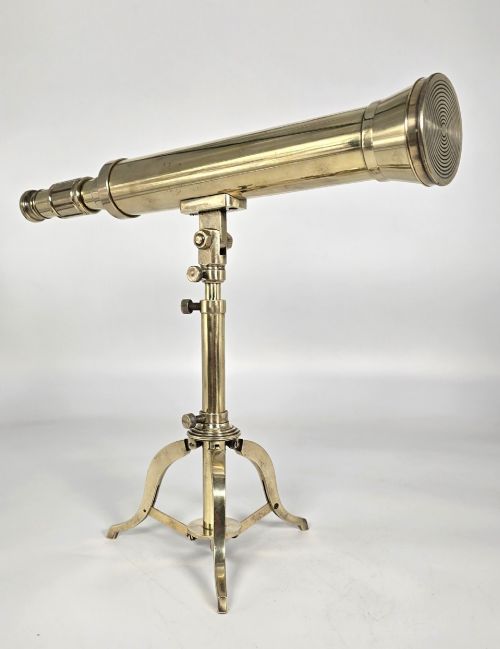


Brass Tripod Spyglass
These brass tripod spyglass instruments offer practical magnification on sturdy stands, bringing historic optics directly to your desk or library.
Brass Tripod Spyglass
A brass tripod spyglass is typically encountered as a library telescope, tabletop telescope, or scientific instrument designed for indoor observation. These pieces span the Georgian, Victorian, and Edwardian periods, alongside specific dates from the eighteenth century through to the early twentieth century.
The forms range from compact cased library models on stands to military campaign versions and larger terrestrial devices. Most examples sit upon folding brass tripods or dedicated tabletop mounts, combining portability with stable viewing.
Makers of these optical instruments often inscribed their signatures directly onto the brass barrels, linking surviving pieces to historic London workshops. Buyers exploring this phrase will find a steady mix of polished brass, mahogany, and nickel finishes across these historical eras.
Materials and construction
These instruments are constructed primarily from polished or gilt brass, paired with glass lenses for optical magnification. Many examples integrate wood components such as mahogany, alongside iron or steel elements within the mechanical supports.
Workshops utilised precision turning and metal-finishing techniques to create sliding draw tubes and adjustable tabletop stands. Protective wooden cases lined with fitted materials frequently accompanied these scientific instruments to safeguard the delicate glass optics during transport.
Some nineteenth-century astronomers used library telescopes indoors because peering at the stars through a parlour window felt suitably civilised.
Distinctions in quality
Quality in these instruments rests upon the precision of the optical glass and the crispness of the maker signatures engraved on the brass barrels. Signed London instruments by notable opticians reflect higher standards of workshop execution compared to anonymous output.
The integrity of the original folding brass tripod stand and the smoothness of the adjustable focus mechanisms further separate standard examples from finer survivals. Complete sets retaining their original fitted wooden cases demonstrate superior preservation.
Johnson·W. & T. Gilbert·Clarkson·Steward of London·S & B Solomons·Matthew Berge·G. Adams
The Brass Tripod Spyglass Glossary
- Library telescope
- A large optical instrument designed for indoor use, typically mounted on a tabletop stand rather than carried outdoors.
- Terrestrial telescope
- An optical device configured to produce an upright image for viewing land-based objects and scenery.
- Gregorian telescope
- A reflective design utilising a concave primary mirror and a secondary mirror to focus light through an aperture.
- Campaign telescope
- A portable instrument engineered to collapse compactly for transport during military or travel use.
- Draw tube
- One of the sliding tubular sections that extends to adjust the focal length of the telescope.
Brass Tripod Spyglass: Frequently Asked Questions
How do I use a brass tripod spyglass?
Mount the telescope securely onto its folding brass tripod or tabletop stand. Adjust the sliding draw tubes until the distant object comes into sharp focus.
Support the main brass barrel gently when altering the angle to protect the historical mount and joints from strain.
Where were these historical telescopes made?
Many surviving examples originate from specialised optical workshops in London, produced by established instrument makers. These urban workshops supplied precision scientific equipment for libraries, naval officers, and domestic use.
Signed barrels frequently record the maker name and street address, anchoring the piece to a specific historic trade district.
How do I clean the brass and glass?
Dust the brass surfaces lightly with a soft, dry cloth to preserve the historical patina accumulated over the centuries. Avoid abrasive polishes that might wear away engraved maker inscriptions or thin gilt layers.
Clean the glass lenses with a dedicated optical microfiber cloth, taking care not to apply liquid directly to antique element mountings.
Can I use it for stargazing?
These historical instruments are primarily configured as terrestrial spyglasses or library telescopes for viewing land-based subjects. Their optical designs and lens configurations are optimised for horizontal observation rather than deep space astronomy.
While major celestial bodies may be visible, terrestrial models produce upright views specifically tailored for daytime landscape or maritime sighting.
How do I date an antique telescope?
Examine any signatures, addresses, or inscriptions engraved on the brass barrel, which often correspond to known working periods of the optician. Stylistic details of the tripod stand, mounting brackets, and enclosing wooden cases also provide clues to the era of manufacture.
Comparing the materials, such as the transition from early mahogany bodies to later nickel-plated brass, helps narrow down the decade.