


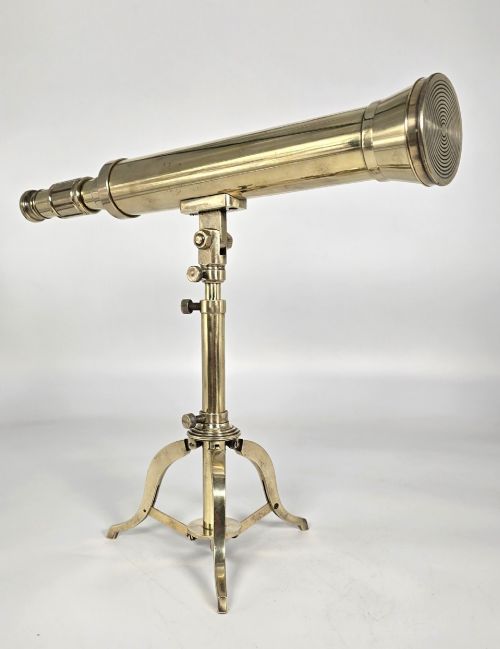


Brass Refractor Telescope
These brass refractor telescope pieces bring historic observation instruments into modern rooms.
Brass Refractor Telescope
A brass refractor telescope is an optical instrument used for viewing distant terrestrial or celestial targets, encountered here across periods from the eighteenth century to the early twentieth century. Buyers seeking a brass refractor telescope examine library telescopes, tabletop models, and portable draw telescopes designed for maritime or field use.
The material record spans nineteenth century, eighteenth century, regency, and georgian eras, with Victorian maritime styles and library instruments appearing frequently. English makers feature prominently in these optical instruments, ranging from pocket formats to large scientific pieces mounted on folding stands.
Materials and construction
Makers construct these instruments primarily from polished brass, often combined with turned mahogany barrels or leather grips for handling. Glass lenses provide the optical magnification within multiple draw tubes or stationary main barrels.
Support systems include original folding brass tripods and cast iron or steel components for tabletop stability. Nickel plating also appears on later twentieth century examples to alter the metal finish.
Brass Refractor Telescope Retail Price Guide 2026
Typical asking prices for brass refractor telescope among the pieces listed under this phrase on Sellingantiques today, from the lower quarter to the upper quarter. They describe what is for sale here now, not the wider market.
One listed library telescope carries the delightful historical model name Starboy.
Distinctions in quality
Quality rests on the precision of the optical engineering and the reputation of the workshop that signed the barrel. Instruments bearing known London maker signatures demonstrate superior metalwork and finishing compared to unsigned examples.
The presence of original fitted stands, complex multi-draw configurations, and secondary materials like well-turned mahogany elevate an instrument. Finer examples maintain crisp engraving on the brass tubes and clear glass optics within the refractor assembly.
Nairne & Blunt of London·W. & T. Gilbert London·Steward of London·S & B Solomons·G.adams of london·Broadhurst & Co
The Brass Refractor Telescope Glossary
- Refractor
- An optical telescope design that uses lenses to form an image. Light passes through a primary objective lens at the front to a local eyepiece.
- Draw
- A sliding tube section that extends the telescope body. Multi-draw instruments collapse down for portability.
- Library telescope
- A larger stationary instrument mounted on a tabletop stand designed for indoor study rather than field carriage.
- Terrestrial
- An optical configuration oriented for viewing land objects rather than inverted astronomical targets. These instruments include erecting lenses to present an upright view.
- Campaign telescope
- A portable instrument built for military use in the field. These pieces typically feature protective leather or robust brass housings.
Brass Refractor Telescope: Frequently Asked Questions
How do I use a draw telescope?
Extend the sliding brass tubes fully until each section locks or seats firmly in place. Adjust the final eyepiece section to bring distant subjects into sharp focus.
Keep the glass lenses clean and handle the moving brass draws steadily to avoid straining the internal alignment.
What is a library telescope?
A library telescope is a substantial optical instrument intended for indoor use on a table or desk rather than handheld observation.
These instruments usually rest on a dedicated wooden or brass stand and offer larger objective lenses for brighter viewing.
How do I date a brass telescope?
Examine the style of the maker signature, the number of draw tubes, and the accompanying materials like mahogany or leather. Eighteenth and nineteenth century pieces often show hand engraving and specific brass casting techniques.
Compare the mounting hardware and overall proportions with documented examples from the same period.
Where were these telescopes made?
The recorded instruments originate primarily from English workshops and London makers operating during the Georgian and Victorian eras. London firms dominated optical instrument production during these centuries.
Regional makers and general maritime supply workshops also contributed to the survival of these brass instruments.