


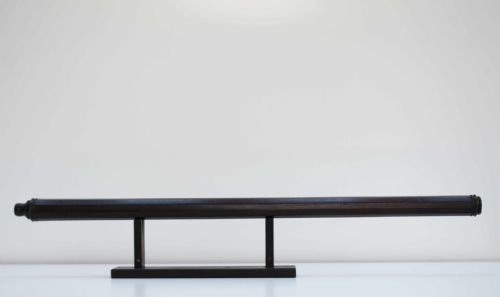
18th Century Telescope
These 18th century telescope pieces are precision brass and timber instruments offering a tangible connection to Georgian navigation and science.
Understanding the 18th Century Telescope
An 18th century telescope represents the pinnacle of Georgian scientific instrument making, designed for both terrestrial navigation and library study. Buyers searching this category encounter portable refractor instruments alongside table-standing Gregorian reflectors.
The most common formats on this page are multi-draw brass spyglasses and mahogany-clad library models. These instruments reflect the scientific curiosity and maritime expansion of the Georgian era.
Originating primarily from English workshops, these pieces encompass navigational instruments and specialised scientific apparatus. Each telescope demonstrates the practical optical needs of the period, from shipboard use to domestic stargazing.
Materials and Construction
Makers constructed these instruments using durable brass for optical tubes and draw-sections, paired with turned timber barrels. Mahogany and walnut provide the primary wood housings, often finished to a smooth polish that protected the metal beneath.
Glass lenses focus light within these tubes, forming the core of non-achromatic and refractor designs. Metalworkers turned brass components with precision threads and sliding collars to allow smooth extension of multiple draws.
Retail Price Guide 2026
Typical UK retail prices for 18th century telescope, calculated from the Sellingantiques database of over a million retail prices indexed since 2003. This retail price guide relies exclusively on Sellingantiques data; no external sources or auction records are used, so the figures do not describe the wider market.
The archive includes specialised folding tripod stands designed to support heavy brass telescopes.
Measures of Quality
Quality in these instruments rests on the crispness of the maker signature and the precision of the brass turning. Finer examples display clean maker engravings on the end-plate or barrel, marking the work of established London and regional workshops.
The integrity of the timber cladding and the snug fit of the draw-tubes distinguish superior pieces from standard workshop output. Heavier gauge brass and carefully fitted original mahogany or walnut sections elevate an instrument's standing.
Nairne & Blunt of London·G. Adams of London·John Gilbert·Bancks and Son
The 18th Century Telescope Glossary
- Draw
- A sliding tube section that extends from the main body of the telescope to adjust focus. Multiple draws allow a long instrument to collapse into a portable length.
- Gregorian telescope
- A reflecting telescope design using a concave primary mirror and a small secondary mirror to bounce light back through a hole in the main mirror. This configuration produces an upright image suitable for terrestrial viewing.
- Non-achromatic
- An optical system utilising a single lens element that does not correct for colour fringing. This was the standard method of lens construction for much of the 18th century before achromatic doublets became widespread.
- Refractor
- An optical telescope that uses a lens to form an image. These instruments rely on the bending of light through glass at the objective end.
Frequently Asked Questions
What is a Gregorian telescope?
A Gregorian telescope is a reflecting optical instrument utilising a primary concave mirror and a secondary mirror to redirect light.
This specific internal arrangement allows the instrument to produce an upright image, making it practical for viewing distant landscapes as well as astronomical bodies.
How do multi-draw telescopes work?
Multi-draw telescopes operate through a series of nested brass tubes that pull outward from the main barrel.
Extending these draws alters the distance between the objective lens and the eyepiece, bringing distant objects into sharp focus while allowing the device to collapse compactly.
What timber was used for barrels?
Makers predominantly turned mahogany and walnut to form the protective outer casings around the brass optical tubes.
These dense timbers offered durability and a comfortable grip for the user, contrasting with the bright metallic finish of the brass fittings.
Were these used at sea?
Many examples served as navigational instruments aboard ships during the Georgian era, aiding officers in spotting land and other vessels.
Their portable construction allowed sailors to store the brass and timber spyglasses safely in cabins or navigational lockers between uses.