


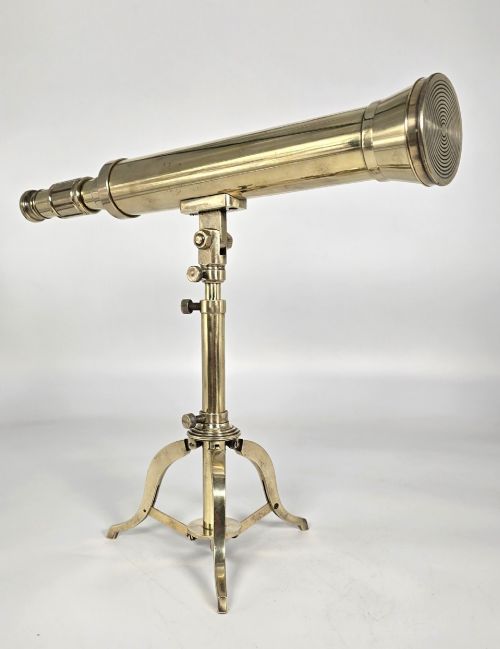


Vintage Refractor Telescope
These vintage refractor telescope examples bring brass and mahogany optics to your study, offering the weight and clarity of Georgian and Victorian craftsmanship.
Vintage Refractor Telescope
A vintage refractor telescope collects light through a primary glass lens to magnify distant terrestrial or celestial views. When you search for a vintage refractor telescope, you encounter instruments housed in polished brass tubes and mounted on folding tripods or table stands.
The pieces listed here span the eighteenth century through the early twentieth century, including library models designed for stationary study and campaign versions built for transport. Most examples originate from English makers and utilise durable hardwoods alongside bright metalwork.
Form follows function across these scientific instruments, shifting from multi-draw maritime spyglasses to large aperture table top configurations. The overarching style reflects the prevailing aesthetic of the Georgian, Regency, and Victorian eras.
How they were made
Opticians constructed the optical tubes primarily from turned brass, often applying a gilt finish or leaving the metal to polish bright. Lenses were ground from glass to focus light accurately down the barrel.
Outer cladding frequently incorporates seasoned mahogany, providing a tactile grip and structural rigidity for portable day or night use. Tripod stands and mounting hardware utilise cast iron and brass to support the heavy optical assemblies.
Materials across these listings span brass, glass, mahogany, steel, and cast iron.
What varies in quality
Quality rests in the precision of the optical glass and the mechanical smoothness of the draw tubes. Heavier gauge brass and carefully fitted mahogany barrels indicate superior workshop standards.
Maker signatures engraved upon the draw tubes or objective collars elevate an instrument, reflecting the reputation of prominent London opticians. The presence of original fitted tripods and accessory lenses further distinguishes the finer examples.
Nairne and Blunt·W and T Gilbert·Steward of London·S and B Solomons·G Adams·Broadhurst and Co
The Vintage Refractor Telescope Glossary
- Refractor telescope
- An optical instrument that uses lenses to form an image of distant objects. Light passes through a primary objective lens at the front to the eyepiece at the rear.
- Draw
- A sliding tube section that extends to adjust the focal length and focus the image. Multi-draw designs collapse for compact storage.
- Objective
- The primary glass lens situated at the front end of the telescope tube. It gathers incoming light and initiates magnification.
- Library telescope
- A larger stationary instrument mounted on a pillar and claw table stand. These were intended for indoor terrestrial viewing and astronomy rather than field transport.
- Campaign telescope
- A portable instrument designed for military or travel use. It often includes folding legs and compact brass construction for field deployment.
Vintage Refractor Telescope: Frequently Asked Questions
What is a vintage refractor telescope used for?
These instruments served varied roles ranging from maritime navigation and military scouting to indoor astronomy and terrestrial observation. Owners relied on them to spot distant ships at sea or study celestial bodies from a library window.
Today, they function as decorative objects of scientific history while retaining their fundamental capacity to magnify distant views.
How do I distinguish an 18th-century model?
Eighteenth-century examples often display specific maker signatures from prominent London opticians alongside distinct hand-turned brass components and rich mahogany barrels. The typography of the engraved signatures and the simplicity of the mounting hardware provide key chronological clues.
Later Victorian versions frequently incorporate heavier table stands and more complex mechanical adjustments for astronomical use.
Can I use it for stargazing?
Many of these instruments are fully functional optical devices capable of viewing the moon and brighter planets. Library and table top models with larger objective lenses offer adequate light gathering for casual night sky observation.
Care must be taken when handling historic glass optics to preserve their alignment and surface coatings.
How should I display my telescope?
Place your instrument on a sturdy table or desk where its brass finish and mahogany wood can catch ambient light. Pairing a table top model with its original folding tripod creates a striking focal point in a study or living space.
Keep the piece away from direct sunlight and extreme humidity to protect the brass polish and wood grain.