




Brass Table Telescope
These brass table telescope instruments bring precision optics and polished metal to any room, offering a tangible connection to scientific history.
Brass Table Telescope
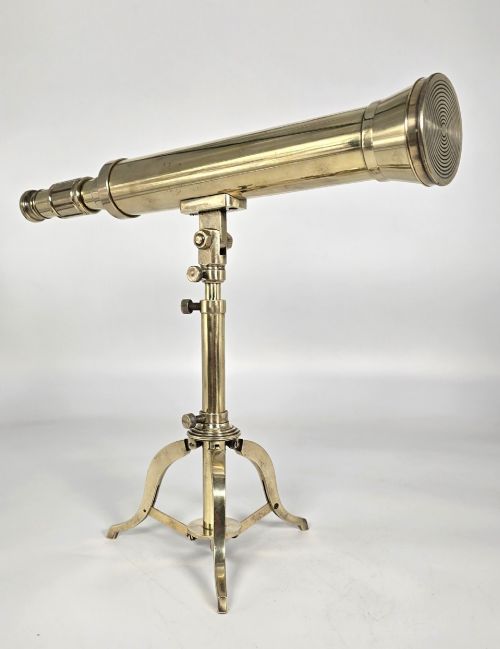
When you search for a brass table telescope, you are looking at optical instruments designed for mounting on furniture rather than holding in the hand or resting on a tall floor tripod. These scientific instruments range from compact table top examples to larger library telescopes intended for serious study.
The versions you are most likely to meet on this page span the Georgian, 18th Century, and Victorian periods. They combine polished metal tubes with wooden or metal supports, occasionally accompanied by fitted storage boxes.
Makers such as Nairne & Blunt, G. Adams, S & B Solomons, Thomas Jones, and William Harris & Co represent the origins of these pieces. Their work demonstrates the standard form of the instrument across different decades of the nineteenth and eighteenth centuries.
How they were made
Makers constructed the primary optical tubes from turned brass, polished to a bright finish or treated with gilt. Glass lenses provided the magnification, housed carefully within the sliding draw tubes.
Support systems combined cast iron, iron, marble, and mahogany. Folding brass tripods and wooden table top stands secured the weight of the metal barrels during observation.
Makers housed certain instruments in dedicated boxes lined to protect the delicate optical components and brass fittings from damage.
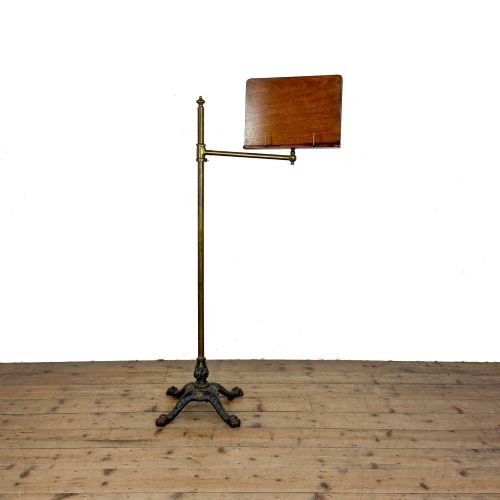
Object forms span telescopes, reading stands, scientific instruments, and floor lamps.
What varies in quality
The standard of optical clarity and the precision of the brass turning distinguish finer examples from simpler student pieces. Heavier gauge metal and smooth, binding-free draw tubes indicate superior workshop production.
The presence of original folding stands, fitted boxes, and identifiable signatures from prominent London or provincial makers elevates the historical interest of an instrument. Unsigned or heavily altered examples lack the documented provenance of signed works.
Nairne & Blunt·G. Adams·S & B Solomons·Thomas Jones·William Harris & Co·Johnson·R. Adie Liverpool
The Brass Table Telescope Glossary
- Library telescope
- A large optical instrument designed for use indoors on a table or desk, often mounted on a sturdy tripod. These instruments provided higher magnification for terrestrial or astronomical viewing.
- Gregorian telescope
- A reflecting telescope design utilising a small concave secondary mirror to reflect light back through a central hole in the primary mirror. This configuration produced an upright image.
- Terrestrial telescope
- An optical instrument configured to show erect, non-inverted images for viewing land-based subjects. Additional erecting lenses inside the brass barrel correct the view.
- Draw tube
- The sliding cylindrical sections of a telescope that pull outward to achieve proper focal length. Smooth movement between sections marks quality construction.
Brass Table Telescope: Frequently Asked Questions
Where were these telescopes used?
Makers designed these instruments for indoor observation in libraries, studies, and drawing rooms. Owners placed them on tables or desks near large windows to view distant terrestrial landscapes or celestial targets.
Their substantial weight and desk-friendly size meant they remained stationary in domestic settings rather than travelling out into the field.
How do I date a brass telescope?
Examine the style of the engraving, the form of the mounting stand, and any maker signatures on the brass barrel. Georgian and 18th Century examples often feature cursive signatures and simpler mahogany box construction.
Victorian instruments typically display more complex adjustable mountings and occasionally incorporate alternative materials like iron or marble in the stands.
Can I still view objects through them?
Many of these historical optical instruments retain functional lenses that permit magnification of distant views. The internal glass elements gather and focus light much as they did centuries ago.
Users should handle the sliding draw tubes with care to avoid misaligning the historical glass components inside the brass barrel.
What is a Gregorian telescope?
This specific reflector configuration uses mirrors rather than solely refractive glass lenses to gather light and form an image. The design places a secondary mirror facing the primary concave mirror.
This layout allowed makers to produce shorter, more compact brass barrels while maintaining effective magnifying power for the user.