


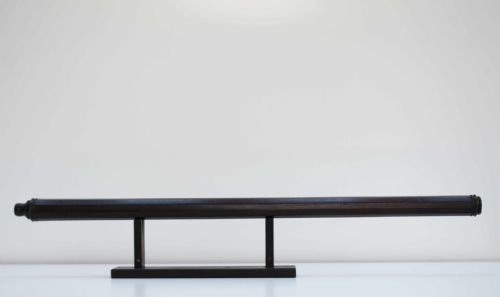
Antique Mahogany Spyglass
These antique mahogany spyglass instruments are practical scientific tools built for precision viewing, offering collectors tactile pieces of maritime and navigational history.
Antique Mahogany Spyglass
An antique mahogany spyglass functions as a portable optical instrument designed for terrestrial and maritime observation, combining polished brass with turned wood casings. When collectors search for an antique mahogany spyglass, they encounter various configurations including multi-draw pocket models and larger library telescopes mounted on stands.
The pieces appearing on this page span several distinct periods from the eighteenth century through the Edwardian era, reflecting shifting demands in naval and civilian optics. Earlier examples often feature distinctive geometric body tubes such as decagonal or nine-sided profiles rather than standard round barrels.
Makers from London dominate the available examples, ranging from pocket-sized day or night glasses to heavy campaign instruments used in the field. These optical devices served practical functions at sea and on land before modern binoculars became standard equipment.
Construction and materials
Makers built the barrels using dense mahogany timber turned on a lathe, frequently pairing the wood with polished brass draw tubes to ensure smooth sliding action. Leather and occasionally oak or steel appear in specific military or cased contexts, though brass and mahogany remain the primary structural pairing.
Listings feature mahogany, brass, leather, and glass across Georgian, Victorian, and Edwardian periods.
Factors that distinguish quality
The precision of the optical system and the smoothness of the draw action determine the mechanical excellence of an instrument. High-grade specimens retain tight joints between the brass draws and crisp maker signatures engraved on the final draw tube.
The condition of the timber casing and the clarity of the original glass lenses heavily influence the integrity of each piece. Finer examples display careful turning on the mahogany body and retain functional focusing mechanisms without excessive play in the draws.
Nairne & Blunt of London·W. & T. Gilbert, London·Clarkson, London·Steward of London·Richardson·Matthew Berge London·G.adams of london·Davis of London·John Gilbert
The Antique Mahogany Spyglass Glossary
- Draw
- A sliding brass tube that extends from the main body to alter the focal length of the telescope. Multiple draws allow a long instrument to collapse into a compact size for travel.
- Achromatic
- An optical lens design corrected to bring light of different wavelengths to a common focus, reducing colour fringing in the field of view. This improvement became standard on better scientific instruments.
- Terrestrial telescope
- An optical device configured with an erecting lens system to present the image the right way up for land viewing. These differ from astronomical telescopes which traditionally show inverted images.
- Campaign telescope
- A sturdy portable instrument designed for military use in the field, often featuring protective leather coverings and robust brass fittings to withstand rough handling.
- Library telescope
- A larger stationary optical instrument mounted on a dedicated stand for use indoors rather than handheld observation.
Antique Mahogany Spyglass: Frequently Asked Questions
How do I use an antique spyglass?
Extend the brass draw tubes fully until the instrument locks firmly into position, then sight a distant object while adjusting the final smaller draw to achieve sharp focus.
Keep the lens surfaces clean using appropriate optical care and avoid forcing stiff draws if timber or brass expansion occurs.
Were these spyglasses used at sea?
Many of these instruments served naval officers and maritime captains for identifying ships and signals at a distance, earning the name day or night glasses.
Their robust construction allowed them to withstand salt air and rough handling aboard ship.
How do I date an antique spyglass?
Examine the engraved signature on the brass draw tube, as maker names and addresses often correspond to known working dates in London directories.
Material choices like multi-sided wooden bodies and brass characteristics also point toward eighteenth or nineteenth-century manufacturing techniques.
How should I display a library telescope?
Place a cased or mounted library telescope on a sturdy desk or table away from direct sunlight and excessive humidity.
Ensure the stand securely supports the weight of the brass and mahogany barrel to prevent accidental tipping.