


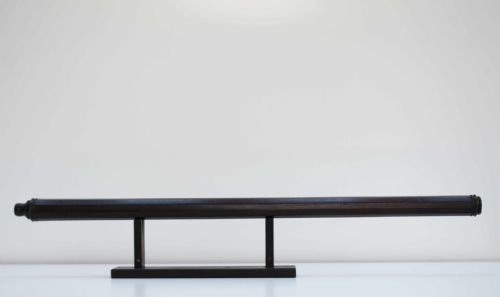
Brass Mahogany Spyglass
A brass mahogany spyglass brings the precision of maritime and scientific instrument making straight to your desk.
Brass Mahogany Spyglass
A brass mahogany spyglass encompasses optical instruments from the eighteenth and nineteenth centuries, including library telescopes, two-draw and three-draw terrestrial models, and military campaign pieces. You will most frequently encounter nineteenth-century Victorian and Regency examples alongside earlier Georgian instruments.
These instruments function as scientific and maritime tools, designed for navigation, day or night terrestrial viewing, and library study. The evidence on this page shows pieces ranging from compact table-top formats to larger four-inch diameter telescopes mounted on stands.
Materials and construction
Maker workshops built these optical instruments using polished brass for draw tubes, mounts, and fittings, paired with turned mahogany barrels. Some examples incorporate supplementary materials such as leather, oak, glass, and steel to complete the construction.
Barrel designs vary from standard cylindrical forms to distinct nine-sided and decagonal reverse taper shapes. Makers signed their work directly onto the brass draw tubes, engraving details of their London workshops.
Materials documented across the page include brass, mahogany, glass, wood, leather, steel, and oak.
Factors of quality
Quality in a brass mahogany spyglass rests in the precision of the optical engineering and the crispness of the maker's signature engraved on the brass draw tube. Superior examples display tighter tolerances in the draw action and cleaner geometric turning on the wooden barrels.
The distinction between standard navigational gear and library instruments on stands involves the complexity of the mountings and the scale of the objective lens. Signed works by established London makers demonstrate a higher grade of mechanical execution.
Nairne & Blunt of London·W. & T. Gilbert, London·Clarkson, London·Steward of London·Matthew Berge London·G.adams of london·Davis of London·John Gilbert
The Brass Mahogany Spyglass Glossary
- Draw
- A sliding tube section that extends the length of a telescope. Telescopes on this page are commonly described by how many draws they possess.
- Terrestrial
- An optical instrument configured to show erect, non-inverted images for viewing land objects. These sit distinct from astronomical setups.
- Achromatic
- An optical lens design intended to reduce chromatic aberration. Several eighteenth-century examples specifically note their non-achromatic construction.
- Decagonal
- Having ten sides. This geometric form appears in the barrel construction of specialised eighteenth-century instruments.
- Library telescope
- A larger stationary instrument intended for indoor study, frequently supplied with a dedicated tabletop stand.
Brass Mahogany Spyglass: Frequently Asked Questions
What is a spyglass used for?
A brass mahogany spyglass serves as a portable optical instrument for terrestrial viewing, maritime navigation, and field use. Owners historically utilised them to observe distant objects across land or water.
Today, they function primarily as decorative scientific antiques and tactile display pieces for a desk or shelf.
How do I date a brass telescope?
Dating relies on maker signatures, stylistic cues in the brass mountings, and the number of draw tubes. Eighteenth-century models often feature simpler taper designs, while Victorian examples frequently use standard multi-draw configurations.
Engraved signatures referencing London addresses help anchor instruments to specific maker active periods.
What is a draw telescope?
A draw telescope consists of multiple nested metal tubes that slide inward for compact storage and pull outward to focus the optics. The number of draws determines the collapsed length and total extension of the barrel.
Most surviving antique pieces feature two or three draws housed within a wood or leather sleeve.
How should I display a spyglass?
Library models equipped with original tabletop stands rest securely on flat surfaces in an upright position. Smaller handheld draw telescopes display well either fully extended or collapsed beside other maritime instruments.
Keeping them away from direct heat sources protects the polished brass and turned mahogany surfaces.