
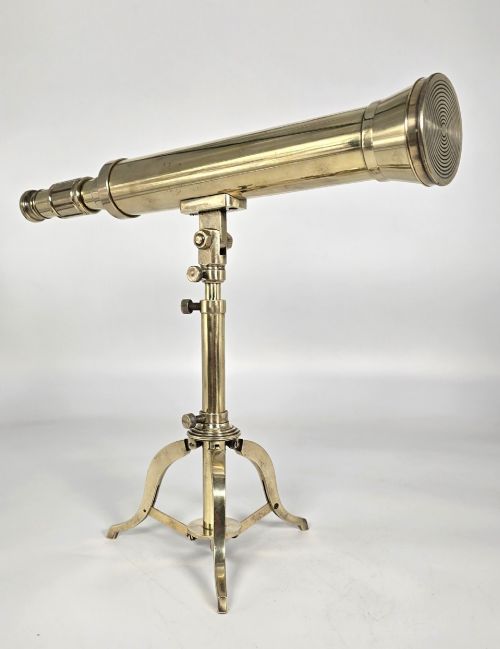


Antique Spyglass on Stand
An antique spyglass on stand is a brass optical instrument mounted for table or desk use, offering both period scientific utility and classic library display appeal.
Antique Spyglass on Stand
When you search for an antique spyglass on stand, you are looking at brass optical instruments designed for table or desk use, often categorised as scientific instruments or telescopes. The pieces listed here span the eighteenth century, the Georgian era, the Victorian period, and the Edwardian era.
You will most commonly meet brass terrestrial telescopes mounted on folding tripods, library stands, or housed in fitted wooden cases. These instruments combine maritime and scientific utility with the decorative presence typical of nineteenth-century studies and libraries.
The origins of these pieces trace back to notable English makers working in London and Sheffield, encompassing single-draw, two-draw, and four-draw configurations. Each example reflects the optical and mechanical standards of its respective decade, from the eighteenth century to the early twentieth century.
How they were made
These instruments rely heavily on turned and polished brass for their optical tubes, draw sections, and mounting stands. Metalworking techniques of the period involved precise lathe work to ensure smooth extension of the draw tubes and secure seating within their mounts.
Many examples incorporate secondary materials such as mahogany, oak, leather, and glass. Leather dressing appears on specific explorer and field variants to protect the exterior brass barrels during handling, while wooden cases utilise fitted joinery and hardware.
Current listings feature materials including brass, glass, leather, wood, mahogany, steel, oak, and iron across Victorian, Edwardian, and Georgian periods.
What varies in quality
The distinction between standard production and the top of the range rests on the precision of the optics, the reputation of the maker, and the mechanical integrity of the mounting stands. Signed instruments from recognised London workshops demonstrate superior finishing on the brass components and clearer glass lenses.
The presence of original accessories, such as matching folding brass tripods, fitted wooden cases, and original dust caps, elevates the standing of an instrument. Quality is also evident in the weight of the brass and the smoothness of the draw mechanism.
Ross of London·W. and T. Gilbert London·Clarkson London·Steward of London·Chadburn Brothers of Sheffield·Matthew Berge London·G. Adams of London
The Antique Spyglass on Stand Glossary
- Draw
- A sliding tubular section of a telescope that pulls out to focus the instrument. Multiple draws allow a longer focal length to collapse into a shorter transportable size.
- Terrestrial telescope
- An optical instrument configured with erecting lenses so that the final image appears right side up for land viewing. These differ from astronomical telescopes which typically show inverted images.
- Tripod stand
- A three-legged support structure, often folding in brass, designed to hold the telescope steady during observation. They provide a stationary mounting for heavy library and marine instruments.
- Library telescope
- A larger optical instrument intended for indoor table use rather than portable field service. They usually feature substantial brass barrels and dedicated mounting stands.
Antique Spyglass on Stand: Frequently Asked Questions
What is an antique spyglass on stand?
An antique spyglass on stand is a portable or library telescope fitted with a dedicated mounting base, allowing it to be used stationary on a desk or table. These instruments were utilised for both terrestrial observation and scientific study.
They bridge the gap between practical navigation tools and decorative library ornaments, reflecting the optical craftsmanship of eighteenth and nineteenth-century workshops.
How do I use an antique spyglass?
To use the instrument, you fully extend the brass draw tubes until the internal lenses lock into their proper focal positions. You then sight the object and adjust the final draw slightly to bring the image into sharp focus.
Because these are historical optical instruments, care should be taken to support the brass barrel and avoid forcing any tight draw sections.
Where were these telescopes made?
The majority of these instruments originate from workshops in England, particularly London and Sheffield, which were centres of scientific instrument manufacturing. Master opticians and makers stamped their business names directly onto the brass draw tubes.
English makers set high standards for brass turning and glass grinding throughout the Georgian and Victorian eras.
How do I date an antique spyglass?
Dating relies on maker signatures, stylistic details of the brass mountings, and the number of draw tubes. Historical directories of makers help connect specific names to active operating dates between the eighteenth and early twentieth centuries.
Materials such as mahogany cases and leather dress finishes also provide contextual clues to the manufacturing period, ranging from Georgian library pieces to Edwardian explorer models.