
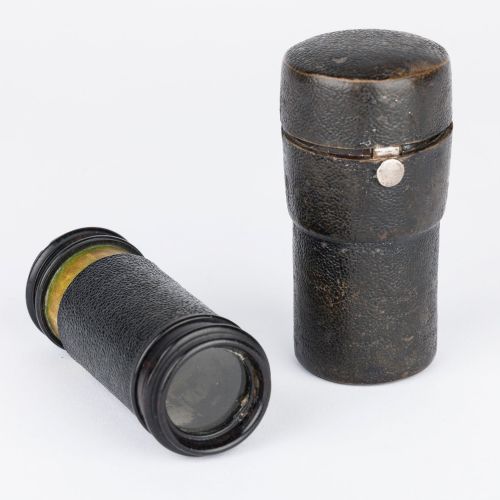


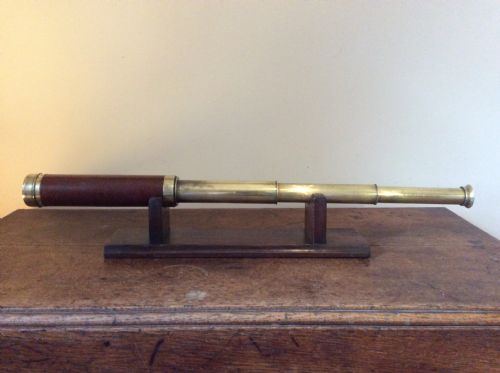
Leather Brass Spyglass
These leather brass spyglass pieces are practical optical instruments designed for portability, offering the keen collector a tactile connection to maritime and military history.
Leather Brass Spyglass
When you search for a leather brass spyglass, you are looking at historical optical instruments designed for marine, military and field use. These items range from pocket-sized monoculars to large multi-draw telescopes used by officers of the watch.
The versions most likely to meet you on this page date from the Victorian and Edwardian periods, alongside a selection of Georgian, Regency and eighteenth-century examples. They typically appear in forms such as single-draw, multi-draw extending tubes, and cased sets complete with wooden or leather housings.
Materials and Construction
Makers constructed the primary optical tubes using turned brass, selected for its durability and resistance to marine environments. Many examples feature exterior jackets of hand-stitched leather, which provided a secure grip and protected the metal beneath during fieldwork.
Internal optical systems incorporate glass lenses housed within telescoping draws, sometimes assisted by supplementary materials like card or wood for internal spacers. Specialised military and naval instruments often include sliding sunshades and protective brass end caps.
Listings feature brass, leather, glass, wood, oak, nickel and cardboard across Victorian, Edwardian, Georgian, Regency and eighteenth-century periods.
Factors of Quality
The distinction between standard utility instruments and superior workshop output lies in the precision of the optics and the tightness of the draw-tube fit. Finer pieces demonstrate smooth, even friction across multiple draws without slackness.
Maker reputation heavily influences standing, with signed tubes from recognised opticians commanding attention for their optical clarity and precise engraving. The condition and original integrity of the stitched leather dressing also set higher-tier survivors apart.
Ross of London·Voigtländer and Sohn AG·Newton and Co·Broadhurst Clarkson and Co·Cary London·L. Casella London·Chadburn Brothers of Sheffield·Dollond·Davis of London
The Leather Brass Spyglass Glossary
- Draw
- A sliding tubular section of a telescope that extends to focus the instrument. Multi-draw designs allow long focal lengths to collapse into compact portable sizes.
- Terrestrial
- An optical configuration designed for viewing land-based objects rather than astronomical bodies. These instruments provide an upright, correctly oriented image.
- Single draw
- A telescope consisting of only two tubes, where one draws out from the main body. This simpler construction offers sturdy alignment.
- Monocular
- A compact optical viewing scope designed for use with one eye. These handheld pieces often served travellers and theatergoers.
- Objective
- The primary lens at the front of the telescope that gathers light. Its diameter determines the brightness and clarity of the viewed image.
Leather Brass Spyglass: Frequently Asked Questions
How do I use a multi-draw spyglass?
Extend all the brass draws fully until each section locks firmly into position. Sight the target and adjust the final smaller eyepiece tube until the image comes into sharp focus.
Keep the lenses clean using appropriate optical cloths and avoid forcing any stuck draws to prevent damage to the internal fittings.
Were these used at sea?
Many of these instruments served naval officers and marine navigators for spotting land, signals and other vessels. Their brass and leather construction resisted harsh maritime conditions.
Officer of the watch models were specifically tailored for deck duty during changing weather.
How should I clean the leather?
Dust the surface gently with a dry cloth and apply a neutral leather preservative sparingly if the hide appears dry. Avoid harsh chemical cleaners that might damage the historic finish.
Take care not to let moisture or cleaning products contact the brass or the glass lenses.
Can I date a piece without a signature?
Examine the number of draws, the typography of any engraved text, and the stitching style of the leather wrap. Earlier eighteenth-century and Georgian pieces often show heavier, simpler construction.
Victorian and Edwardian examples frequently incorporate standardised multi-draw configurations and finer maker signatures.