


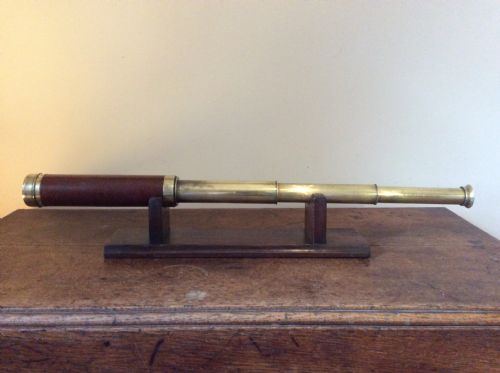


Maritime Draw Telescope
These maritime draw telescope examples are portable optical instruments designed for navigation and observation, offering a tactile connection to historical seafaring.
Maritime Draw Telescope
When you search for a maritime draw telescope, you encounter extending optical instruments housed in brass, leather, and wood. These pieces span periods from the Georgian era through to the Victorian and Edwardian decades, reflecting the evolution of portable navigation.
You meet multi-draw configurations most frequently on this page, ranging from two-draw pocket versions to longer single-draw or four-draw spyglasses. These optical tools served officers of the watch and explorers alike across maritime and terrestrial settings.
The objects present in forms such as marine telescopes, day or night glasses, and officer of the watch instruments. Each specimen records the practical demands of historical navigation through extending brass tubes and protective outer coverings.
What varies in quality
The precision of the optical lenses and the tightness of the draw tube fit distinguish finer instruments from standard production. Smooth extension across multiple brass sections demonstrates superior mechanical execution by the maker.
The choice of exterior materials, from plain polished brass to finely stitched leather or figured walnut casings, influences the character of the piece. Engraved maker signatures and dedicated case work indicate higher workshop status.
Makers stamped their names onto the draw tubes so ship captains could verify their optical gear.
Ross of London·Voigtländer and Sohn AG·Newton and Co·Broadhurst Clarkson and Co·Cary London·L Casella London·Davis of London·W Harris
The Maritime Draw Telescope Glossary
- Draw
- A sliding tubular section of a telescope that extends to bring the optical system into focus. Multiple draws allow a longer instrument to collapse into a compact length.
- Spyglass
- A small, portable refracting telescope used primarily for terrestrial observation. These handheld devices were essential equipment for maritime lookouts and travellers.
- Day or night
- An optical configuration designed to gather extra light in low-visibility conditions or at sea. These lenses provided functional utility across changing times of day.
- Objective
- The primary lens at the front of the telescope that gathers light from the subject. Its diameter determines the brightness and clarity of the magnified image.
Maritime Draw Telescope: Frequently Asked Questions
How do you focus a maritime draw telescope?
You extend all the draw tubes fully and then gently adjust the final eyepiece section inward or outward until the distant subject appears sharp.
Securing the correct focal length relies on the smooth sliding action of the brass barrels.
What were officer of the watch telescopes used for?
Naval officers utilised these specific instruments on deck to identify distant ships, landmasses, and navigational hazards.
Their optical power aided in maintaining watch duties and signalling other vessels during daylight or dusk.
How do I tell a Victorian telescope from a Regency one?
Regency examples often display simpler lines and specific London signatures associated with early nineteenth-century opticians. Victorian pieces frequently incorporate multi-draw variants and distinct leather or wood dressings.
Examining the engraving styles and overall proportions helps clarify the period of manufacture.
Can I use an antique telescope outdoors today?
These optical instruments remain functional for casual terrestrial viewing when the lenses are clean and aligned. Care must be taken to protect the historic brass and leather surfaces from moisture.
Gentle handling preserves the mechanical movement of the extending draw tubes.