




Vintage Marine Telescope
These vintage marine telescope examples offer tangible links to naval history, prized by collectors for their optical mechanics and maritime heritage.
Vintage Marine Telescope
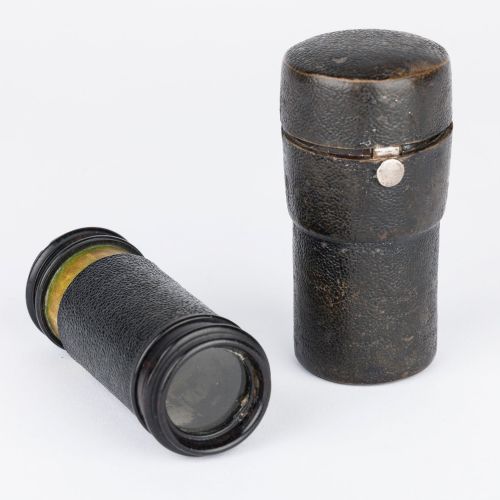
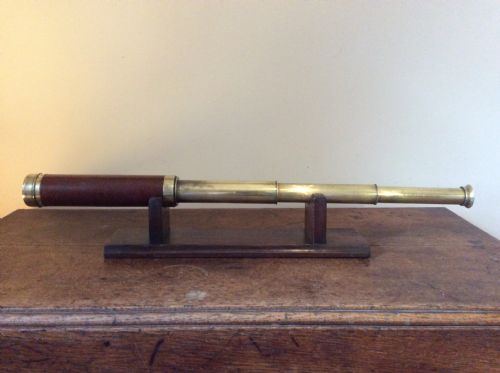
A vintage marine telescope encompasses portable brass and leather optical instruments designed for navigational use at sea. These pieces range from compact pocket spyglasses to extended multi-draw officer models intended for terrestrial and celestial observation.
The selection on this page draws heavily from Victorian and Regency periods, alongside Georgian and Edwardian examples. Buyers frequently encounter multi-draw configurations, including single, two, three, and six-draw variants housed in brass tubes.
Object classifications span scientific instruments, naval telescopes, and navigational instruments. Makers such as Ross of London, Richardson, Broadhurst Clarkson & Co, and A Hurlimann Paris appear across the chronological spread from the eighteenth century to the twentieth.
Materials and construction methods
Construction relies heavily on polished brass for the main draw tubes and optical housings, often paired with stitched leather grips for handling at sea. Wood varieties like mahogany, oak, and walnut frequently appear on specific barrels or associated mountings.
Optical systems incorporate precision glass lenses housed within telescoping brass draws. Makers utilised specialised draw configurations, including hexagonal and nine-sided barrel geometries alongside traditional round brass tubing.
Materials recorded across the inventory include brass, leather, glass, mahogany, oak, walnut, and nickel.
Quality differences in optical instruments
Distinction across the range rests on mechanical execution and the precision of the draw action. Instruments featuring signed maker details, such as Ross of London or Dollond attributions, demonstrate higher workshop standards than unsigned equivalents.
Material selection and barrel geometry influence the overall grade. Standard round brass tubing contrasts with specialist configurations like hexagonal or nine-sided bodies paired with fine leather or turned timber components.
Ross of London·Richardson·Broadhurst Clarkson & Co·A Hurlimann Paris
The Vintage Marine Telescope Glossary
- Draw
- A sliding tubular section of a telescope that extends to focus the instrument. Multi-draw designs collapse for portability.
- Spyglass
- A small, portable refracting telescope used primarily for terrestrial viewing. These pocket-sized instruments were common in the eighteenth century.
- Terrestrial
- An optical configuration designed to show images the right way up for land or sea viewing. This differs from astronomical telescopes which often invert the image.
- Officer of the Watch
- A specific style of marine telescope utilised by naval officers on duty. These instruments balanced magnification with field of view for horizon scanning.
Vintage Marine Telescope: Frequently Asked Questions
How do multi-draw telescopes function?
Each sliding section pulls outward to increase the focal length between the objective lens and the eyepiece. Proper alignment of these brass draws brings distant objects into sharp focus.
Securing the outer tube while extending the inner draws prevents binding in the metal sleeves. Once fully extended, slight adjustments to the final draw fine-tune the image.
What distinguishes a pocket spyglass?
Pocket spyglasses feature compact dimensions designed for easy transport by travellers and mariners. Their shorter barrel lengths accommodate fewer draw sections while maintaining functional magnification.
These smaller instruments often date from the eighteenth and nineteenth centuries. Their reduced scale made them practical companions for casual land and sea observation.
Why are leather grips used on brass?
Leather wrapping provides a secure, non-slip surface for hands operating the instrument in wet maritime conditions. It also insulates the metal against cold temperatures at sea.
Stitched leather sleeves protect the underlying brass barrel from minor knocks and handling wear. Over time, the leather develops a distinct patina through active use.
How are Victorian and Georgian periods told apart?
Georgian instruments often display simpler timber and brass combinations from the late eighteenth century. Their construction methods reflect the hand-tooling techniques of earlier instrument makers.
Victorian pieces frequently incorporate standardised multi-draw mechanisms and maker signatures. The expansion of industrial production during the nineteenth century influenced their finishing details.