




Brass Maritime Scope
These brass maritime scope pieces are functional instruments of navigation and observation that bring historical craftsmanship into any room.
Brass Maritime Scope
A buyer seeking a brass maritime scope examines optical instruments designed for use at sea or along the coast, encompassing telescopes, monoculars, and related scientific gear. The selections span periods from the mid eighteenth century through the Edwardian era and the First World War, reflecting centuries of optical development.
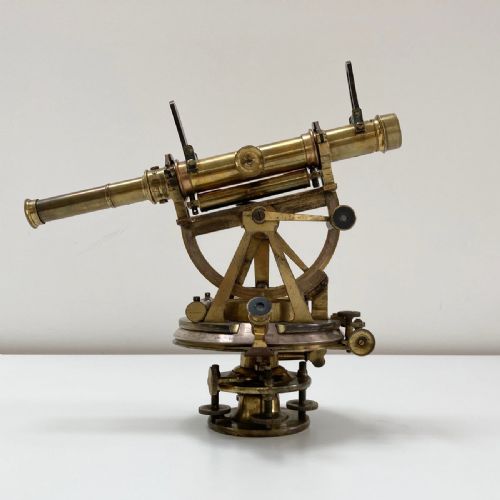
Most items encountered on this page belong to the Victorian period, frequently taking the form of multi-draw handheld telescopes or tabletop mountings. English makers dominate the record, alongside German naval instruments and specialised surveying equipment such as theodolites.
The assortment includes day or night telescopes, decagonal reverse taper designs, and cased miniature instruments. Each piece demonstrates the practical utility demanded by officers of the watch and navigators afloat.
Construction and materials
The primary construction relies heavily on turned brass, shaped into draw tubes and main barrels, sometimes finished with nickel plating or paired with silvered metal details. These metallic components provide the necessary rigidity and weight for precision optical alignment.
Many barrels feature hand-stitched leather or polished wood coverings such as mahogany, walnut, and oak to improve grip and protect the metal underneath. Glass lenses provide the magnification, ranging from early non-achromatic systems to later multi-draw configurations.
Brass Maritime Scope Retail Price Guide 2026
Typical asking prices for brass maritime scope among the pieces listed under this phrase on Sellingantiques today, from the lower quarter to the upper quarter. They describe what is for sale here now, not the wider market.
Several Victorian captains clearly needed help remembering which way was up, judging by the survival of day or night naval scopes.
Evaluating the standard of manufacture
Quality appears in the precision of the draw tubes and the clarity of the glass optics, where tighter tolerances allow smoother extension without wobble. The reputation of the maker, whether London opticians or provincial specialists, influences the standing of an instrument.
The choice of secondary materials, from fine leather wrappings to solid mahogany cases, indicates the intended market and cost of original production. Engraved signatures and detailed maker inscriptions add a level of documentation that elevates certain specimens above unsigned workshop output.
Voigtländer and Sohn AG·Ross of London·Richardson·Newton and Co·Broadhurst Clarkson and Co·Davis of London·Cox of Devonport·John Gilbert·J Sewill
The Brass Maritime Scope Glossary
- Draw
- A sliding tube section that extends from the main body of a telescope to adjust focus. Multiple draws allow a compact instrument to extend significantly for use.
- Achromatic
- An optical design utilising multiple lens elements to correct colour fringing and produce a sharper image. Earlier models sometimes employed non-achromatic configurations.
- Terrestrial
- An optical instrument configured to view land-based objects the right way up, unlike astronomical telescopes which often present inverted images.
- Altazimuth
- A mounting system allowing rotation in both horizontal and vertical planes. This mechanism appears on surveying and navigational instruments.
- Monocular
- A single-barrel optical device for magnified viewing with one eye. These share construction techniques with larger multi-draw telescopes.
Brass Maritime Scope: Frequently Asked Questions
What is a brass maritime scope used for?
These instruments were originally utilised at sea by naval officers and merchant mariners to sight distant ships, landmarks, and navigational hazards. Day or night lenses accommodated varying light conditions during watches.
Today, collectors appreciate them as decorative objects that connect directly to maritime history and the evolution of optical engineering.
How do I identify the period of a telescope?
Makers frequently engraved their names, addresses, and military appointments directly onto the draw tubes or brass casings. Comparing these signatures with known working dates provides a reliable timeframe.
Design characteristics such as the number of draw sections, the presence of leather coverings, and overall finishing also point toward Victorian, Edwardian, or earlier Regency origins.
How should I display a tabletop telescope?
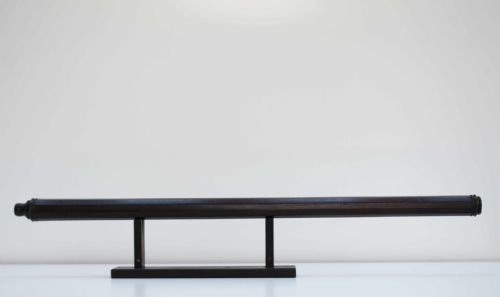
Tabletop models with dedicated stands require a stable surface away from direct sunlight and high humidity, which can affect the antique wood and brass finishes. Positioning them near a window allows for occasional viewing while serving as a focal point in a room.
Ensure the mounting cradle supports the weight evenly across the barrel to prevent strain on the historical metalwork.
What is the difference between a two draw and three draw telescope?
The number of draws refers to the sliding extension tubes that pull out from the main barrel to achieve focus and magnification. A three draw model collapses into a shorter overall length for storage while extending further than a two draw version.
More draw sections generally indicate a later nineteenth or early twentieth century date, as manufacturing tolerances improved to allow tighter fits.