


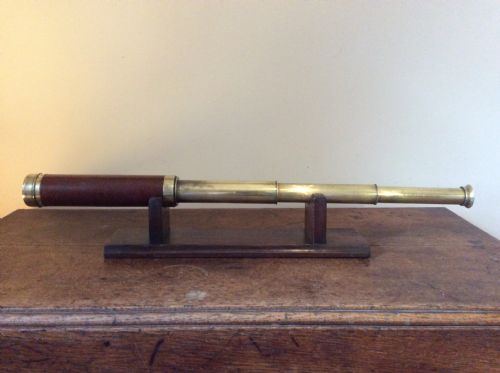
Vintage Nautical Monocular
These vintage nautical monocular pieces are historic optical instruments built for navigation and observation, offering a tactile connection to maritime exploration.
Vintage Nautical Monocular
When you search for a vintage nautical monocular, you encounter portable optical instruments designed for maritime use across several centuries. The selection on this page encompasses single-draw and multi-draw telescopes, pocket telescopes, and officer of the watch models originating from the 18th century, Regency, Georgian, and Victorian periods.
These pieces take various physical forms, including hexagonal marine telescopes and cased instruments equipped with stands. Makers such as Ross of London, Nairne & Blunt, and Chadburn Brothers of Sheffield produced these objects for navigation, exploration, and naval duties.
How they were made
Workshop production involved turning and fitting sliding draw tubes to allow the instrument to collapse for portable use. Cased sets often required specialised woodworking skills to house the telescope and its optical components securely.
The object types on this page include naval telescopes, scientific instruments, and pocket spyglasses by English and continental makers.
What varies in quality
The standard of a piece often depends on the precision of its optical assembly and the quality of the brass work executed by the maker. Finer instruments demonstrate smooth sliding draw mechanisms and clear glass optics housed within well-fitted wooden or leather barrels.
Provenance and maker attribution elevate certain items, particularly signed works by prominent London or regional opticians. The choice of materials, such as figured mahogany or detailed fruitwood, also distinguishes standard production pieces from more elaborate or specialised instruments.
Nairne & Blunt·Ross of London·Voigtländer and Sohn AG·Newton and Co·Chadburn Brothers of Sheffield
The Vintage Nautical Monocular Glossary
- Monocular
- An optical instrument designed for magnification using a single eyepiece. These pieces provide a concentrated view for terrestrial or maritime observation.
- Draw
- A sliding tube section that extends from the main body of a telescope to focus the instrument. Multi-draw models collapse into compact forms for easy carriage.
- Spyglass
- A historic term for a small, portable refracting telescope used at sea or in the field. These instruments were essential tools for officers and explorers.
- Terrestrial
- An optical design configured to display images the right way up for land viewing, unlike astronomical telescopes which invert the image. Most historical marine pieces utilise this optical setup.
Vintage Nautical Monocular: Frequently Asked Questions
How do I date a vintage nautical monocular?
You examine the number of draw tubes, the materials used for the body, and any maker inscriptions engraved on the brass barrel. Earlier Georgian and Regency examples often feature different proportions compared to later Victorian or Edwardian designs.
Maker signatures and specific styles also help narrow down the period of manufacture. Comparing the construction techniques to known dated pieces provides a reliable guide to its age.
Can I still use these telescopes for viewing?
Many of these historical optical instruments remain functional and can be focused for terrestrial observation. The quality of the glass lenses determines the clarity of the image you see.
Gentle handling is required when extending the draw tubes to avoid straining the historic brass and leather components. Regular use should be approached with care to preserve the original materials.
What is an officer of the watch telescope?
An officer of the watch telescope was a specialised maritime instrument used by naval personnel for signalling and monitoring ship movement. These pieces were built to withstand demanding conditions at sea.
They often feature robust construction with protective leather or metal casings. Their optical configurations were optimized for daylight and day-or-night maritime duties.
Why do some telescopes have leather coverings?
Leather was applied to the outer brass barrels to provide a secure grip in wet marine environments and to protect the metal from dents. This traditional technique added durability to instruments carried on deck.
Over time, the leather acquires a distinct patina from handling and exposure. Different woods like mahogany or fruitwood were also used for similar protective and aesthetic reasons.