

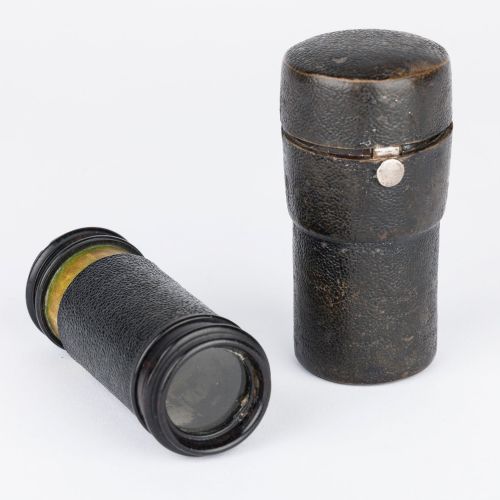


Brass Monocular Telescope
A brass monocular telescope brings distant horizons into sharp focus, offering the satisfying weight of polished metal and glass crafted for navigation and discovery.
Brass Monocular Telescope
A brass monocular telescope represents a distinct class of optical and navigational instruments designed for observation at sea, on land, or in the library. Buyers searching for a brass monocular telescope encounter forms ranging from pocket spyglasses and multi-draw draw-tubes to library telescopes mounted on stands and even telescopes concealed within walking sticks.
The pieces on this page span the 18th century, Georgian, Regency, Victorian, and Edwardian periods, reflecting centuries of practical optical development. Marine telescopes, officer of the watch instruments, and terrestrial viewing scopes dominate the selection, showing how makers adapted optics for naval, military, and civilian use.
Most items you meet here are English or German in origin, signed by notable makers or finished with hand-stitched leather dressings. Whether housed in original wooden cases or carried as portable pocket instruments, each brass monocular telescope bears the mechanical hallmarks of its specific decade of manufacture.
Materials and construction
Makers constructed these instruments using solid brass for the draw-tubes, objective cells, and end fittings, ensuring a rigid optical alignment. Brass components were often turned on a lathe, threaded with precision, and polished to a bright finish or left with a toned patina.
Many terrestrial and marine examples incorporate leather, mahogany, oak, walnut, fruitwood, or bone to wrap the main barrel, providing a secure grip for the hand. Glass lenses within the draw-tubes gather and magnify light, while internal stops manage stray reflections to maintain clarity.
Some Victorian gentlemen chose to see the world entirely straight through a nine-sided brass tube.
Judging quality
Quality in these instruments rests upon the precision of the optical system and the tightness of the draw-tube fit. Lenses that deliver a crisp, clear image with minimal distortion distinguish superior pieces from those with simpler optical configurations.
The standard of assembly and engraving marks the division between workshop grades. Cleanly cut threads, smooth action when extending the draws, and crisp maker signatures engraved on the terminal draw-tube indicate higher workshop execution.
Nairne and Blunt of London·Ross of London·Chadburn Brothers of Sheffield·Newton and Co
The Brass Monocular Telescope Glossary
- Monocular
- An optical instrument used for magnification with one eye, distinct from binoculars. This form allows for compact portability in field and marine use.
- Draw-tube
- A sliding cylindrical section of a telescope that moves in and out to adjust focus. Multiple draw-tubes allow a long barrel to collapse into a pocket-sized length.
- Spyglass
- A small, portable refracting telescope used historically at sea and on land. These pocket-sized instruments were essential tools for officers and travellers.
- Terrestrial telescope
- An optical device designed for viewing land objects rather than astronomical bodies. These instruments use erecting lenses to present the image the right way up.
- Objective
- The lens at the front of a telescope that gathers light from the subject. Its diameter determines the light-gathering power of the instrument.
Brass Monocular Telescope: Frequently Asked Questions
How do I use a draw-tube telescope?
Extend the sliding brass tubes fully until each section locks or seats firmly in place. Hold the instrument steady and adjust the final draw nearest your eye until the distant view sharpens.
Keep the lenses clean using appropriate optical cloths and avoid forcing jammed tubes, supporting each section as you push them back together for storage.
What is the difference between a spyglass and a marine telescope?
A spyglass generally refers to a smaller, pocket-sized portable telescope used by travellers or for casual observation. Marine telescopes are typically larger, designed for naval officers and watch duties at sea.
Marine versions often feature leather or wood barrel coverings to withstand harsh maritime environments and provide a secure grip on rolling decks.
Can I use these antiques for modern viewing?
These historical instruments function optically and can still magnify distant objects outdoors. Their historic lenses offer a wonderful connection to past methods of viewing the world.
However, they lack modern optical coatings and wide fields of view, so treat them with care during use rather than relying on them as everyday modern optics.
How do I date an antique brass telescope?
Examine the style of lettering, the presence of a maker signature, and the mechanical construction of the draw-tubes. Materials like mahogany, fruitwood, or specific leather dressings also point to distinct periods.
Signatures naming specific London or regional workshops often allow you to tie an instrument to a precise decade of production.